Fill Roles Faster with Job Ad SEO, JSON-LD and Templates for Recruiters

The three moves that most improve job-ad discoverability are a standard, searchable job title, decision-critical details like pay and location placed at the top, and valid JobPosting JSON-LD on the page. Validate the markup with Google's Rich Results Test before you publish. Templates and a full technical checklist follow below.
TL;DR:
- Using clear, role-specific job titles and placing pay, location, and hours at the top of the listing significantly improves discoverability and candidate filtering.
- Validating structured data with Google's Rich Results Test and including essential fields like
title,description,datePosted, andvalidThroughare non-negotiable for appearing in Google for Jobs.- Focusing keyword research on candidate phrasing, incorporating natural language, and placing primary keywords in titles and first sentences enhances search performance and applicant relevance.
- Writing job descriptions with specific, measurable requirements and upfront salary and location details reduces unqualified applications and improves candidate self-selection.
- Keeping postings unique and clear, avoiding keyword and content duplication, and monitoring search impressions and click-through rates improves both SEO and recruitment outcomes.
Reach more qualified candidates. Sam's Social Media Club connects employers with curated, relevant talent across social media, content, marketing, and communications. Advertise a role
Table of Contents
- At-a-glance checklist recruiters can copy into templates
- Keyword research for job adverts
- Write the job title, page title and meta description that rank and convert
- Job description structure: put deciding info first and write for the human shortlister
- Call to action, application flow and location or remote targeting
- Structured data and Google for Jobs: implementation checklist
- Publishing cadence, indexing and measurement
- Templates and recruiter-tested examples
- Avoiding common SEO mistakes in job ads
- What actually moves the needle in job ad SEO
- Consider posting with Sam's Social Media Club
- Sources
- FAQ
At-a-glance checklist recruiters can copy into templates
Run this before any job goes live. It covers what candidates see first and what Google needs to read the page correctly.
- Top of page: clear title, salary or band, hours, and seniority level, all visible without scrolling.
- Structure: responsibilities, requirements, and benefits split into their own labelled sections.
-
Technical: a unique URL per job, a complete JSON-LD block, a
validThroughdate, adirectApplyflag where applicable, and a mobile-friendly layout. - Validation: test the page in Google's Rich Results Test, check Search Console for errors, and confirm the page is submitted through the Indexing API rather than left to a sitemap alone.
Keyword research for job adverts
Start with the phrases candidates actually type, not the internal title your HR system generated. Google Autocomplete and the People Also Ask boxes on a search for your role reveal the exact wording jobseekers use, and a scan of similar postings on LinkedIn or industry boards shows which job titles are standard versus niche. Your own applicant tracking system's internal search logs, if it has that feature, are an underused source: they show what candidates search for once they land on your careers page.
Prioritise phrases that combine role, seniority, location or remote status, and contract type, since these carry the clearest intent. "Senior social media manager remote UK" tells you more about the searcher's needs than "social media manager" alone.
Increasingly, natural language matters as much as exact-match keywords. Search engines and AI-driven answer engines respond better to full phrases like "marketing manager remote with flexible hours" than to a string of disconnected keywords. Write the way a candidate would ask a question, not the way a keyword tool exports a list.
Once you have your terms, place the primary phrase directly in the job title, then work secondary phrases naturally into the first one or two sentences of the description and into your subheadings. Do not force a phrase where it reads awkwardly. A title and opening line that a human would actually say will outperform one stuffed with every variant you found.

Write the job title, page title and meta description that rank and convert
Use the job title candidates would search for, not an internal code or a flourish. "Senior Social Media Manager" beats "Social Media Rockstar (Grade 7)" every time it matters for search visibility. Add seniority or contract type only when it changes what the candidate needs to know, such as "Content Strategist (Contract, 6 Months)". Our guide to UK marketing job titles covers which titles map to which seniority.
- Keep the visible title short: role, seniority if relevant, nothing else.
- Push clarifying details, salary, location or remote status, and a one-line hook into the meta description instead of the title.
- Write the meta description as one or two sentences that include your primary keyword and the information that decides whether someone clicks: pay band, hours, and how to apply.
A meta description that answers "is this worth my time" in the search results page will pull more qualified clicks than one that just repeats the job title.
Job description structure: put deciding info first and write for the human shortlister
Candidates decide whether to keep reading within the first few lines, so the information that actually changes their decision belongs at the top, not buried under a paragraph about company culture.
- Lead with pay, hours, and location status. State the salary or band, the shift pattern or hours, and whether the role is remote, hybrid, or on-site, in the opening lines.
- Make requirements specific and measurable. Replace vague asks like "strong communication skills" with a concrete outcome, such as "has managed a content calendar across three or more platforms."
- Use short paragraphs and clear subheadings. Break responsibilities, must-haves, and nice-to-haves into their own labelled sections with bullets, not one dense block of text.
- Keep perks proportionate. A short, honest benefits list reads better than a long one that overshadows the actual requirements.
Large-scale tracking of UK job adverts found that writing for the human shortlister and placing deciding information early improves candidate self-selection, which cuts down on unqualified applications without shrinking your total pool.
Call to action, application flow and location or remote targeting
Make the path to applying as short as the information that got the candidate there. If you can offer a short application directly on your own site, use directApply in your structured data so Google can surface that option; job-board widget builders can help if your site doesn't have a careers page yet. When you rely on an external applicant tracking system, say so plainly and describe the steps: what to click, what to attach, and roughly when to expect a response. See what direct apply means for candidates for the other side of this.
- Write one clear instruction, not three competing ones: a single link or email, not both presented as equal options.
- State expected response time if you know it; even a rough estimate reduces candidate anxiety and drop-off.
- For remote roles, set
jobLocationTypetoTELECOMMUTEand useapplicantLocationRequirementsto name the country or countries where applicants must be eligible to work. - Never leave location fields blank. An empty or vague location field is one of the more common reasons a job posting fails structured-data validation.
Structured data and Google for Jobs: implementation checklist
Google will not consider a job posting for its Jobs rich results without valid JobPosting JSON-LD, and the required fields are non-negotiable.
-
Required fields:
title,description,datePosted,hiringOrganization, and eitherjobLocationorjobLocationType, plusvalidThroughwhen you use it. Google's own JobPosting documentation lists these as the baseline for eligibility. -
Recommended fields:
baseSalary,directApply, and your organisation'slogoall improve how the listing appears and performs once indexed. -
Lifecycle rules: when a job closes, either remove the JobPosting markup, set
validThroughto a past date, or return a 404 or 410 status. Hiding the apply button while leaving the markup live is not enough, and Google can remove the listing anyway. - Validation: test every template in the Rich Results Test before deployment, then monitor the Job Postings report under Search Console's Enhancements section for ongoing errors.
The Indexing API is a meaningfully faster path to discovery for time-sensitive listings than waiting on a sitemap crawl. Google's own guidance recommends notifying the API directly whenever a job is created, updated, or closed, since job postings are exactly the kind of short-lived content the API was built to handle.
Publishing cadence, indexing and measurement
Speed of discovery matters for a posting that might only run a few weeks. The Indexing API, not a sitemap alone, is the preferred route for pushing new or updated job pages to Google quickly, since sitemaps rely on a crawl schedule that may not catch a listing before it closes. For when to post, see our guide on the best time to post jobs.
Once the job is live, track a small set of numbers that actually tell you something:
- Impressions and clicks in Search Console, to see whether the listing is being found at all.
- Click-through rate, which flags a weak title or meta description before you waste weeks on a bad one.
- Number of applications and shortlist rate, which tells you whether the traffic you are getting is the traffic you want.
Run title and description tests in short cycles, a couple of weeks at most, and treat a high click rate paired with a low shortlist rate as a sign your requirements section needs more specificity, not your title.
Templates and recruiter-tested examples
For a senior role: title "Senior Content Strategist, Remote", meta "Senior Content Strategist, remote, £55,000 to £65,000, apply in 5 minutes", opening line stating pay, hours, and reporting line. For a junior role, shorten the title, keep the salary band, and lead with training or mentorship if that is the actual draw. For more ready-made wording, see our 10 social media job ad examples and social media job description templates.
Avoiding common SEO mistakes in job ads
The most common mistake is repeating the same keyword phrase across the title, the first paragraph, and every subheading, hoping it improves ranking. It does not. Search engines read repeated phrasing as a signal to check, not reward, and a candidate skimming a posting that says "social media manager" five times in three sentences will assume the whole thing was written by a template, not a person.
Duplication is the second problem, and it shows up in two forms. Cross-posting the identical job description word for word across your careers page, a job board, and social media without a canonical tag or any variation can create competing pages that dilute each other's visibility. Internally, copying the same requirements section across five open roles because they are "similar enough" tells candidates, correctly, that nobody customised this for them.
The fix for both is the same: write once, specifically, for the role in front of you. Vary phrasing naturally rather than forcing exact-match repetition, and if you must reuse a description across platforms, adjust the framing for each rather than pasting identically. A posting that reads like it was written for this job, at this company, right now, will outperform one that reads like a mail merge, on both search visibility and applicant quality.

What actually moves the needle in job ad SEO
Most advice on this topic treats structured data as the finish line, as if getting a green tick in the Rich Results Test means the job is done. It is not. A perfectly marked-up posting with a vague title and a requirements section written in corporate speak will still underperform a plainer listing that states the salary, the hours, and what the person will actually do on day one.
The conventional wisdom overrates technical polish and underrates specificity. Analysis of UK job adverts found that stating pay bands and measurable outcomes improves applicant pre-qualification, which matters more for hiring outcomes than any schema field.
If you can only fix one thing this year, fix the opening three lines of your job descriptions. Put the pay, the hours, and the location status where a candidate sees them in the first five seconds. The JSON-LD gets you found. The opening lines decide whether the right person keeps reading.
— Sam
Consider posting with Sam's Social Media Club
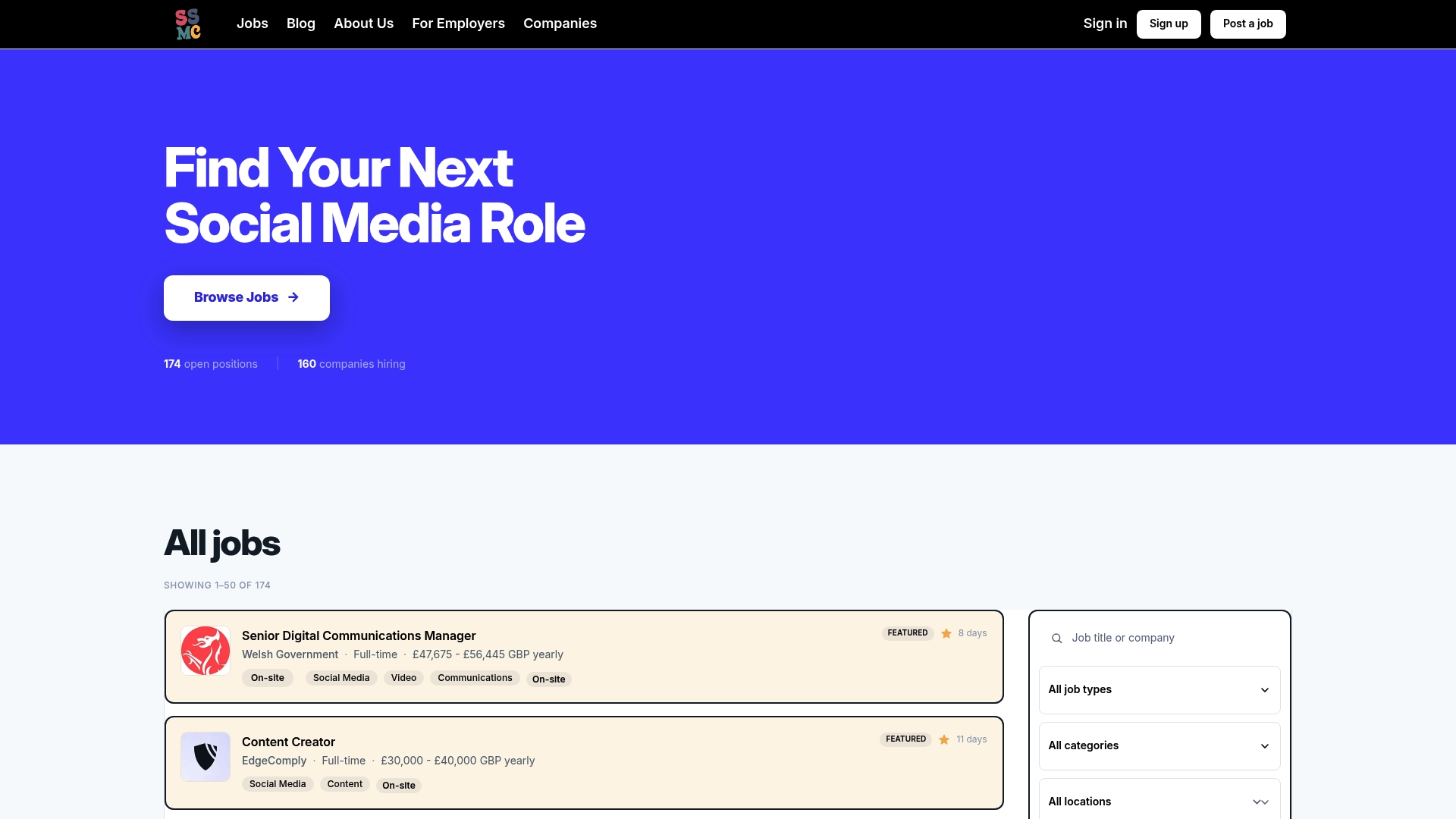
General job boards get volume; a curated one gets fit. Sam's Social Media Club lists roles in social media, content, marketing, and communications with mandatory salary transparency and a vetting process built to match the posting to the right candidate, not just the largest audience. Every listing on the board also carries JobPosting structured data, so roles are eligible for Google for Jobs. If your team is weighing where to place a listing alongside your own site, see pricing and options to advertise with SSMC.
Sources
Start technical validation with Google's own JobPosting documentation and its companion intro to structured data. For field-by-field JSON-LD examples, Reqcore's implementation guide walks through recommended fields like baseSalary and directApply. For the effect of pay transparency and requirement specificity on applicant quality, the UK-focused analyses from HR Press and Sausage Dog's advert tracking are worth reading in full.
- Learn About Job Posting Schema Markup | Google Search Central
- Inside 200 UK recruitment job adverts: what pay transparency and performance language tell HR teams about applicant quality - HR Press
- We read 15,291 UK job adverts. Ten findings that change how you should apply. | Sausage Dog
FAQ
What does job ad SEO actually involve?
Job ad SEO means writing and structuring job postings so search engines and Google for Jobs can read, index, and rank them. The work spans keyword research, page titles, meta descriptions, and structured data implementation, and sits alongside standard recruiting work rather than replacing it.
Is SEO still worth it in 2026?
Yes: search remains one of the main ways candidates find open roles, and a posting with a searchable title, clear deciding information, and valid JobPosting markup consistently reaches more qualified candidates than one without. The mechanics have shifted toward natural-language phrasing and structured data, but the underlying value has not changed.
How much do SEO roles pay?
Salary for SEO-focused roles varies widely by seniority, industry, and location, and no single figure applies across the market. Our marketing job titles guide includes typical UK SEO pay bands by level.
How hard is it to get an SEO job?
Difficulty depends on the specific role and market, but postings that are vague about requirements tend to draw a flood of unqualified applicants, making the hiring process harder for both sides. Writing specific, measurable requirements helps candidates self-select before applying, which benefits jobseekers and recruiters alike.