Wednesday 4pm and Salary First: When UK Recruiters Should Post Jobs

The strongest general window for posting a job is midweek, in the late afternoon or early evening, roughly 3pm to 8pm, with Wednesday at 4pm standing out as the single best slot in LinkedIn engagement data. If you only change one thing beyond timing, add a salary or salary range to the listing: it raises the relevance of who applies. Get the timing and the transparency right together, and you improve both visibility and quality.
TL;DR:
- Posting jobs midweek between 3pm and 8pm, especially on Wednesdays at 4pm, maximises visibility and engagement on LinkedIn.
- Early-week, morning posts perform better on job boards to align with digest cycles, while social channels are better for evening or weekend candidate discovery.
- Listing seasonal roles well ahead of demand peaks and tailoring timing to industry-specific hiring cycles increases application relevance.
- Staggering posts across channels and time zones prevents applicant flow overload and keeps listings fresh in search results.
- Including salary or compensation range upfront significantly improves applicant relevance and filters out unsuitable candidates.
Hiring for a marketing role? Sam's Social Media Club puts salary-transparent roles in front of social media, content, marketing and communications professionals. Advertise a role
Table of Contents
- Data-backed summary: best days and times to post jobs
- Platform-specific timing: LinkedIn, job boards, and social channels
- Seasonal and monthly patterns: plan hiring around calendar cycles
- How to schedule and stagger postings to manage applicant flow
- Content and conversion factors to prioritise over chasing the perfect minute
- Sam's Social Media Club: what we see from the board
- Industry-specific posting windows and hiring cycles
- Geographic and time zone considerations for posting timing
- Impact of job type or seniority level on optimal posting times
- Posting frequency and reposting strategies
- A simple weekly rule for scheduling job posts
- Why advertise with Sam's Social Media Club
- Sources
- FAQ
Data-backed summary: best days and times to post jobs
The old advice to post jobs first thing Tuesday morning is fading. A 2026 analysis of 4.8 million LinkedIn posts found peak engagement between 3pm and 8pm on weekdays, with Wednesday at 4pm the strongest single slot. That heatmap also shows evening windows now frequently beating mornings, a shift from the business-hours consensus recruiters relied on for years.
This does not mean morning posting is wrong, only less reliably optimal. Tuesday through Thursday during business hours remains a sound fallback when you cannot schedule around exact peak windows, especially on job boards with their own refresh cycles. The main thing to keep in mind is that timing shifts the odds of a post being seen, not the outcome of the hire itself.
Practical takeaways for scheduling a post this week:
- Favour Wednesday or Thursday afternoons over Monday mornings when you have flexibility.
- Treat 3pm to 8pm as your primary posting window on LinkedIn.
- Track views and applicant quality for two to three cycles before locking in a fixed schedule.
Platform-specific timing: LinkedIn, job boards, and social channels
Each channel has its own rhythm, and treating them identically wastes reach. LinkedIn rewards the late-afternoon window described above, with Friday 3pm to 4pm also performing well as professionals wind down their week and browse more freely. Job boards behave differently: many refresh their rankings and digest emails early in the business week, so a Monday or Tuesday morning post is more likely to land in that day's alert batch. Social channels sit somewhere in between, useful for candidate discovery in evenings and on lighter weekend browsing, but secondary to LinkedIn and job boards for serious professional hires.
- LinkedIn: prioritise Wednesday 4pm and Friday afternoon slots for maximum visibility.
- Job boards: post early in the week to catch daily or weekly digest cycles.
- Social channels: use evenings and weekends for candidate discovery, not as your primary channel.
- Cross-posting: stagger releases across channels rather than publishing everywhere at once.
Pro Tip: Stagger your cross-posting by a few hours to a day between channels so your listing stays fresh in search results instead of ageing out everywhere at the same time.
Seasonal and monthly patterns: plan hiring around calendar cycles
Job posting timing is not just about the day and hour. It follows a calendar rhythm too. January and the first full business week of the year typically bring a burst of jobseeker activity as people reassess their careers after the holidays, making it a strong window to have listings live and ready.
Summer hiring depends heavily on sector. REC's Labour Market Tracker points to a summer hiring bounce concentrated in hospitality, tourism, and construction, sectors where demand climbs from May through July. Outside those industries, summer can be quieter as both recruiters and candidates take time off.
Holiday and seasonal roles follow their own curve. Indeed Hiring Lab found that searches for seasonal Christmas jobs typically start climbing from August and continue building toward a peak around October and November, which means postings for those roles need to go live well ahead of the December rush rather than during it.
- Expect an early-year spike in jobseeker activity during the first full week of January.
- Time hospitality, tourism, and construction campaigns for the May to July window.
- List seasonal or Christmas roles from August, with postings peaking by October or November.
How to schedule and stagger postings to manage applicant flow
Posting everywhere at once floods your inbox and buries strong candidates under volume. A staggered cadence keeps flow manageable and gives each channel a chance to perform on its own terms.
- Post to your priority channel first, typically LinkedIn, during its peak window.
- Wait 24 to 72 hours before pushing to job boards and secondary channels.
- Send a reminder post or refresh around the 48 to 72 hour mark to catch a second wave of browsers.
- Send a final closing reminder about a week out to prompt fence-sitters before the deadline.
- Watch views, click-through rate, and applicant quality, and refresh the listing if performance drops before you are ready to close it.
Pro Tip: If you are hiring across distributed teams or time zones, use a scheduling tool to publish at the target audience's local peak hours rather than your own.
Content and conversion factors to prioritise over chasing the perfect minute
Getting the hour right helps a post get seen. What happens next depends on the content itself. Salary transparency is the biggest single lever here: including a clear number or range filters in candidates who are genuinely a fit and filters out those who would drop off at an offer stage anyway. Transparent salary listings tend to improve both the relevance and quality of who applies.
The first two lines of a posting carry disproportionate weight, since most candidates scan rather than read in full. State the role, the salary or range, and one concrete benefit before anything else. Beyond wording, mechanics matter: mobile-friendly formatting, one-click apply, and a short application process all reduce drop-off between someone reading and someone actually applying. Our 10 social media job ad examples show this in practice.
- Lead with role, salary, and one clear benefit in the first two lines.
- Keep the application process to a few steps, ideally with one-click apply.
- Test one variable at a time, whether headline, CTA, or posting time.
| Factor | What to test | What to track |
|---|---|---|
| Headline | Role title wording | Click-through rate |
| Opening lines | Salary and benefit framing | Application starts |
| Posting time | Midweek afternoon vs. morning | Views and applicant quality |
Sam's Social Media Club: what we see from the board
Sam's Social Media Club is a curated job board for social media, content, marketing, and communications roles, and salary listings are mandatory rather than optional. The pattern we see matches the wider timing and content data: when a well-timed post leads with a real salary, the applications that come in are more relevant to the role.
- Every listing carries a salary or salary range.
- The audience is focused on creative and marketing professionals.
- Transparency and timing work best together, not as alternatives.
Industry-specific posting windows and hiring cycles
Different industries hire on different clocks, and applying one blanket schedule across all of them wastes the timing advantage. Retail and hospitality often ramp hiring ahead of known seasonal peaks, as REC's tracker shows for the summer season, which means postings need to go live weeks before the actual demand spike, not during it. Creative, marketing, and communications roles tend to follow a steadier year-round pattern, with less pronounced seasonal swings, though budget cycles at the start of a financial year can still create a modest uptick in openings.

Tech and product roles often see hiring activity tied to funding rounds or product launches rather than the calendar, making timing less about the month and more about internal company signals. Sectors with heavy compliance or public-sector hiring cycles, meanwhile, may run on fixed recruitment windows tied to budget approval periods, so the "best time" there is dictated by internal process more than external candidate behaviour.
The practical move is to map your own sector's demand curve before defaulting to generic weekday advice. A hospitality recruiter chasing the summer rush and a marketing recruiter filling a steady-state role are working from different calendars entirely, even if both benefit from the same midweek afternoon posting window once a listing goes live.
Geographic and time zone considerations for posting timing
Posting at 4pm only helps if that hour lines up with when your candidates are actually online. A single national audience makes this simple, but distributed or remote hiring adds a layer of complexity that flat advice like "post at 4pm" does not address. If your candidate pool spans multiple time zones, the safest approach is to post so the listing is live and gaining traction during the target region's own business hours, even if that means scheduling outside your own.
Scheduling tools make this manageable without requiring anyone to post at odd hours themselves. A guide to building a social ad workflow covers the same logic recruiters can apply to job posts: plan the release around audience behaviour, not publisher convenience. For remote-first roles where candidates could be anywhere, staggering a post across a few key time zones over the course of a day often captures more of the midweek afternoon window globally than a single fixed post does.
Local hiring is more forgiving here. If you are filling a role tied to a specific city or region, the general midweek afternoon guidance holds without much adjustment, since your candidate pool and your own working hours are likely already aligned.
Impact of job type or seniority level on optimal posting times
A graduate scheme and a director-level search do not behave the same way once posted, and timing advice should flex with the role. Entry-level and high-volume roles tend to draw larger numbers of applicants quickly, so posting midweek in the peak window described earlier maximises the initial wave, and a short application process matters even more given the volume of casual browsers.
Senior and specialist roles work differently. Candidates at that level are less likely to be actively browsing job boards at a given hour and more likely to see a role through a direct share, a recruiter outreach message, or a considered LinkedIn scroll later in the evening. For these roles, the exact minute matters less than making sure the listing is visible when a passive candidate happens to check LinkedIn, which still points back to the 3pm to 8pm window but with less urgency around hitting it precisely.
Mid-level roles sit in between: enough active searching to benefit from peak timing, but enough discernment among candidates that content quality, especially salary transparency, does more work than the exact posting hour. Across all levels, the content factors outlined earlier, particularly a clear opening line and salary information, tend to matter more the higher up the seniority ladder you go, since senior candidates are pickier about what earns a click.

Posting frequency and reposting strategies
A single post rarely captures the full pool of interested candidates, since most jobseekers are not browsing at the exact moment a listing goes live. Reposting or refreshing a listing after the initial 48 to 72 hour window, as covered in the scheduling section earlier, helps capture a second wave without duplicating effort.
Frequency needs limits, though. Reposting the same role too often within a short window can read as a sign the role is hard to fill or make your account look like it is spamming a feed, which can hurt engagement on future posts. A reasonable pattern is an initial post, one reminder around the midpoint of the listing's life, and a final push near the application deadline, which mirrors the cadence recommended for staggering across channels.
Tools that support scheduled social media posting make this cadence easier to manage without needing to remember exact posting windows each time. When a listing's performance drops off noticeably, whether in views or in applicant quality, that is usually the signal to refresh the wording or the image rather than simply reposting the same content again.
A simple weekly rule for scheduling job posts
Post midweek afternoon, lead with salary and benefit, then test one variable at a time. Timing opens the door. Content decides who walks through it. Treat applicant quality, not just volume, as the number that tells you whether it worked.
— Sam
Why advertise with Sam's Social Media Club
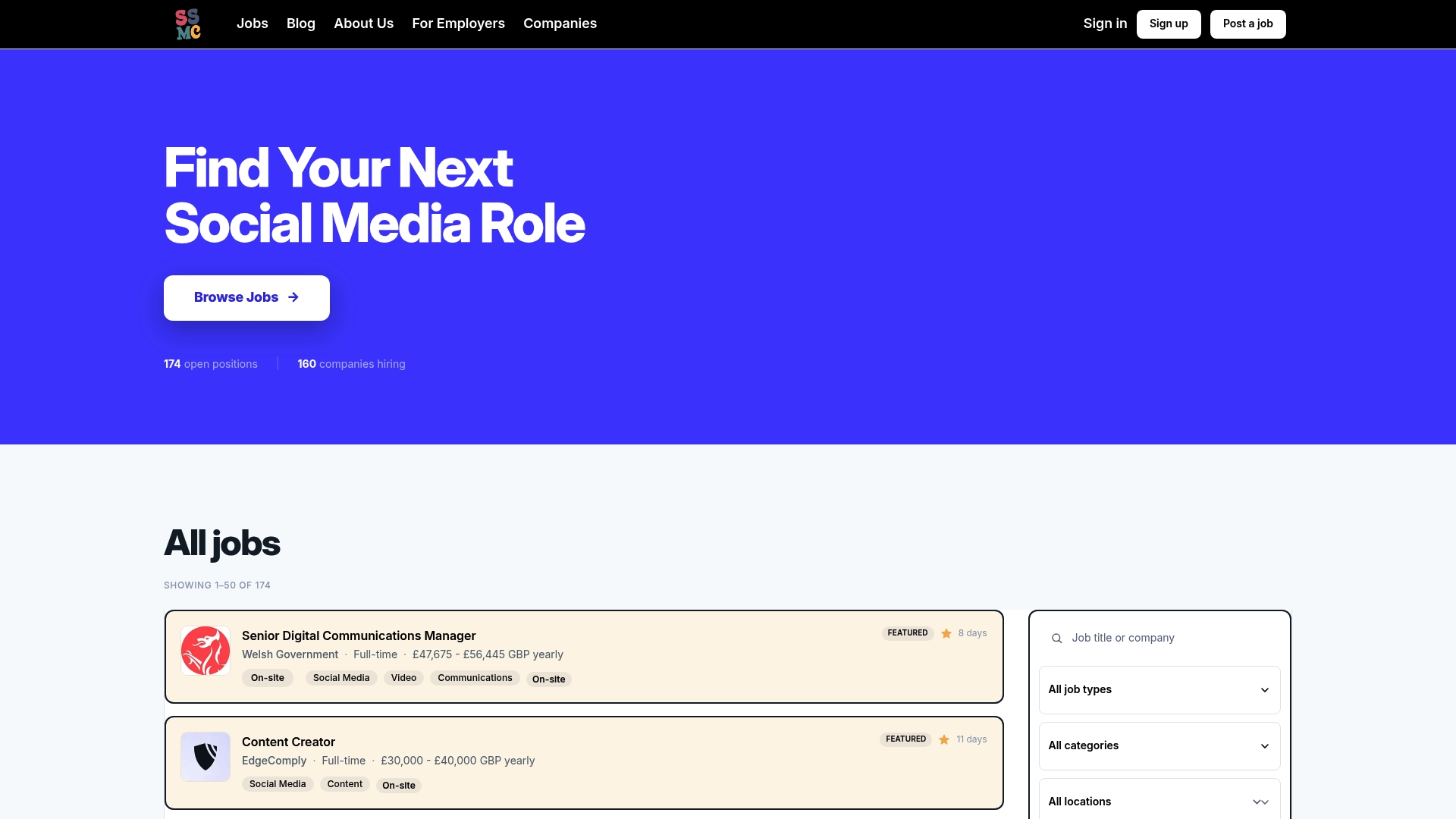
Good timing gets a listing seen. A curated, salary-transparent audience determines whether the people who see it are the right fit. Sam's Social Media Club focuses specifically on social media, content, marketing, and communications roles, with every listing carrying a salary or range by default, which removes the guesswork candidates otherwise face.
- Every listing reaches a curated audience of creative and marketing professionals.
- Mandatory salary transparency filters for candidates who are a genuine match.
- Employers can advertise a single role or choose SSMC SUPER for expanded visibility.
If you are ready to post a role to an audience built for social media and marketing hiring, check current advertising options and pricing or send an enquiry for bespoke or bulk listings.
Sources
- Best time to post on LinkedIn in 2026: 4.8M posts analysed — Buffer
- Searches for Seasonal Jobs Are the Strongest in Years, but Postings Are Sluggish - Indeed Hiring Lab UK & Ireland
- Labour Market Tracker: Summer jobs comeback, with year-on-year rise in seasonal hiring – REC
FAQ
What month sees the most job postings?
January often sees a notable rise in jobseeker activity as people start new-year job searches, though seasonal roles tied to the holidays typically ramp from August. Postings themselves follow employer demand cycles, which vary by sector rather than following one fixed national peak month.
What is the 7-second rule for a CV?
The idea behind this rule is that recruiters skim a CV for roughly the first few seconds before deciding whether to read further, so the top section needs to communicate fit immediately. The same logic applies to job postings: the opening lines need to state the role, salary, and a key benefit before a candidate scrolls past.
What is the best day to post a new job?
Wednesday tends to perform best on LinkedIn, with 4pm standing out as the strongest specific slot in recent analysis. Job boards behave differently and often favour an early-week post to catch digest and alert cycles.
Is three months too early to start a job search?
Three months is a reasonable window for many professional roles, especially at senior or specialist levels where hiring cycles run longer. For high-volume or entry-level roles, activity tends to concentrate closer to the actual posting date, so earlier searching mainly helps with research rather than application timing.