
90 Day Employer Branding Marketing to Cut Time to Fill for HR and TA
Employer branding marketing is the practice of researching, defining, and publicizing what it’s actually like to work at your company so the right candidates recognize themselves in it before they apply. The immediate next step is not a new careers page or a slicker Instagram feed. It’s an EVP evidence audit: pull real survey data, exit interview themes, and Glassdoor patterns before you write a single word of messaging.
TL;DR:
- Authentic employer branding depends on a thorough EVP audit, using real survey data and exit interview themes, before developing messaging.
- Consistent alignment among HR, marketing, and recruitment is essential, with responsibilities clearly split and regularly shared metrics to maintain credibility.
- Employer branding strategies should focus on evidence-based claims, honest communication about pay and culture, and agility through monthly content reviews.
- High-volume, competitive, or reputation-challenged industries benefit most from strong branding, transparency, and targeted niche advertising channels.
- Tracking metrics such as time-to-fill, retention, Glassdoor ratings, and content engagement helps measure success and adjust employer branding efforts effectively.
Table of Contents
- What Is Employer Branding and How Does It Differ From EVP and Recruitment Marketing?
- Why Employer Branding Matters for Recruiting and Retention
- Who Owns Employer Branding Inside the Company?
- How Do You Build an Employer Branding Strategy Step by Step?
- How Do You Market and Amplify Your Employer Brand?
- How Do You Measure Employer Branding Success?
- Aligning HR and Marketing: What Practitioner Alignment Actually Looks Like
- Common Pitfalls in Employer Branding Marketing
- Why Honesty Beats Polish in Employer Branding
- An Adjacent Option: Amplifying Your Employer Brand Through Curated Job Advertising
- Sources
- FAQ
What Is Employer Branding and How Does It Differ From EVP and Recruitment Marketing?
These three terms get used interchangeably in job postings and vendor pitches, and that sloppiness causes real strategy problems. Untangling them is the first job of anyone building an employer branding marketing program.
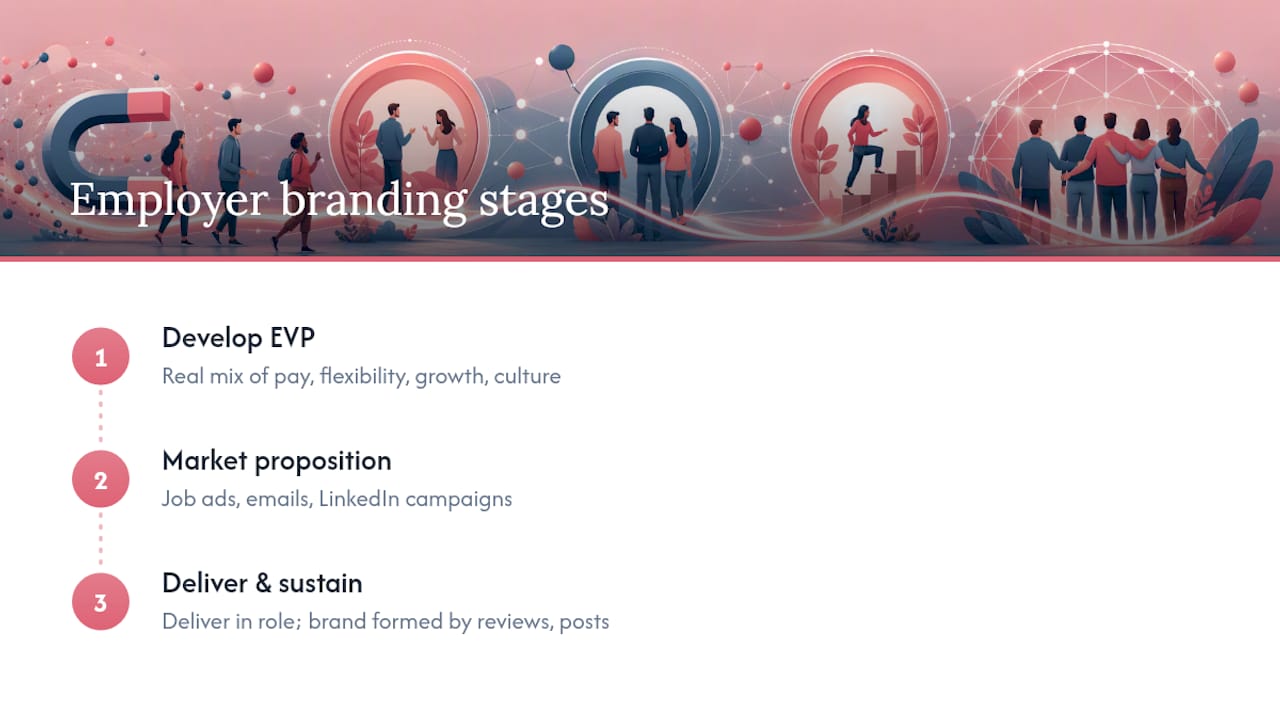
The classic framing, from researchers Backhaus and Tikoo, breaks the work into three stages, as summarized by Employerbranding: develop the employee value proposition, market that proposition to attract candidates, and deliver on it once people are hired. Skip any one of the three stages and the whole thing collapses. A company can have a gorgeous careers site and still lose new hires in month four because nobody delivered on what the site promised.
So here’s the breakdown. The employee value proposition (EVP) is the substance: the actual mix of pay, flexibility, growth opportunity, and culture that employees experience. It’s a set of true statements, not a slogan. Employer brand is the reputation built from that EVP over time, shaped by reviews, employee posts, and word of mouth as much as by anything the company publishes. Recruitment marketing is the tactical layer: the job ads, the email sequences, the LinkedIn campaigns that activate the brand for a specific opening.
A concrete example makes this click. If your EVP includes “four-day compressed workweeks for operations’ staff,” your employer brand is whatever reputation that policy has earned you on review sites over the past two years. Your recruitment marketing is the paid LinkedIn post announcing the open operations role, built around that same four-day claim. Confuse the layers and you end up promoting a culture perk in a job ad that your actual employer brand doesn’t support, which candidates spot within a week of starting.
Why Employer Branding Matters for Recruiting and Retention
The business case comes down to four numbers most TA leaders already track: time-to-fill, cost-per-hire, quality-of-hire, and retention. Strong employer branding marketing moves all four, because candidates arrive pre-sold and pre-screened rather than cold.
The trust signal that matters most: Gartner’s guidance on EVP design finds that employees who perceive transparent decision-making are substantially more likely to trust leadership — a signal that carries directly into how candidates evaluate a company before they ever submit an application.
Authenticity does the heavy lifting here. Candidates today don’t take a careers page at face value. They cross-reference it against Glassdoor, LinkedIn comments, and increasingly, AI-generated summaries pulled from all of it at once, according to SHRM’s employer branding guide. A mismatch between what you claim and what employees actually say shows up fast, and it costs you the candidates who did their homework, which tend to be the strongest ones.
Employer branding pays off hardest in a few specific situations: high-volume hiring where every point of friction multiplies across hundreds of applicants, competitive technical roles where candidates have three offers on the table, and industries with public reputation problems where trust has to be rebuilt deliberately rather than assumed.
Who Owns Employer Branding Inside the Company?
Nobody owns employer branding alone, and pretending otherwise is why so many programs stall. HR holds the authenticity and the access to employee stories. Marketing holds the audience targeting and content discipline. Split the work and you get inconsistent messaging; hoard it in one department and you get either a tone-deaf campaign or a brand nobody outside HR ever sees.
A workable governance model splits responsibilities like this:
- HR/People team: owns EVP research, employee story sourcing, and delivery on lifecycle promises (onboarding, career paths, benefits).
- Marketing/Comms: owns channel strategy, content production quality, and brand voice consistency with the corporate brand.
- Talent acquisition: owns activation in job ads, interview messaging, and candidate-facing follow-through.
- Senior leaders: show up in employee stories and town halls; their visible buy-in is what keeps the program funded past year one.
Set a monthly cross-functional check-in, not a quarterly one. Employer brand content ages fast, especially anything tied to pay or policy, and a monthly cadence catches drift before it becomes a credibility problem. One industry analysis put it plainly: your employer brand is a marketing problem that HR can’t solve alone, and the reverse is just as true.
How Do You Build an Employer Branding Strategy Step by Step?
Building a credible EVP is research work first, creative work second. Skip the research and you get a brand built on executive assumptions, which candidates and employees both see through immediately.
- Audit before you write anything. Run employee surveys, mine exit interview themes for patterns, and walk your own candidate journey as if you were applying cold. The CIPD’s recruitment brand factsheet recommends starting activation with exactly this kind of touchpoint audit rather than a messaging workshop.
- Segment your audience before you segment your message. Early-career candidates and senior hires respond to different proof points. Treating the EVP as a single blanket promise, rather than a portfolio adjusted by segment, is one of the most common ways employer branding drifts from what candidates actually care about.
- Draft the EVP from evidence, not aspiration. Every claim should trace back to a survey response, a policy document, or an employee quote. If you can’t point to the source, the claim doesn’t go in.
- Validate it with the people it describes. Take the draft back to a cross-section of employees, including some who left recently. Their pushback is more valuable than their agreement.
- Operationalize it everywhere candidates touch you. Job descriptions, the careers site, and interview scripts should all reflect the same EVP language. iCIMS treats job descriptions and careers pages as content assets that need the same consistency standard as any other marketing material.
- Set a 90-day build timeline. Weeks 1 to 3 for audit and research, weeks 4 to 6 for drafting and validation, weeks 7 to 12 for rollout across job ads, the careers site, and interview training.
Pro Tip: Pull three exit interview transcripts from the last quarter before you write a single EVP sentence. The gap between what departing employees actually said and what your current careers page claims is usually where your authenticity problem lives.
How Do You Market and Amplify Your Employer Brand?
Channel choice depends on what you’re trying to build: reach, trust, or conversion. Owned channels, your careers site and employee newsletters, give you control but limited reach. Earned channels, employee posts and press coverage, carry the most trust but the least control. Paid channels, sponsored job ads and targeted campaigns, buy you reach fast but need a credible foundation underneath or they backfire.
Content formats that actually move candidates:
- Employee-led video stories over polished corporate testimonials, since candidates can tell the difference within seconds.
- “A day in the life” posts tied to specific roles, not generic culture montages.
- Structured salary data published directly in job ads rather than buried in a benefits PDF.
- Leadership Q&A formats where employees ask the questions, not marketing.
Employee advocacy is the credibility lever most companies underuse. A simple toolkit, pre-approved talking points, a shared content library, and permission (not pressure) to post, turns willing employees into your strongest recruitment channel. SHRM’s guide is direct on this point: employee advocacy and authentic stories are critical for credibility, more so than any paid campaign.
For channel selection by segment: LinkedIn content and thought-leadership posts work well for senior and specialist hires, and platforms with strong LinkedIn content strategy guidance can help sharpen that specific channel. Curated, niche job boards outperform generic ones for high-volume specialist roles like social media, content, and marketing, where candidates are already tired of sorting through irrelevant listings.
How Do You Measure Employer Branding Success?
Most companies skimp on measurement, and it shows. The CIPD notes that only a minority of organizations measure employer brand impact on a regular cadence, which means most are flying on instinct rather than data.
A workable dashboard mixes outcome metrics with perception signals:
| Metric type | Example fields | Cadence |
|---|---|---|
| Recruitment outcomes | Time-to-fill, cost-per-hire, offer-accept rate | Monthly |
| Quality signals | 90-day retention, hiring manager satisfaction score | Quarterly |
| Reputation signals | Glassdoor rating trend, review volume, employee referral rate | Monthly |
| Content performance | Careers page traffic, employee post engagement | Monthly |
Set a baseline in month one, then run small experiments, like testing a salary-transparent job ad against a control version, rather than overhauling everything at once. A simple 90-day plan: baseline in weeks 1 to 2, one or two content or channel experiments in weeks 3 to 10, and a full report comparing outcome and perception metrics in weeks 11 to 12.
Aligning HR and Marketing: What Practitioner Alignment Actually Looks Like
Programs that work treat HR and marketing as one team with two skill sets, not two departments trading files. Marketing brings targeting discipline and content craft; HR brings the access and authenticity that make the content believable in the first place.

Transparent salary listings are a strong test case for this alignment. When pay ranges are public and consistent across every posting, it removes one of the biggest trust gaps between an employer’s claims and a candidate’s experience, echoing the transparency findings from Gartner’s EVP research.
Operational habits that keep alignment real:
- A shared content brief template used by both HR and marketing for every employer brand asset.
- A single content library so nobody is recreating employee quotes from scratch.
- A biweekly metrics-sharing routine, not a once-a-quarter readout.
Pro Tip: If HR and marketing are drafting job ad copy in separate documents, that’s the tell. Merge the workflow before you merge the metrics.
Common Pitfalls in Employer Branding Marketing
The authenticity gap opens fastest through a handful of repeatable mistakes:
- Overpromising on culture claims the exit interview data doesn’t support.
- Siloed messaging where marketing’s campaign contradicts what recruiters say in screening calls.
- Ignoring review sites until a bad Glassdoor pattern becomes a hiring blocker.
Fast repair steps: respond publicly to recent reviews, audit your last five job ads against your actual EVP evidence, and align recruiter talking points with marketing copy within the week, not the quarter.
Why Honesty Beats Polish in Employer Branding
The best-performing employer brands I’ve seen aren’t the most produced. They’re the most willing to publish an uncomfortable truth, like an actual pay band, alongside the good news. Candidates reward that instinct with trust that a highlight reel never earns. This week, pick one job description and add the real salary range to it. Watch what happens to your applicant quality.
— Sam
An Adjacent Option: Amplifying Your Employer Brand Through Curated Job Advertising
Everything above is strategy work: audits, EVP drafting, cross-functional governance. None of it requires a job board. But once your EVP is solid, you still need a channel that puts it in front of candidates who actually care about salary transparency and role fit rather than volume alone.
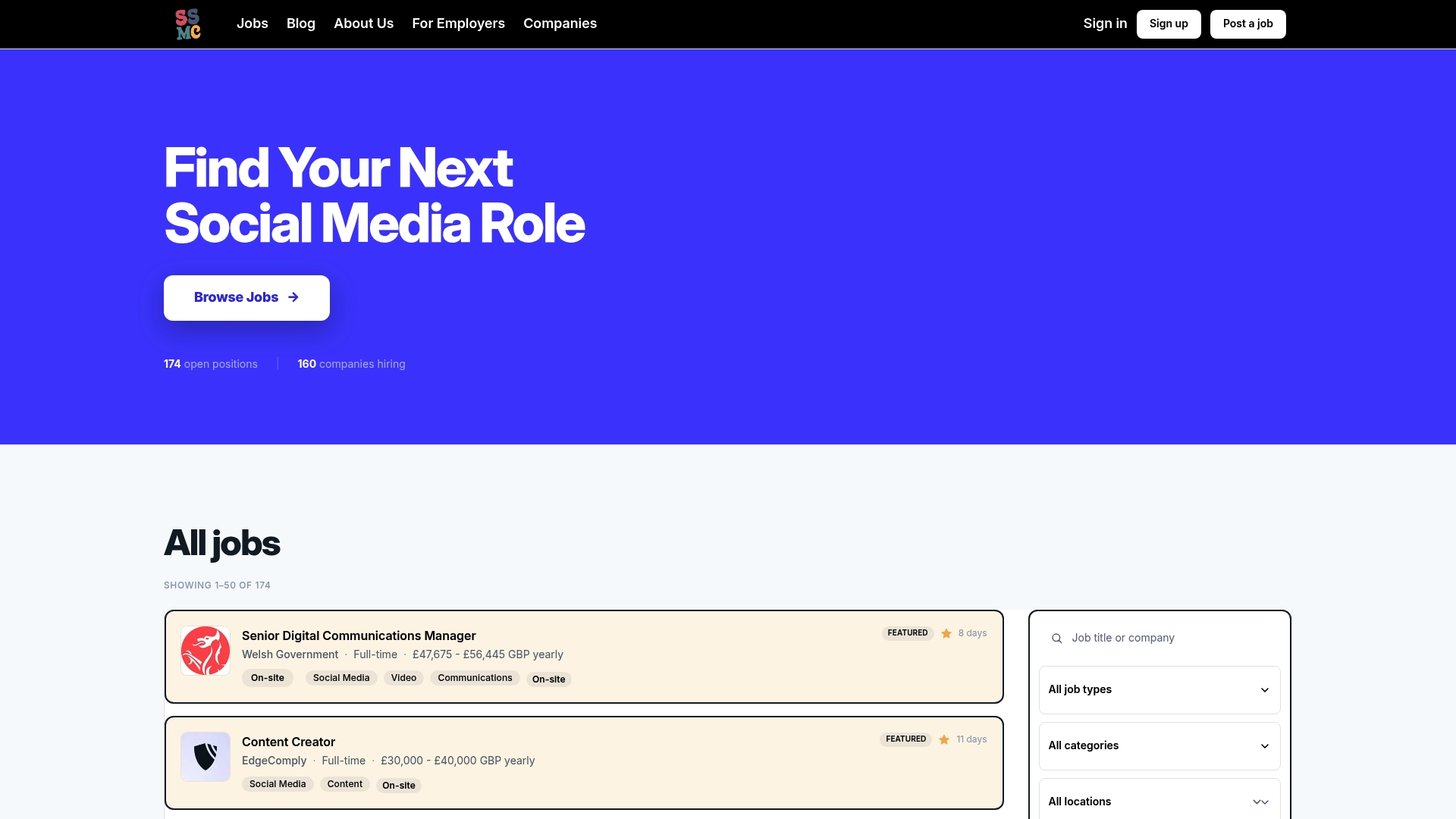
That’s the gap Samssocialmediaclub fills. The listings carry transparent salary ranges, reinforcing the employer brand’s honesty message when candidates view the posting. The audience is focused on professionals searching for roles in social media, content, marketing, and communications, helping ads reach relevant candidates instead of a generic applicant pool. Employers have reported improved applicant quality possibly related to curation and salary transparency on the listings.
This works best as a complement to the strategic groundwork covered above, not a replacement for it. If your EVP evidence is solid and your governance rhythm is set, advertising through SSMC or checking the SSMC SUPER option gives that work a targeted audience to land on. Ready to see fit? Submit an enquiry and get pricing details for your next open role.
Sources
- Gartner — Employee value proposition (EVP) insights
- SHRM — Employer branding guide
- CIPD — Recruitment brand factsheet
- iCIMS — Employer branding strategy guide
FAQ
What Are the Four P’s of Employer Branding?
Definitions vary across practitioners, but a common version covers People (employee stories and leadership visibility), Purpose (mission and values), Perks (pay, benefits, flexibility), and Promotion (how the brand gets marketed across channels). Treat these as a checklist for auditing your EVP coverage, not a rigid formula.
What Are the Employer Branding Trends for 2026?
Pay transparency has moved from a nice-to-have to a baseline expectation, partly because candidates now cross-check claims against AI-generated summaries and multi-source reputation signals. Employee-led video content and segmented EVPs for different talent audiences are also gaining ground over generic, one-size-fits-all messaging.
What Are the Most Commonly Used Branding Strategies?
Common approaches include employee advocacy programs, structured salary transparency, employee-led storytelling, careers site content investment, leadership visibility campaigns, targeted niche job advertising, and cross-functional HR and marketing governance. The strongest programs combine several rather than leaning on one channel alone.
What Are the Five Pillars of EVP?
Most frameworks group EVP around compensation, benefits, career development, work environment, and culture or values. Some versions add a fifth pillar around purpose or social impact, depending on the industry.
Where Can Employers Advertise Roles With Built-In Salary Transparency?
Samssocialmediaclub curates job listings for social media, content, marketing, and communications roles and requires transparent salary ranges on every posting. Pricing details for the Advertise with SSMC and SSMC SUPER options are available directly on the site.