4 Quick Edits HR Must Make to Inclusive Job Ads Today

An inclusive job advert is short, specific, and signals real accommodation. Update four things immediately: strip out gendered and ableist wording, publish an actual salary range, default the role to flexible working, and add a genuine accessibility contact line. Templates and applicant tracking system fields can wait for your next process review, but these four edits belong in every advert you post starting today.
TL;DR:
- Including a real salary range in job adverts significantly increases application rates and clarifies compensation expectations for candidates.
- Explicitly stating flexible work arrangements and including a dedicated accessibility contact boost diversity and accessibility in applicant pools.
- Removing gendered, ableist language and avoiding jargon improves the inclusiveness and appeal of job postings across underrepresented groups.
- Posting on specialised, curated job boards with transparent pay policies reaches candidates actively seeking mission-driven and flexible roles.
- Building a checklist and regular review process ensures consistent application of inclusive language and practices across all job advertisements.
Reach candidates seeking transparent pay. Share your marketing role with professionals looking for transparent salaries and curated opportunities across social media, content, and communications. Advertise a role
Table of Contents
- What to Include in an Inclusive Job Advert
- How Do You Remove Biased Language From a Job Ad?
- How Should You Advertise Flexibility and Accessibility?
- Where Should You Post Jobs to Reach Underrepresented Candidates?
- Copy-and-Adapt Advert Templates
- What's Legally Allowed: Positive Action vs. Positive Discrimination
- What Does the Research Actually Say About Inclusive Adverts?
- Author Perspective: Making Inclusive Adverts Stick This Quarter
- Post Your Inclusive Job Ad With Full Salary Transparency
- Sources
- FAQ
What to Include in an Inclusive Job Advert
A well-built advert answers a candidate's real questions before they have to ask them: what will I actually do, what do I need to qualify, what will I be paid, and can I get help if I need an adjustment? Miss any of those and you lose applicants who would have been strong hires, simply because they couldn't tell if the role fit.
Start with a role summary that describes outcomes, not personality traits. One or two sentences on what the person will actually produce or move forward beats a paragraph of "dynamic self-starter" language every time. The CIPD's inclusive recruitment guidance recommends listing concrete behaviours and competencies instead of vague traits, because specific tasks are easier for a diverse pool of candidates to self-assess against.
Split your criteria into essential and desirable, and keep the essential list short and concrete.
- Essential criteria should cover only what someone genuinely cannot do the job without, tested from day one.
- Desirable criteria should hold anything you'd love but can teach or that develops on the job.
- Cut vague soft skills like "excellent communicator" unless you can attach a specific example of what that looks like in the role.
- Recheck every years-of-experience requirement. Does the job really need five years, or does it need someone who can already do the three specific things you listed?
Salary range comes next, and it needs to be a real range, not a placeholder. "£32,000 to £38,000 depending on experience" tells a candidate whether to bother applying. Guidance across the industry increasingly treats salary transparency as standard practice because it cuts the friction that stops qualified candidates, especially women and career changers, from applying to roles they'd have to negotiate blind. For wording ideas, see what to write instead of "competitive salary".
Spell out the working pattern explicitly rather than leaving it implied. State whether the role is full-time only, open to part-time or job-share, or flexible on hours and location, and say so in the advert itself, not buried in a linked policy page.
Close with the practical logistics: how to apply, how many stages the process has, roughly how long it will take, and who to contact if someone needs an adjustment to apply or interview. Candidates who know the process will take three weeks and involve two interviews are far more likely to stick with it than candidates guessing in the dark.
How Do You Remove Biased Language From a Job Ad?
Run your draft through a mental filter for three things: gendered coding, ableist assumptions, and unnecessary jargon. Each one quietly narrows your applicant pool without you noticing.

Masculine-coded words like "dominant," "aggressive," "ninja," or "rockstar" measurably shrink your pool of applicants. A large-scale peer-reviewed analysis of job postings found that gender-sensitive wording and explicit neutral language correlate directly with higher application rates from women and other underrepresented genders. Swap "aggressive negotiator" for "skilled negotiator." Swap "rockstar developer" for "experienced developer." The meaning survives; the coding doesn't.
Ableist phrasing is more common than most hiring teams realise. A recent analysis of nearly 1,900 job ads found ableist language in the majority of them, while explicit accommodation statements were rare, and those statements correlated with higher application intent from candidates with disabilities, according to research on ableist language in job postings.
Plain English does more work than most hiring managers give it credit for. Aim for sentences under 20 words and a reading level a general audience can follow without a dictionary. Jargon and internal acronyms don't signal expertise to outside candidates. They signal "you don't already know our culture," which is exactly the barrier you're trying to remove.
Tools like Textio, the Gender Decoder for Job Ads, and Grammarly's tone checker can flag coded language automatically, but treat them as a first pass, not a final verdict. They miss context, sector-specific terms, and sarcasm, and they can flag neutral words as biased simply because of statistical patterns in their training data. Read the advert aloud yourself before it goes live.
Pro Tip: Read your draft advert as if you're a strong candidate who's never worked in your industry. If a sentence makes you feel like you need insider knowledge just to understand the job, rewrite it.
How Should You Advertise Flexibility and Accessibility?
Say flexibility out loud in the advert, don't imply it. "Flexible working considered" buried at the bottom of a listing does almost nothing. Naming the specific type of flexibility on offer does a lot.
GOV.UK guidance points to real case data on this: when Zurich Insurance began explicitly advertising senior roles as flexible, applications for those roles rose 19%, and when John Lewis & Partners did the same, applications rose 35%. That's not a marginal gain. That's the difference between a shortlist of five and a shortlist of eight for the exact same role.
Name the actual pattern on offer rather than a generic "flexible" label:
- "Open to part-time (0.6 FTE or above) and job-share arrangements."
- "Remote-first, with optional access to our London office twice a month."
- "Core hours 10am to 4pm; start and end times flexible around that."
Since every employee in the UK now has the legal right to request flexible working from day one of employment, say so directly: "You can request flexible working arrangements from your first day with us."
Accessibility needs the same directness. A generic "equal opportunities employer" line at the bottom of an advert tells a disabled candidate nothing useful. Replace it with something specific: "Need an adjustment to apply or interview? Contact [name/role] at [email], and we'll sort it before the process starts." Where your organisation runs a guaranteed-interview scheme for disabled candidates who meet the essential criteria, name that scheme explicitly rather than hinting at it.
Review every physical requirement in the advert against what the role actually demands. "Must be able to lift 25kg" belongs in a warehouse listing. It has no business in a content marketing job description, and including it anyway quietly filters out candidates who could do the job perfectly well.
Where Should You Post Jobs to Reach Underrepresented Candidates?
Posting only on the boards you've always used reproduces the same applicant pool you've always had. Reaching underrepresented candidates takes a deliberate mix of channels, not a single silver bullet.
- Start with mainstream reach. General job boards give you volume and search visibility, and they're worth keeping in the mix for that reason alone.
- Add specialist and community channels. Boards and networks built around specific communities, disability employment services, career-returner programmes, and sector-specific job clubs reach people who never see your mainstream listing at all.
- Brief your referral programme carefully. Employee referrals are efficient, but the CIPD warns that relying heavily on word-of-mouth hiring reproduces existing homogenous networks rather than expanding them. Cap the proportion of hires you'll accept through referrals, and ask staff to refer people outside their immediate circle, not just former colleagues.
- Track source performance, not just volume. Break down applicant source by conversion rate, not just raw numbers. A channel that produces fewer applicants but a higher interview-to-offer ratio for underrepresented groups is worth more than a channel that floods your inbox with a mismatched pool.
- Watch two simple numbers over time. Apply rate per view, broken out where you can, and the proportion of applicants requesting adjustments, give you an early read on whether your advert language is actually working before you get to the interview stage.
For roles in social media, content, and marketing specifically, a curated job board with mandatory salary transparency reaches candidates who've already opted into pay-transparent work, which narrows the mismatch between what you're offering and who's applying. If you're building outreach around less visible opportunities, guidance on unadvertised roles and hidden channels is worth a look too.
Copy-and-Adapt Advert Templates
Two full examples below, one entry-level, one senior, show how salary, flexibility, and accessibility signals fit into a real advert without bloating the word count.
Entry-level example (Social Media Coordinator, £26,000 to £30,000):
"You'll plan and post content across our social channels, track basic performance metrics, and support our community management. We need someone comfortable writing for different platforms and open to learning our scheduling tools; no prior agency experience required. Full-time or 0.8 FTE considered, remote with monthly team days in Manchester. Flexible working available from day one. Need an adjustment to apply? Email jobs@[company].com and we'll sort it."
Senior example (Head of Content, £58,000 to £68,000):
"You'll set content strategy across three brands and manage a team of four writers and editors. Essential: proven experience leading a content team and setting measurable goals. Desirable: experience in the charity or education sector. Hybrid, two days in our Bristol office, job-share arrangements considered for this role. We use anonymised shortlisting for all applications at this level."
Three one-line signals you can paste directly into any advert:
- "Need an adjustment to apply or interview? Contact [name] directly at [email]."
- "We anonymise applications before shortlisting to reduce unconscious bias."
- "Meet the essential criteria and have a disability? You're guaranteed an interview under our scheme."
Scale the language up or down for seniority by keeping the structure identical and swapping the specifics. A senior advert can afford one more sentence on strategic scope; an entry-level advert should stay leaner, since long lists of requirements disproportionately discourage first-time applicants from applying at all.
What's Legally Allowed: Positive Action vs. Positive Discrimination
Positive action is legal. Positive discrimination is not, and the line between them comes down to one word: outcome.
Positive action means encouraging underrepresented groups to apply, running targeted outreach, or offering training aimed at closing a specific gap you can point to. Positive discrimination means actually selecting or hiring someone because of a protected characteristic rather than merit. The GOV.UK guidance on inclusive job descriptions sets out the practical steps that stay on the right side of that line: neutral language, a genuine review of requirements, and accessibility built in from the start.
There's one narrow exception worth knowing: the "tie-breaker" rule. If two candidates are genuinely equally qualified at the final stage, an employer can lawfully choose the candidate from an underrepresented group to address a specific, evidenced imbalance. It only applies at a true tie, not as a general thumb on the scale.
In practice, this means your advert language should:
- Welcome applications from underrepresented groups explicitly ("We particularly welcome applications from...") without promising preferential treatment.
- Avoid any wording suggesting a candidate will be selected based on a protected characteristic rather than qualification.
- Get sign-off from your legal or HR team before running any targeted outreach campaign or applying a tie-breaker in a live hiring decision.
What Does the Research Actually Say About Inclusive Adverts?
The evidence here isn't theoretical. It's measurable, and some of the effect sizes are large enough to change how you write every advert you post.
The numbers that matter: Advertising flexible working explicitly produced a 19% rise in applications for senior roles at Zurich Insurance and a 35% rise in applications at John Lewis & Partners, according to GOV.UK case data.
On language, the peer-reviewed analysis of gendered wording in job ads found that gender-sensitive phrasing correlates with a higher share of female views and applications, confirming what smaller studies have suggested for years: the words in an advert shape who bothers to click apply, before a hiring manager ever sees a CV.
On accessibility, the pattern is stark in the opposite direction. Ableist language showed up in the majority of the nearly 1,900 job ads analysed in one recent study, while explicit accommodation statements were rare, even though those statements were linked to higher application intent among disabled candidates.
You don't need a formal research team to test this yourself. Run two versions of an advert for a similar role, one with your current language and one with the edits described here, and track apply rate per view and the proportion of applicants requesting adjustments across two hiring cycles. Two cycles is usually enough to see whether the change moved the needle before you roll it out everywhere.

Author Perspective: Making Inclusive Adverts Stick This Quarter
Most companies treat inclusive language as a one-time editing pass instead of a system. That's the real gap. Fix the wording once, and it drifts back within two hiring cycles because nobody owns the template.
Build a short approval checklist into your applicant tracking system: salary range present, flexibility stated, accessibility contact named, essential criteria under six items. Make it a required field, not a suggestion, or it gets skipped under deadline pressure.
Bring hiring managers in early with a five-minute template walkthrough rather than a policy document nobody reads. Review outcomes quarterly: applicant source mix, adjustment requests, and time-to-fill by advert version.
Once the advert itself is right, where you post it matters just as much. A curated board with mandatory salary transparency, like Sam's Social Media Club, puts your listing in front of candidates who already expect the transparency you've built into the ad.
— Sam
Post Your Inclusive Job Ad With Full Salary Transparency
Every fix in this guide gets undercut by one thing: posting a carefully rewritten, salary-transparent advert on a board where candidates can't tell if you're serious about it. Sam's Social Media Club is built specifically for that gap. Every listing carries a mandatory salary range, so the transparency you just added to your advert doesn't get lost among postings that still say "competitive salary."
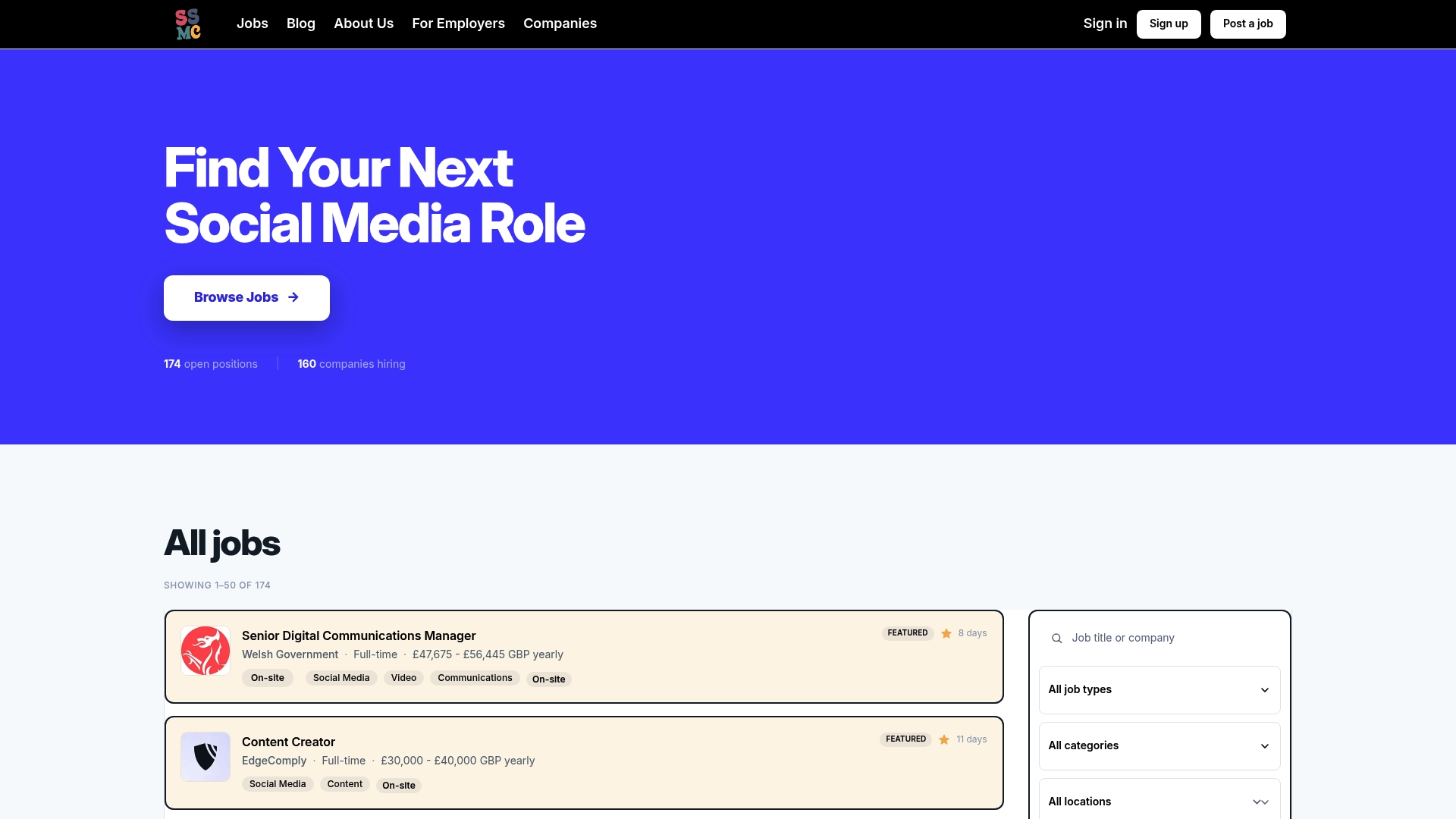
Employers list through paid placement options aimed at reaching a curated community of social media, content, marketing, and communications professionals who've already opted into pay-transparent job searching. Because the board is curated rather than open to unlimited postings, your inclusive advert reaches candidates actively looking for exactly this kind of role, not a generic flood of applicants scanning fifty listings at once.
Check current listing options and see pricing details, or get in touch with our team if you want help adapting your advert before it goes live.
Sources
For the legal and policy detail behind these recommendations, go straight to the primary documents rather than secondhand summaries.
- Advertise flexible working arrangements in job adverts - GOV.UK
- Effects of gendered wording in job advertisements (peer-reviewed analysis)
- Prevalence of ableist language and accommodation statements in job advertisements
FAQ
How Do You Write an Inclusive Job Advert?
Start with outcome-focused responsibilities, keep essential criteria short and concrete, and publish an actual salary range instead of "competitive salary." Add explicit flexible working language and a named accessibility contact, then review the draft for gendered or ableist wording before it goes live, following the GOV.UK checklist for inclusive job descriptions.
What Should a Good Job Advert Include?
A strong advert includes a clear role summary, a short essential-criteria list separated from desirable extras, a published salary range, explicit working-pattern details, and application logistics with a named contact for adjustments. Missing any one of these tends to quietly filter out qualified candidates before they even apply. See also the six benefits every job ad should name.
What Are the Six Pillars of Inclusive Employers?
Definitions vary across organisations, but most frameworks converge on similar themes: inclusive leadership, fair recruitment, accessible workplaces, pay equity, flexible working, and ongoing measurement of diversity outcomes. Job adverts sit squarely inside the fair recruitment and pay equity pillars, since they're often a candidate's very first signal about how seriously an employer takes both.
Can You Give Examples of Inclusive Job Descriptions?
An inclusive description states a real salary range, names the specific flexible working pattern on offer, lists a handful of essential criteria phrased around actual behaviours, and includes a direct accessibility contact rather than a generic equal-opportunities line. The entry-level and senior templates above show both patterns in full, ready to adapt.
Does Sam's Social Media Club Help With Inclusive Hiring?
Yes. Every listing on Sam's Social Media Club requires a published salary range, and the curated approach connects employers with candidates actively seeking transparent roles in social media, content, and marketing. Current listing options are available on the pricing page.