
How to Hire a Marketing Manager: Step-by-Step Guide for Employers (2026)
Hiring a Marketing Manager: A Step-by-Step Guide for Employers

Hire the candidate whose past experience matches the primary outcome your business needs right now, whether that’s demand generation, brand awareness, or customer retention. Validate that fit with a short, paid brief before making an offer, and use a simple scorecard to compare finalists objectively. Your immediate next step: write a one-sentence role mission (“We need a marketing manager to own [primary outcome] and hit [specific KPI] within 90 days”) and hand it to your recruiter or paste it into your job posting today.
Three signals to check before you schedule a single interview:
- Relevant channel outcomes: Did they own a channel or campaign that moved a metric you care about (pipeline, CAC, retention rate)?
- KPI ownership: Can they name the number they were accountable for, not just the activity they ran?
- Cross-functional fit: Have they worked alongside sales, product, or a leadership team in a way that mirrors your org structure?
Pro Tip: Before you open the role, write down the one metric this hire must move in their first 90 days. Every sourcing, screening, and interview decision gets easier when you have that anchor.
Key Takeaways
Hiring a marketing manager works best when you define the primary outcome first, test candidates with a paid brief, and use a consistent scorecard to compare finalists before making an offer.
| Point | Details |
|---|---|
| Define the outcome first | Write a one-sentence role mission tied to a specific KPI before posting or sourcing. |
| Use a paid brief | A 90-minute realistic scenario reveals execution ability faster than behavioral questions alone. |
| Post the salary range | U.S. digital marketing manager salaries run $85,000–$160,000; posting the range upfront reduces negotiation time. |
| Score consistently | Weight strategy (—), execution (30%), analytics (—), and leadership (20%) across all finalists. |
| Samssocialmediaclub | Post your marketing manager role on Samssocialmediaclub for curated applicants with transparent salary alignment. |
Table of Contents
- What does a marketing manager actually own?
- What skills should you look for in a marketing manager?
- Which backgrounds translate well into this role?
- How do you write the job description and set a fair salary?
- Where do you find candidates and how do you screen resumes?
- How should you structure the interview process?
- How do you evaluate finalists and close the hire?
- What does the research say about who succeeds in this role?
- What most hiring guides get wrong about this process
- Samssocialmediaclub makes it easier to find the right marketing hire
- Sources
What does a marketing manager actually own?
A marketing manager’s job is not to “run campaigns.” The role exists to move a specific business outcome, and the best job descriptions make that explicit. Depending on your stage and model, that outcome might be qualified pipeline, lower customer acquisition cost, higher retention, or category awareness.
Core responsibilities typically span four outcome areas:
- Demand generation: Owning paid and organic channels, lead volume, and pipeline contribution
- Brand and content: Messaging consistency, content calendar, share of voice
- Retention and lifecycle: Email, CRM, loyalty programs, and LTV improvement
- Product growth: Positioning, launch coordination, and cross-sell activation
Scope varies significantly by company size. At a startup, this person may be a team of one managing agency relationships and a modest budget. At a mid-market company, they likely manage two to five direct reports and own a six-figure channel budget. Be explicit about both in the posting.
KPIs worth including in your job description: pipeline contribution percentage, cost per acquisition, email open and conversion rates, organic traffic growth, and net revenue retention. According to the BLS, marketing managers coordinate and evaluate marketing programs, which means the role is inherently measurement-driven, not just execution-focused.
What skills should you look for in a marketing manager?
Hard skills vary by role type. A growth-focused hire needs fluency in paid acquisition platforms (Google Ads, Meta), attribution modeling, and A/B testing. A content or SEO-focused hire needs editorial judgment, keyword strategy, and an understanding of how content maps to pipeline stages. A CRM or lifecycle hire needs hands-on experience with platforms like HubSpot, Klaviyo, or Salesforce Marketing Cloud, plus a track record with segmentation and automation.
Across all role types, four soft skills separate managers who execute from those who lead:
- Cross-functional influence: Can they get buy-in from sales or product without direct authority?
- Prioritization under constraint: When budget or headcount gets cut, do they protect the highest-ROI activities?
- Analytical honesty: Will they report a campaign that underperformed, explain why, and pivot quickly?
- Written and verbal communication: Can they brief an agency, present to a board, and write a clear creative brief?
Testing these in the interview process matters more than asking about them. AAMAX recommends using paid case studies to test strategic thinking directly, rather than relying on self-reported skills. A 90-minute paid brief, a dashboard review, or a campaign post-mortem walkthrough will reveal more than three rounds of behavioral questions.
Pro Tip: Ask candidates to walk you through a campaign that failed. The quality of their diagnosis and what they changed next tells you far more about analytical honesty than any success story.
Which backgrounds translate well into this role?
The best marketing manager candidates don’t always come with that exact title. These adjacent backgrounds often produce strong hires:
- Product marketing: Deep on positioning, messaging, and cross-functional coordination. Fits well when the role involves launches or sales enablement.
- Sales enablement: Understands the buyer journey from the revenue side. Strong fit for demand gen or pipeline-focused roles.
- Growth or performance marketing: Analytically strong, channel-native. Best for roles where CAC and conversion rate are the primary KPIs.
- Communications or PR: Excellent for brand-led roles, especially in regulated industries or mission-driven organizations.
- Marketing analytics: Underrated source. Someone who has spent years in the data layer often makes a sharper manager than a generalist who has never built a dashboard.
For a startup’s first marketing hire, a growth or product marketing background tends to outperform a traditional brand background. For an established team lead role, communications and cross-functional experience matter more. When reviewing non-traditional resumes, look for evidence of ownership: did they set the strategy, or just execute someone else’s plan?
Understanding what candidates expect from their own career path can also sharpen your evaluation. Reviewing entry-level marketing career perspectives helps you calibrate what motivates candidates at different stages.
How do you write the job description and set a fair salary?
A strong job description does two things most postings skip: it states the role’s mission in one sentence, and it defines what success looks like at 30, 60, and 90 days. The job description template from HireLikeAPro recommends building the posting around an explicit role mission, milestone-based success metrics, and a competencies checklist, rather than a generic list of duties.
A practical structure to follow:
- Role mission (1 sentence): What outcome does this person own?
- Core responsibilities (5–7 bullets): Specific activities tied to that outcome
- Must-haves: Hard skills, tools, and years of relevant experience
- Nice-to-haves: Adjacent skills that add value but aren’t disqualifying if absent
- Success metrics: What does “great” look like at 30, 60, and 90 days?
On compensation, U.S. digital marketing manager salaries typically range widely depending on seniority and region, with significant variation by region, seniority, and industry. Major metro markets often have higher salaries, while mid-market cities and remote roles tend to have salaries somewhat lower within the typical range.
Pro Tip: Post the salary range in the job description. Transparent salary listings attract more qualified applicants and cut negotiation time at the offer stage, because expectations are aligned from day one.
Where do you find candidates and how do you screen resumes?
Sourcing channels worth prioritizing, roughly in order of yield:
- Employee referrals: Still the highest conversion rate from application to hire
- LinkedIn Recruiter or targeted search: Effective for mid-senior candidates with specific channel experience
- Industry-specific job boards: Curated boards focused on marketing and social media roles attract candidates who are actively looking in the right space
- Marketing communities: Slack groups, newsletters, and professional associations (AMA chapters, for example) surface passive candidates
- Outbound recruiter outreach: Works well for senior roles where the candidate pool is small
Marketing MO recommends casting a wide net that includes referrals and industry-specific postings, while defining evaluation criteria before you start sourcing, not after.
Resume screening checklist:
- Does the resume show outcomes (numbers, percentages, revenue impact) or just activities?
- Did they own a budget or manage a team, or were they a contributor?
- Is there evidence of channel depth in the area your role requires?
- Do their most recent roles match the seniority level you’re hiring for?
- Are there unexplained gaps or a pattern of very short tenures?
For outreach to mid-senior candidates, keep the message under 100 words, name the specific outcome the role owns, and include the salary range. Response rates improve sharply when candidates can self-qualify before replying.
How should you structure the interview process?
A three-stage process works well for most marketing manager hires. HRHelperG’s hiring workflow recommends running a campaign walkthrough or short brief as a core evaluation step, scored consistently across all candidates.
Stage 1: Recruiter screen (30 minutes)
- Confirm compensation alignment and availability
- Ask for one example of a measurable outcome they owned
- Assess communication clarity and role fit at a basic level
Stage 2: Hiring manager interview (60 minutes)
- “Walk me through a campaign you built from strategy to results.”
- “What metric were you most directly accountable for in your last role, and how did you move it?”
- “Tell me about a time you had to kill a project or channel. What was the decision process?”
- “How do you prioritize when you have more requests than budget?”
Stage 3: Cross-functional panel + paid brief
- Assign a 90-minute paid brief: a realistic scenario tied to your actual business challenge
- Panel includes one cross-functional stakeholder (sales lead, product manager, or CFO)
- Panel question: “How would you work with our sales team to improve lead quality?”
Pro Tip: Pay candidates for brief work, even a modest amount. It signals respect, reduces ghosting, and attracts candidates who take the process seriously.
Score each stage on the same rubric before moving to the next round. Consistency here prevents the “gut feel” drift that leads to hiring the most confident presenter rather than the most capable operator.

How do you evaluate finalists and close the hire?
A simple scorecard keeps the decision grounded. Weight four dimensions separately so one strong interview doesn’t override a weak brief.
Reference checks should target the gaps the scorecard surfaces. If execution is the question mark, ask the reference: “Can you describe a project they took from zero to launch? What was their role versus the team’s?” If leadership is uncertain: “How did they handle a direct report who was underperforming?”
Realistic hiring timeline: from posting to accepted offer, most marketing manager searches run 6–10 weeks. Budget for two to three weeks of sourcing, two weeks of interviews, one week for the brief and debrief, and one to two weeks for offer negotiation. A consistent scorecard, as HRHelperG notes, removes bias and speeds the final decision by giving the hiring team a shared language for comparing finalists.
For a $110,000 role, total cost-to-hire often lands between $16,500 and $27,500 when using an external recruiter.
What does the research say about who succeeds in this role?
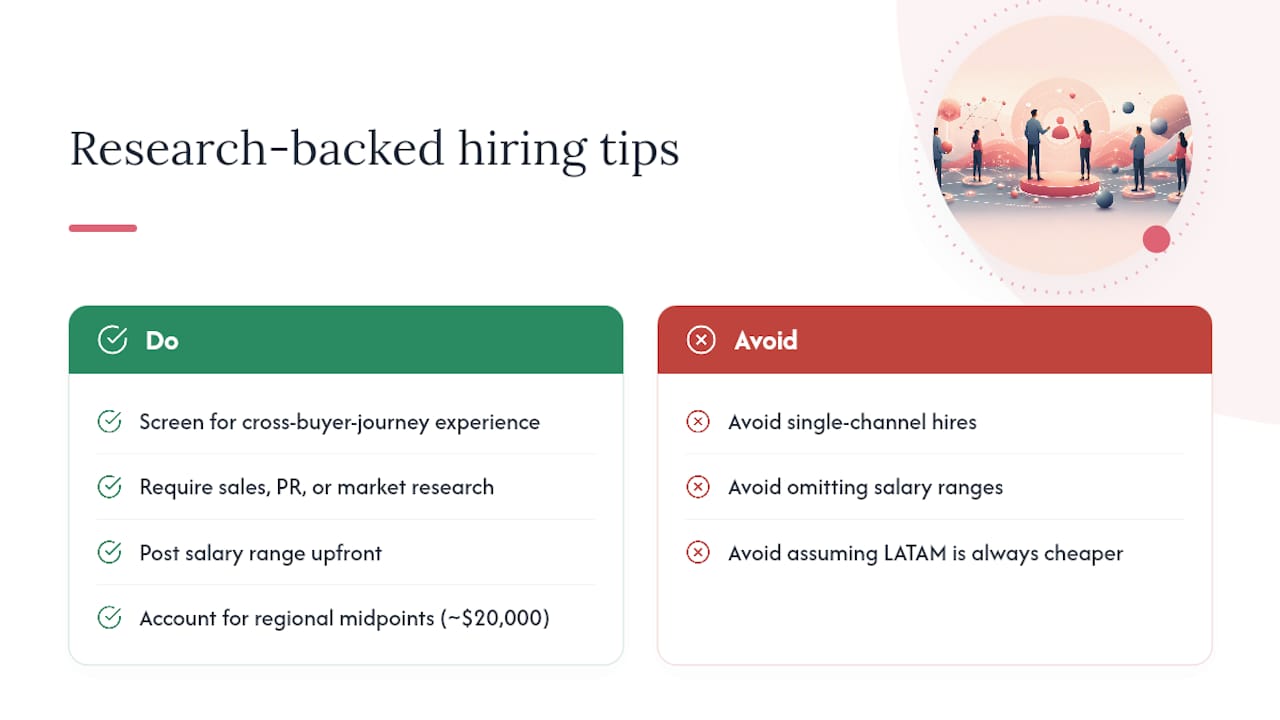
The BLS reports that marketing managers commonly hold a bachelor’s degree in business, communications, or a related field, and that prior experience in sales, public relations, or market research is a reliable predictor of readiness for manager-level marketing work. That career path signal is worth using in your screening: candidates who have worked across the buyer journey, not just inside one channel, tend to ramp faster.
On compensation, the salary data reinforces the case for transparent postings:
U.S. digital marketing manager salaries typically range widely depending on seniority and region, with regional differentials that can shift the midpoint by $20,000 or more depending on market. Posting the range upfront reduces time-to-offer and attracts candidates who are already aligned on expectations. — How to Hire a Digital Marketing Manager
For international or remote hiring, the same source notes that equivalent talent in Latin America may cost substantially less, though that trade-off involves time-zone overlap, legal entity requirements, and onboarding complexity that should be factored into the decision.
What most hiring guides get wrong about this process
The most common mistake isn’t a bad interview question. It’s writing a wishlist job description that asks for ten years of experience across six channels, then being surprised when the only applicants are either overqualified or inflating their resume to fit.
The second mistake is skipping the brief. Behavioral interviews reward confident storytelling. A paid brief rewards actual thinking. The candidate who gives a polished answer about a past campaign but stumbles on a realistic scenario for your business is telling you something important.
One check most guides omit: ask candidates, during the brief debrief, what they would stop doing in the first 90 days if they joined. The answer reveals whether they understand resource constraints and strategic focus, or whether they’re planning to add to an already overloaded roadmap.
On onboarding, AAMAX emphasizes giving new hires analytics access and a clear 30/60/90 plan from day one. The fastest-ramping marketing managers get their first data pull within the first week, not the first month.
Samssocialmediaclub makes it easier to find the right marketing hire
Posting a marketing manager role on a generic job board means sorting through hundreds of applications from candidates who don’t specialize in marketing or social media. Samssocialmediaclub is built specifically for marketing, social media, content, and communications roles, with every listing required to include a transparent salary range, so the candidates who apply already know what the role pays.
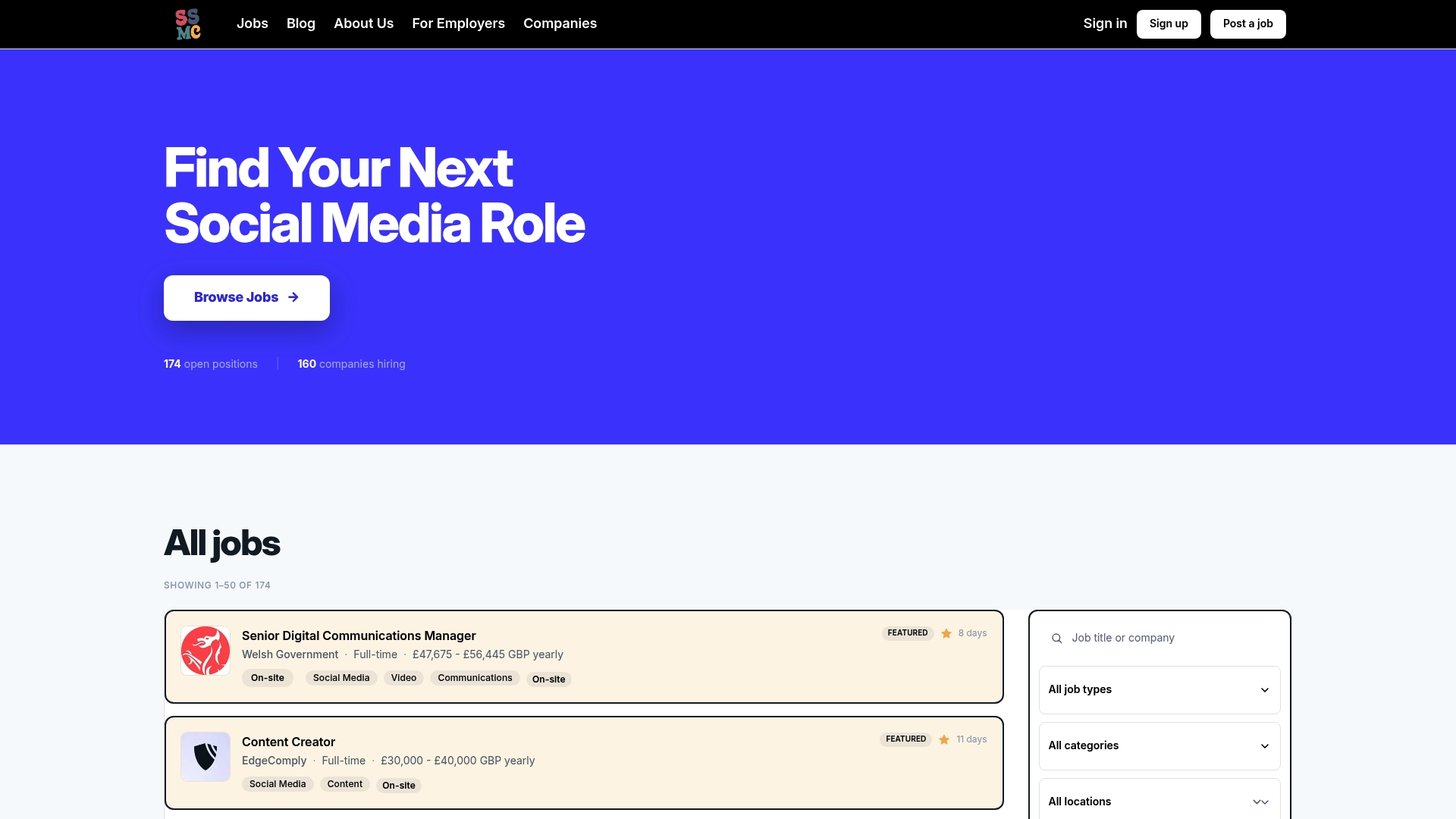
Employers get direct access to a curated pool of marketing professionals who are actively looking for roles in this space, without the noise of unrelated applications. The vetting process is designed to improve match quality, which means less time screening and more time evaluating candidates who actually fit. If you’re ready to post the role or want help sourcing candidates, submit your enquiry here and the team will walk you through the next steps.
Sources
These U.S.-focused resources are worth bookmarking for salary benchmarks, job description templates, and interview frameworks:
- Advertising, Promotions, and Marketing Managers – Occupational Outlook Handbook
- How to Hire a Digital Marketing Manager: Your Complete Guide
- How to Hire a Marketing Manager — Hiring Process & Timeline | HRHelperG
- Marketing Manager Job Description Template (Free)
- How to Hire a Digital Marketing Manager | AAMAX