
HR Teams: Calculate Salary Range Midpoint in 4 Spreadsheet Ready Steps

The salary range midpoint is the midpoint’s job in one sentence: it’s the dollar figure exactly between a role’s minimum and maximum pay, calculated as (minimum + maximum) ÷ 2, and it marks the target salary for someone fully proficient in the job. HR teams use it to anchor offers, raises, and pay equity checks. It’s a reference point built into your pay structure, not a promise or a ceiling on what any one person will earn.
TL;DR:
- The midpoint is an internal target salary, typically set as the average of the minimum and maximum pay for a role, not an external market figure.
- Misalignment between your pay range midpoint and the market median signals whether your ranges are outdated or overpaying, requiring regular benchmarking.
- The midpoint guides offer negotiations, raises, and pay equity checks, usually serving as the ideal offer point for capable hires.
- Designing effective pay ranges involves setting wider spreads for senior roles and narrower ones for entry-level positions, based on the target midpoint and organizational level.
- Tracking metrics like compa-ratio and range penetration helps assess if employees are paid fairly within the range, with a typical target between 90 and 110 percent of the midpoint.
Table of Contents
- Salary Midpoint vs. Market Median: Why They’re Not the Same Thing
- Why the Midpoint Matters for Hiring, Raises, and Pay Equity
- How to Calculate the Midpoint: Formula and Worked Example
- How Employers Design Ranges Around a Midpoint
- Compa-Ratio, Range Penetration, and Time to Midpoint
- Benchmarking: Keeping Your Midpoint Aligned with the Market
- How Salary Transparency Complements Midpoint-Based Pay
- What the Research Actually Supports, and Where Common Advice Falls Short
- Publish Transparent Salary Ranges and Attract Sharper Applicants
- Sources
- FAQ
Salary Midpoint vs. Market Median: Why They’re Not the Same Thing
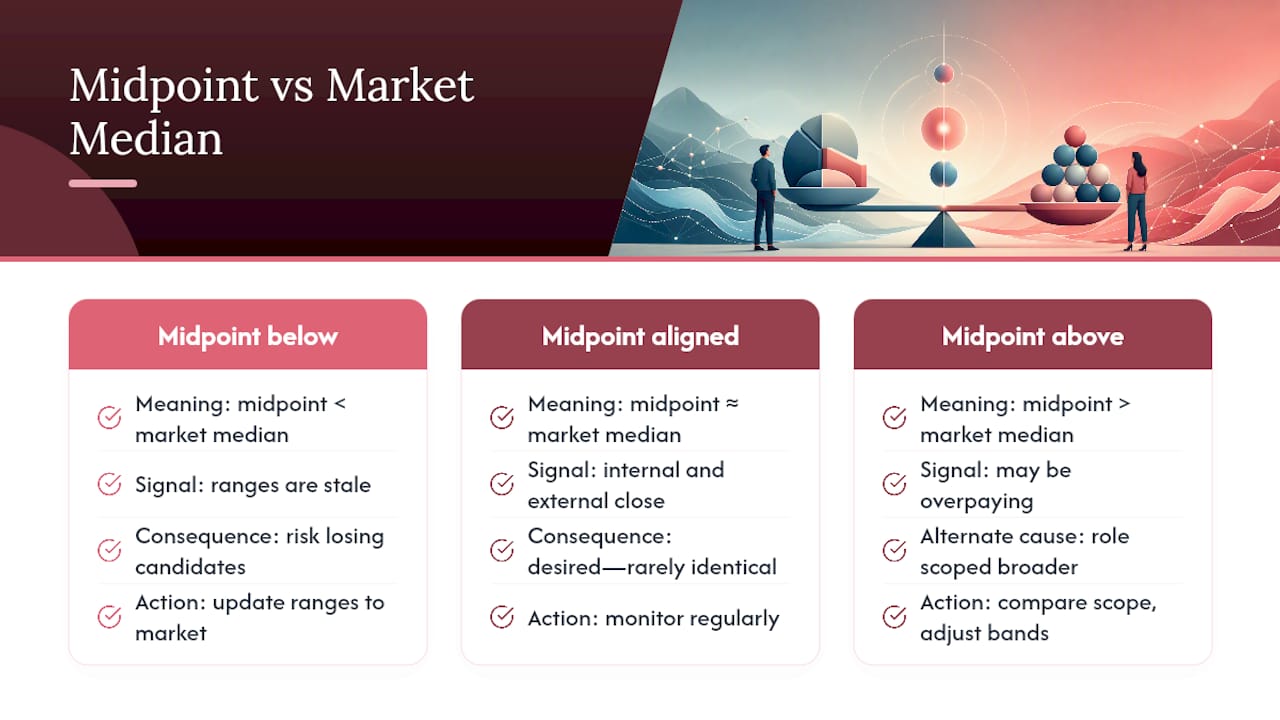
The salary midpoint definition matters because people conflate two different numbers. The midpoint is an internal figure: half of your salary range’s minimum and half of its maximum, set by whoever built your pay structure. The market median is external. It comes from a survey of what other employers actually pay for a comparable role, and it moves with the labor market whether or not your pay bands do.
You want these two numbers close together, though rarely identical. A midpoint sitting well below the market median usually signals your ranges are stale and you’re about to lose candidates to competitors. A midpoint sitting well above median might mean you’re overpaying relative to market, or it might mean your role is scoped more broadly than the survey benchmark assumes. Either way, the gap is the signal. Reconciling internal policy against external market data is a recurring task, not a one-time setup step.
Why the Midpoint Matters for Hiring, Raises, and Pay Equity
Midpoint earns its keep in three recurring decisions: setting a starting offer, deciding a merit increase, and checking whether pay is equitable across a team doing similar work.
For a fully proficient hire with solid but unremarkable experience, midpoint is usually the right anchor for an offer, not the minimum and not the maximum. New hires with less experience typically land below midpoint; specialists or long-tenured performers land above it. Merit budgets lean on midpoint too. A common approach ties higher raises to employees furthest below midpoint, since they’re the ones most underpaid relative to the job’s target value, while employees already above midpoint get smaller increases to avoid range compression.
A few things to keep straight when you’re applying this in practice:
- Midpoint is a target, not an entitlement. Nobody is owed midpoint pay just for tenure.
- Two employees in the same grade can sit at different points in the range for good reason, as long as you can explain why.
- If most of your team clusters near the minimum, your range may be underfunded relative to the work being done.
How to Calculate the Midpoint: Formula and Worked Example
The core salary midpoint calculation is simple enough to do in your head:
Midpoint = (Minimum + Maximum) ÷ 2
That’s the entire formula behind the salary midpoint calculator most compensation teams already use. Here’s how it plays out with real numbers.
- Set your range. Say a Content Marketing Manager role has a minimum of $65,000 and a maximum of $95,000.
- Add them together. $65,000 + $95,000 = $160,000.
- Divide by two. $160,000 ÷ 2 = $80,000. That’s your midpoint.
- Convert to hourly if needed. $80,000 ÷ 2,080 hours (a standard full-time year) comes out to roughly $38.46 an hour.
Range width tells you the spread: $95,000 minus $65,000 is $30,000, or about 46% of the minimum. Midpoint differential, the percentage gap between one grade’s midpoint and the next grade up, is what keeps promotions meaningful instead of cosmetic.
Pro Tip: Build these four numbers, minimum, midpoint, maximum, and range width, into one spreadsheet row per grade. When market data shifts, you only need to update two cells and the rest recalculates.
Free tools like online midpoint calculators will spit out midpoint, range width, and percentage-to-midpoint automatically if you’d rather skip the spreadsheet.
How Employers Design Ranges Around a Midpoint
Once you know the midpoint you want to hit, usually pulled from market data, you work backward to set the minimum and maximum. That backward math uses a spread percentage, and spreads widen as you move up the org chart.
- Entry-level roles typically have a narrower spread reflecting less variation by experience.
- Mid-level and specialist roles usually have a moderate spread reflecting increased variation.
- Senior and executive roles often have wider spreads, reflecting the broader range of responsibilities and experience these roles encompass.
The formulas, per Complogix’s compensation guidance, are:
Minimum = Midpoint ÷ (1 + spread/2)
Maximum = Midpoint × (1 + spread/2)
Midpoint differentials between grades, the percentage jump from one grade’s midpoint to the next, commonly run 8 to 12%. A jump much smaller than that makes promotions feel meaningless on the paycheck; much larger, and you risk pay compression complaints from people just below the line.
Compa-Ratio, Range Penetration, and Time to Midpoint
Three metrics tell you where someone actually sits relative to the target, and each answers a slightly different question.
- Compa-ratio = (Employee salary ÷ Midpoint) × 100. A compa-ratio between 90 and 110 is the typical target band; below 80 usually flags a retention risk, above 120 flags an overpay concern.
- Range penetration = (Employee salary − Minimum) ÷ (Maximum − Minimum) × 100. This tells you how far into the full range someone has progressed, which is a useful complement to compa-ratio because it accounts for range width, not just distance from center.
- Time to midpoint tracks how many years it typically takes a new hire to progress from starting salary to the midpoint.
That timeline varies, but many HR sources put the typical range at roughly 3 to 5 years, shaped heavily by review frequency, performance ratings, and how much responsibility the role picks up along the way.
Pro Tip: Run compa-ratio and range penetration side by side once a year. If they tell wildly different stories for the same employee, your range width is probably too wide for the grade.
Benchmarking: Keeping Your Midpoint Aligned with the Market
Paid compensation surveys are the gold standard for a defensible midpoint, especially for specialized marketing and communications roles where public data is thin; using the best marketing attribution tools for marketing teams can help refine these benchmarks. Where budget doesn’t stretch to a paid survey, government occupational wage statistics and large public salary datasets are a reasonable, documented starting point, provided you label them as provisional rather than final.
Review your midpoints at least once a year. In a volatile hiring market, quarterly spot checks on the roles you’re actively recruiting for catch drift faster. When your internal midpoint has clearly fallen behind the market, don’t try to fix it purely through new-hire offers. Adjust the range itself, then use compa-ratio data to figure out which existing employees need a correction first.
How Salary Transparency Complements Midpoint-Based Pay
Publishing a midpoint, or at least a defined range, in a job advert closes the gap between what candidates expect and what the role actually pays. It also cuts negotiation time considerably, since both sides start from the same number instead of guessing. Sam’s Social Media Club built its listings around this idea for marketing, content, and communications roles specifically, where pay ranges have historically been vague to the point of uselessness. For HR teams hiring into these fields, stating the grade and range upfront, not just a single number, gives candidates enough context to self-select accurately.
What the Research Actually Supports, and Where Common Advice Falls Short
Most compensation guidance treats the midpoint like a finish line: get someone there, and the job’s done. That framing is backward. The midpoint is more useful as a diagnostic than a destination. If your compa-ratios cluster tightly around 100 across an entire department, that’s not proof of fair pay. It might mean your ranges are too narrow to reward the genuine difference between someone in their first year and someone in their fifth.
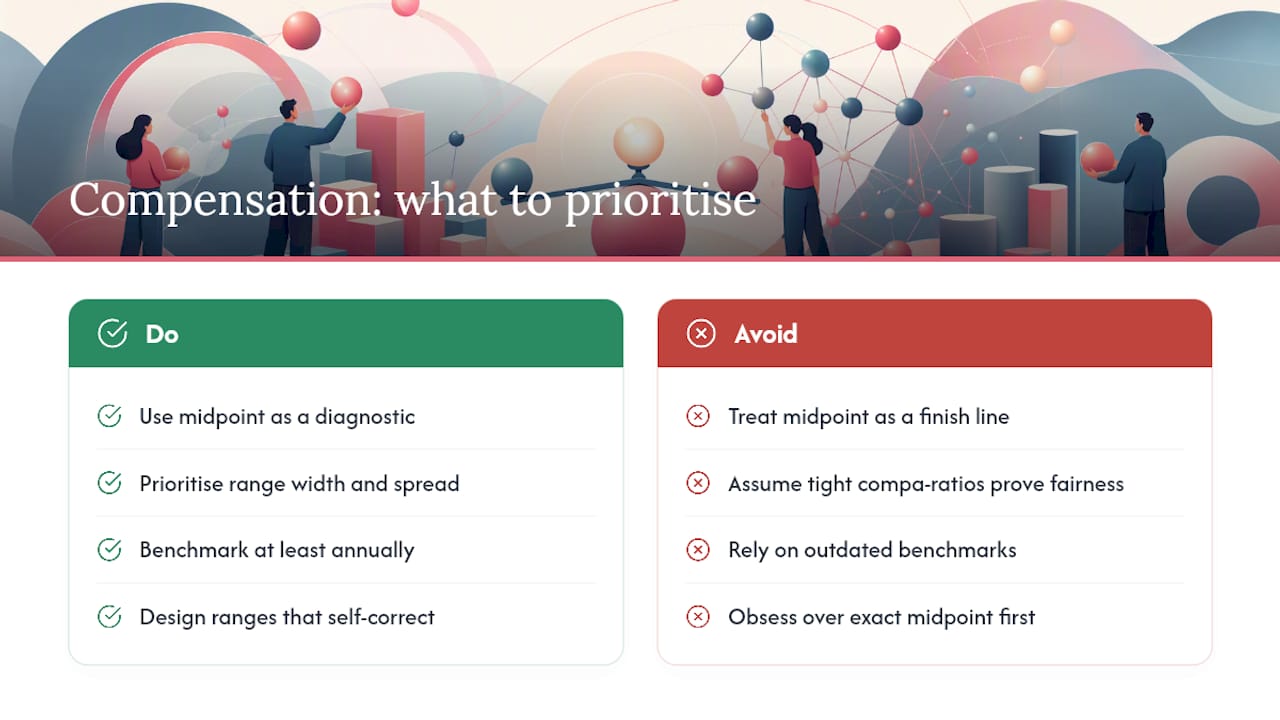
The conventional advice also underrates how fast midpoints go stale in fields like social media and content marketing, where the skill set itself shifts every couple of years. A midpoint benchmarked against 2023 survey data for a “Social Media Manager” role may already be misaligned with what that job actually demands today. Annual benchmarking is the floor, not the ceiling, for roles evolving this quickly.
If you take one thing from this, prioritize getting the range width and spread right before you obsess over pinpointing the exact midpoint dollar. A slightly-off midpoint on a well-designed range self-corrects over a few review cycles. A precise midpoint bolted onto a range that’s too narrow or too wide creates problems no amount of recalculating will fix.
— Sam
Publish Transparent Salary Ranges and Attract Sharper Applicants
Some job boards are built around the idea that candidates apply faster and negotiate less when they can see the grade, range, and midpoint before they click apply. Listings that require transparent pay details can help applicants self-select against real numbers rather than guesses.

That matters most in marketing, content, and social media hiring, where job scope varies wildly from one company to the next and a vague listing wastes everyone’s time. If you’ve just worked through the calculations above, you already have the midpoint and range you need. Post it directly rather than burying it, and let the applicant pool sort itself before your inbox fills up. Employers ready to list a role with a clear, calculated range can submit a job through the enquiry page and start receiving matches built around the numbers you’ve already set.
Sources
- Salary Midpoint: Definition and How To Calculate
- How to Make Sure You Are Internally Equitable by Using the Salary Midpoint Calculator
- Salary Range Calculator: Min, Max, Midpoint & Compa-Ratio
- Salary Midpoint Calculator - Determine Fair Pay Ranges
FAQ
How long does it take to reach midpoint salary?
Most estimates put it at roughly 3 to 5 years, depending on performance ratings, review frequency, and how quickly the role’s responsibilities grow.
How do you calculate the midpoint of a salary range?
Add the minimum and maximum together and divide by two: Midpoint = (Minimum + Maximum) ÷ 2. A $65,000 to $95,000 range gives a midpoint of $80,000.
What should I put as a salary range in a job posting?
List the full grade range with the midpoint clearly identifiable, rather than a single number, since it lets candidates gauge fit immediately. Some job listing platforms require this kind of transparent salary range listing for exactly that reason.
What’s the difference between salary midpoint and compa-ratio?
Midpoint is the target dollar figure for a fully proficient employee; compa-ratio measures where an individual’s actual salary sits relative to that midpoint, expressed as a percentage.
Why doesn’t my company’s midpoint match market salary surveys?
A mismatch usually means your pay structure hasn’t been benchmarked recently. Review midpoints against current market survey or public wage data at least annually to close the gap.