Hire Faster: Social Media Manager Job Description Kit for Employers

A social media manager owns audience growth, brand voice, community response, and the reporting that ties all three to business goals. According to the National Careers Service, the role spans content creation, paid promotion, and performance tracking, while the CIPD recommends setting the level and scope before writing the job description. Sam's Social Media Club exists to help employers find candidates who already understand that scope.
TL;DR:
- Effective social media managers must own strategy and outcomes, including platform selection, KPI setting, and crisis response, not just daily content posting.
- Seniority should reflect scope; junior roles handle execution and reporting, mid-level own platform strategy and campaigns, while seniors set overall direction and budgets.
- Clear role design involves outcome-based responsibilities, explicit task ownership, and a published salary range to attract relevant candidates.
- To improve hiring quality, use curated niche platforms, transparent pay details, practical assessments, and structured interview scoring rather than general job boards alone.
- Restrict the role's scope to prevent burnout and scope creep, clearly define escalation authority, and align KPIs with business metrics to prove true ROI.
Reach quality social media talent. Sam's Social Media Club connects employers with curated candidates across social media, content, marketing, and communications roles. Advertise a role
Table of Contents
- What is the purpose of the social media manager role?
- What are the key responsibilities and daily tasks?
- What skills and experience should candidates bring?
- How do junior, mid-level, and senior roles differ?
- How should you set salary and benefits for the role?
- Where should you look for candidates and how should you screen them?
- How do you write a clear, ready-to-use job description?
- How does Sam's Social Media Club support the hiring process?
- What does career progression look like in this role?
- What are the common challenges in this role and how do you address them?
- What tools and platforms does the role typically use?
- A short note on realistic role design
- Advertise your open role with Sam's Social Media Club
- Sources
- FAQ
What is the purpose of the social media manager role?
The role sits between marketing strategy and daily execution. A social media manager is measured on audience growth, consistent brand voice, responsive customer care, and outcomes that connect back to revenue, leads, or brand awareness targets. That last part matters: a candidate who can post consistently but cannot explain how a campaign moved a business metric is only doing half the job.
Reporting lines vary by company size. In smaller teams, the role reports to a marketing director and works alongside customer service and product on messaging. In larger organisations, it often sits inside a broader marketing or communications function with dedicated liaisons for PR and paid media.
The clearest hiring mistake is blurring strategy with production. A social media manager should own:
- Strategy and accountability: platform selection, content pillars, KPI targets, crisis response protocol.
- Delegated production: day-to-day posting, asset creation, and community replies, which can sit with a coordinator or freelancer.
Separating these two layers early prevents the role from collapsing into a content-only position with strategic expectations attached.
What are the key responsibilities and daily tasks?
A usable job description lists responsibilities in order of weight, not as a flat wish list. Use this as a starting checklist and trim to match your team's actual structure.
- Plan and manage the content calendar across the platforms relevant to your audience, coordinating with design and copy resources.
- Set up and monitor paid social campaigns, including budget pacing and audience targeting.
- Moderate community activity, tracking sentiment and escalating anything that touches brand reputation or legal risk.
- Own analytics and reporting, translating platform metrics into decisions that adjust content or spend.
- Brief other teams, requesting assets from design, coordinating messaging with PR, and flagging customer issues to support.
The Skills England occupational framework for digital community management treats moderation, escalation, and reporting as distinct formal skills rather than side tasks, which is worth reflecting in how you weight this list.
Pro Tip: List responsibilities as outcomes ("grow qualified leads from social by a stated target") rather than tasks ("post three times a day") so performance reviews have something concrete to measure.
What skills and experience should candidates bring?
Split the person specification into what a candidate must already have and what you can teach on the job. Hard skills include running paid campaigns on platforms like Meta Ads Manager or LinkedIn Campaign Manager, reading analytics dashboards, working with scheduling tools such as Hootsuite or Buffer, writing a basic creative brief, and understanding how search behaviour affects social discovery. Soft skills matter just as much: clear written communication, the organisational discipline to run a content calendar without missing deadlines, sound judgement under pressure during a public complaint or crisis, and the ability to push back on stakeholders who want everything posted immediately.
Verification beats a strong CV. Ask for:
- A portfolio walkthrough where the candidate explains the strategy behind three past posts or campaigns, not just the results.
- A short practical test, such as drafting a week's content calendar for a sample brand brief.
- Reference questions that probe how the candidate handled a real crisis or an underperforming campaign.
Sprout Social's hiring guidance makes the case directly: assess strategic thinking and measurable outcomes through practical scenarios, not portfolios alone, since a polished feed says little about whether someone can defend a decision with data.
How do junior, mid-level, and senior roles differ?
Seniority should track scope, not just years worked.
- Junior: executes an existing content calendar, handles day-to-day posting and basic community replies, and reports metrics upward rather than setting targets.
- Mid-level: owns the content strategy for one or two platforms, runs paid campaigns within an agreed budget, and manages a freelancer or coordinator.
- Senior: sets the overall social strategy, owns the budget and KPI targets, manages escalations that touch brand reputation, and reports results to leadership.
When one person is asked to do all three simultaneously, either the strategy suffers or the daily output does. Splitting production into a separate coordinator or freelance role, as covered in our guide to freelance social media manager hiring, often solves this without adding a full headcount.
How should you set salary and benefits for the role?
Publishing a real salary range, rather than "competitive salary," shortens time to hire and filters out mismatched applicants before they apply. Our pay data for social media and marketing roles breaks pay down by level and can be used as a starting reference point when setting a range for your own listing.
Transparent salary ranges reduce wasted applications and speed up screening, which is the reasoning behind Sam's Social Media Club's mandatory salary-transparency policy on every listing it carries.
Beyond base pay, the benefits that tend to attract strong candidates for this role include:
- Flexible working hours, since social platforms are active outside standard office time.
- A dedicated training or courses budget, given how often platform algorithms and ad formats change.
- A tools budget covering scheduling software, design licences, and paid ad spend the manager controls directly.
For more on which benefits to name, see the six benefits every job ad should name.
Where should you look for candidates and how should you screen them?
Sourcing channels break into four types worth combining rather than choosing between:
- General job boards for broad reach across jobseekers not actively targeting this niche.
- Curated, niche-specific boards such as Sam's Social Media Club, where every listing carries a published salary and applicants are pre-screened for relevance.
- LinkedIn and professional networks, useful for sourcing candidates with visible portfolios and endorsements.
- Referrals and community groups, often the fastest route to a candidate who already understands your industry.
Once applications come in, a consistent screening sequence keeps the process fair and fast:
- Quick role-fit check against the must-have criteria in the job description.
- Portfolio triage, filtering for strategic thinking rather than polish alone.
- A short practical task, such as briefing a one-week content plan for a sample scenario.
- Structured interview scoring against a fixed rubric rather than open impressions.
Our interview questions and hiring rubric covers sample questions and scoring criteria you can apply directly at the interview stage.
How do you write a clear, ready-to-use job description?
Start with the level, not the task list. CIPD's role-design guidance recommends fixing the role's level and purpose first, then building responsibilities and criteria around that decision, which avoids the common trap of writing a job description that lists every possible social media task regardless of seniority.
A working template needs these sections:
- Role summary: one or two sentences on purpose and level.
- Key responsibilities: five to seven outcome-based bullets, ordered by weight.
- Essential criteria: skills and experience the candidate must already have.
- Desirable criteria: skills you can develop after hiring.
- Reporting line and team structure.
- Salary range and benefits.
- Application instructions, including any practical test.
Two short summary examples show the level difference in practice:
- Junior: "Executes the content calendar across two social platforms, handles daily community replies, and reports weekly performance to the marketing manager."
- Senior: "Owns social strategy and budget across all platforms, sets and reports against quarterly KPIs, and leads escalation response for reputation-sensitive issues."
Before publishing, check the draft against a short clarity list:
- Does each responsibility describe an outcome rather than a task?
- Is the seniority level obvious from the responsibilities alone, without reading the job title?
- Have you removed language that would only make sense for a completely different level?
How does Sam's Social Media Club support the hiring process?
Sam's Social Media Club curates listings for social media, content, marketing, and communications roles and requires a published salary range on every post. Employers write the job description, post it, and receive applications from candidates who have already seen the actual pay and role scope, which cuts down on mismatched applications before screening even starts.
The platform's value for hiring managers comes down to three things:
- Curated listings filtered for relevance to social and marketing roles specifically.
- Mandatory salary transparency, so candidates self-select based on real numbers.
- Direct application access, meaning employers see interest from candidates who already understand the role rather than mass-apply traffic.
What does career progression look like in this role?
Most social media managers move up through a fairly consistent path: coordinator or assistant, to social media manager, to senior manager or head of social, and from there into broader marketing leadership such as head of marketing or communications director. The National Careers Service profile notes that progression commonly leads into senior marketing or communications roles once a candidate has built up strategic and budget-management experience.

The jump from mid-level to senior is usually the biggest one, since it requires shifting from running campaigns to setting the strategy and owning the budget that funds them. Some social media managers branch sideways into content strategy, brand marketing, or PR, since the skill set overlaps heavily with all three. Others move into specialist paid social or community management tracks rather than staying generalist, particularly at larger organisations where those functions are split out.
For employers, this means retention often depends on giving a mid-level hire a visible next step, whether that is more budget ownership, a direct report, or a defined path to the senior title. A role with no progression attached tends to lose good hires within a couple of years, since the skill set transfers easily to competitors offering more scope.
What are the common challenges in this role and how do you address them?
The most persistent challenge is scope creep: a role advertised as "social media manager" that quietly absorbs graphic design, copywriting, customer service, and paid media because no one else owns those tasks. The fix starts at the job description stage, by naming exactly which tasks the role owns outright and which it coordinates with other teams.
Crisis response is the second recurring pressure point. A negative comment or complaint that goes public needs a fast, judged response, and job descriptions rarely spell out who has the authority to respond without escalation. Stating escalation authority clearly, as the Skills England framework for digital community roles recommends, removes the guesswork during an actual incident.
Burnout from constant availability is common too, since social platforms do not stop outside office hours. Setting clear expectations around after-hours monitoring, and building in coverage for holidays and weekends, keeps this sustainable rather than assuming one person will always be watching.
Finally, proving return on investment remains a sticking point in many organisations. A manager without clear KPIs tied to business goals ends up defending vanity metrics like follower counts instead of outcomes leadership actually cares about. Fixing this goes back to the job description again: define the metrics that matter before the role starts, not after a budget review goes badly.

What tools and platforms does the role typically use?
Day-to-day work usually spans four categories of tools. Scheduling and publishing platforms such as Hootsuite or Buffer handle the calendar and posting workload the National Careers Service profile describes as core to the role. Native ad managers, including Meta Ads Manager and LinkedIn Campaign Manager, run the paid promotion side and budget pacing.
Analytics sits on top of both: platform-native insights combined with a dedicated tool like Sprout Social give the manager the reporting layer needed to tie content decisions back to business metrics. Design tools, most commonly Canva or Adobe Creative Cloud, cover lighter asset production when a dedicated designer is not briefed in.
For paid campaign strategy specifically, agencies sometimes bring in outside expertise; resources on audience targeting and campaign optimisation can be useful context when a job description needs to define how much paid media expertise the role should carry versus what gets outsourced.
A short note on realistic role design
The biggest mistake in these job descriptions is hiring for a unicorn: strategist, designer, copywriter, and community manager in one person, at one salary. Generalists work well for small teams with a narrow scope. Once a brand needs consistent paid performance and fast crisis response, specialists earn their cost.
Write the job description around outcomes, not a task list, and the right candidate becomes obvious.
— Sam
Advertise your open role with Sam's Social Media Club
Every listing on Sam's Social Media Club carries a published salary range and goes through a curated review before it reaches candidates, which means the applications you receive have already seen the real pay and scope of the role.
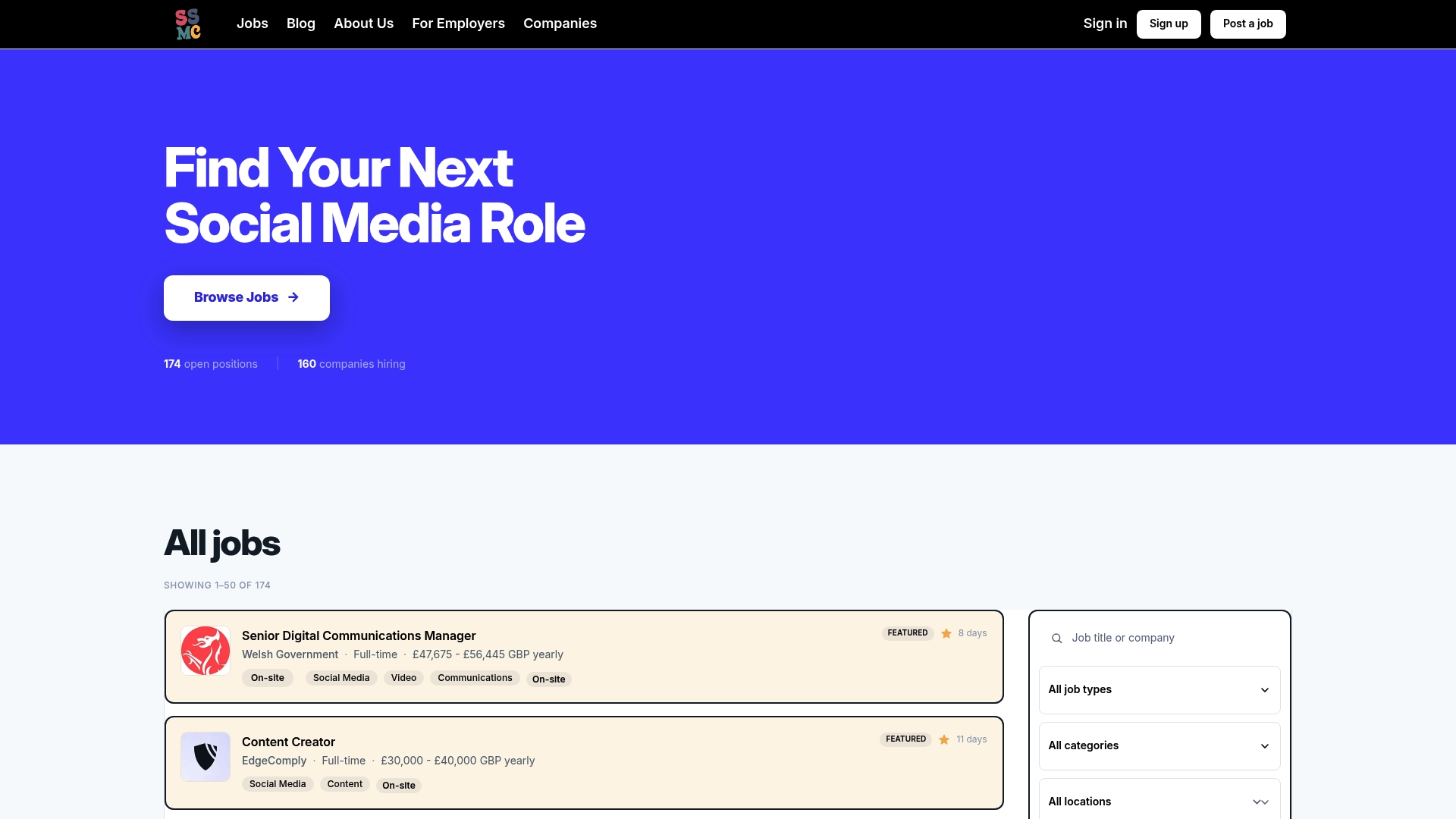
That matters most for teams that have struggled with high volumes of mismatched applicants from general job boards. If you are hiring a social media manager, content lead, or communications specialist and want applicants who already understand what the role pays and involves, posting through Advertise with SSMC or the SSMC SUPER listing tier gets your role in front of a targeted, relevant audience. Pricing and details are available on the pricing page, and for a bespoke hiring request, reach out through the enquiry page.
Sources
- Social media manager | Explore Careers | National Careers Service
- Digital community manager / Skills England
- How to use the Profession Map for role design | CIPD
- Social media manager job description: Tips and templates for 2026 | Sprout Social
FAQ
What is the 5 5 5 rule for social media?
Definitions vary across marketing sources, and there is no single official version tied to a named framework. In practice it is usually described as a habit of engaging with five posts, following five new accounts, and commenting on five posts daily to build platform presence, though this is a common convention rather than a formal standard.
What skills do you need to become a social media manager?
Core skills include content planning, paid campaign management, analytics, and clear written communication, alongside the organisational discipline to run a content calendar under deadline pressure. The National Careers Service also lists creativity, commercial awareness, and the ability to work under pressure as key requirements.
What is the average salary for a social media manager?
Pay varies by seniority, industry, and location, so there is no single figure that applies everywhere. Our pay data breakdown covers ranges by level and is a more useful reference than a single average figure.
What are the core pillars of social media marketing?
Common frameworks group the work around strategy, content creation, community engagement, paid promotion, and analytics, though exact groupings vary between sources. What matters more for hiring is that a job description assigns clear ownership across these areas rather than leaving them undefined.
How is a social media manager different from a content creator?
A social media manager owns strategy, analytics, community response, and brand voice, while a content creator focuses primarily on producing the content itself. Sprout Social's hiring guidance treats this ownership boundary as the practical dividing line between the two roles.