£500–£1,500: Hire a Social Media Manager with UK Pricing Rubrics

Most small and mid-sized businesses should hire an experienced freelancer or a small specialist agency before considering an in-house role, since it delivers professional output without the overhead of a full salary. Expect a working budget of roughly £500 to £1,500 per month for genuinely managed accounts, not just scheduled posts. That range buys strategy, content creation, and reporting, and it scales up cleanly once you know what results you need.
TL;DR:
- Hiring an experienced freelancer or small agency provides a cost-effective way to manage social media without the overhead of a full-time employee, with budgets around £500 to £1,500 per month for managed accounts.
- Content strategies, reporting, and platform-specific production require clear scope and often influence pricing tiers, ranging from basic posting to full campaign management.
- Speed to value favours freelancers and agencies, as they can usually start delivering content within one to two weeks, compared to four to eight weeks for in-house hires.
- When evaluating candidates, focus on campaign results, reporting ability, and platform experience, especially for short-form video on TikTok and Instagram versus evergreen posts for LinkedIn or Facebook.
- Proper vetting, transparent communication, and a structured hiring process are essential to avoid common mistakes like vague briefs, under-budgeting, and superficial candidate assessments.
Find better social media talent. Post your role where social media, content, marketing and communications people already look, with the salary shown upfront. Advertise a role
Table of Contents
- Comparing hiring routes: freelancer, agency, in-house, or hybrid
- What a social media manager actually does
- Skills, experience, and portfolio evidence to look for
- Cost expectations and pricing tiers
- Step-by-step hiring process: from brief to onboarding
- Vetting, privacy, and legal basics for social media checks
- Evaluation toolkit: interview questions, test tasks, and scoring
- Common hiring mistakes and how to fix them fast
- How Sam's Social Media Club helps you hire faster
- Sources
- FAQ
Comparing hiring routes: freelancer, agency, in-house, or hybrid
The right route depends on how much control you want, how fast you need results, and how much internal time you can spare to manage the relationship.
A freelancer works well when you need flexible capacity and a single point of contact. You get direct communication and lower overhead, but coverage can be thin if that person is sick or overbooked, and you rely on one person's range of skills.
An agency suits businesses that want a full team behind the account: strategists, designers, and often paid media specialists in one package. Agencies cost more but reduce key-person risk. Some general digital agencies handling web, SEO, and social together, such as BasicBS, bundle social media into a wider digital service. This can suit businesses that want one supplier for everything.

An in-house hire gives you the deepest brand knowledge and the fastest internal feedback loop, but it carries full salary, benefits, and management costs, and it takes the longest to become productive.
A hybrid model, an in-house coordinator supported by a freelance content creator or a part-time agency retainer, often gives the best balance for growing businesses.
- Freelancer: best for lean budgets and fast starts; risk is limited backup capacity.
- Agency: best for full-service delivery and paid media; higher monthly cost.
- In-house: best for deep brand alignment; slowest to ramp up and most expensive overall.
- Hybrid: best for businesses scaling content while keeping strategic control internal.
Speed to value tends to favour freelancers and agencies, since both can start producing content within one to two weeks of signing, while an in-house hire usually needs four to eight weeks between advertising the role and onboarding.
What a social media manager actually does
A social media manager's job splits into daily execution and longer-term strategy, and confusing the two is a common reason briefs go wrong.

Day-to-day work includes writing captions, scheduling posts, responding to comments and messages, and monitoring performance dashboards. Strategic work includes setting content pillars, planning campaigns around business goals, briefing designers or videographers, and adjusting approach based on what the data shows.
Expect these deliverables from a properly briefed hire:
- A content calendar covering at least four to six weeks ahead.
- A consistent posting cadence matched to each platform's audience behaviour.
- Monthly reporting tied to agreed KPIs, not just vanity metrics like follower count.
- Campaign briefs for any paid promotion or product launch tie-in.
Platform nuances matter more than many employers expect. Short-form video for TikTok or Instagram Reels needs a different production rhythm and editing skill set than evergreen posts for LinkedIn or Facebook, and a manager strong in one is not automatically strong in the other. Ask candidates which platforms they have actually grown, not just posted to.
Skills, experience, and portfolio evidence to look for
Judge candidates on evidence, not job titles. A polished portfolio deck means little without numbers behind it.
- Ask for campaign results, not just screenshots: engagement rate, follower growth over a defined period, or conversion data from a linked campaign.
- Check reporting samples to see whether they explain what worked and why, not just what happened.
- Test written communication directly, since captions, community replies, and client updates all depend on it.
- Confirm brand fit by asking how they would adapt tone for your specific audience, not a generic one.
- Watch for vague answers about results, reluctance to share real client work, or an inability to explain a metric they claim to have improved.
Pro Tip: Ask every candidate to walk you through one campaign that underperformed and what they changed. How they answer tells you more than any highlight reel.
Cost expectations and pricing tiers
Budget should match the deliverables you actually need, not a flat industry guess. UK-aligned pricing generally breaks into four tiers.
| Tier | Typical monthly range | Example deliverables |
|---|---|---|
| Posting only | From about £250 | Scheduled posts, no strategy or reporting |
| Managed | £500 to £1,500 | Content calendar, strategy, community management, monthly reporting |
| Premium | Around £1,500 and up | Strategy, video production, campaign planning |
| Enterprise | £3,000 or more | Full-service team, paid media integration, multi-platform coverage |
These bands come from current UK pricing research, which found posting-only packages starting around £250 per month and full-service packages with strategy and video commonly starting near £1,500 and rising past £3,000 for larger scopes.
Freelancers typically price by the hour or by monthly retainer, and both models are common depending on scope:
- Hourly rates commonly sit in a moderate range depending on experience and specialism.
- Monthly retainers usually correlate with the managed or premium tiers above, depending on hours committed.
- Ad management is usually billed separately from content work, often as a percentage of ad spend or a flat monthly fee.
- Production costs (photography, video editing, paid stock) are frequently quoted as extras, not included in a base retainer.
Before agreeing a number, get a written scope: platforms covered, posts per week, whether community management is included, and who owns ad spend reporting. A cheap quote that excludes reporting or community management often costs more once you add those back in.
Step-by-step hiring process: from brief to onboarding
A structured process cuts down on wasted interviews and gives you a paper trail if a hiring decision is ever questioned.
- Write a brief with measurable objectives: define which platforms matter, what success looks like in three months, and what budget tier you're targeting.
- Source candidates across a mix of channels: a specialist job board, a freelancer network, or a shortlist from a digital agency such as Setworks if you're considering an agency route.
- Screen applications against your brief, not against generic experience, and shortlist no more than five to seven candidates.
- Set a short, paid test task, such as a content plan for one week across two platforms, and give every candidate the same brief and time allowance.
- Interview using a consistent rubric so answers are comparable across candidates rather than judged on gut feel.
- Make an offer that specifies scope, deliverables, reporting frequency, and notice period before either side signs anything.
- Onboard with a documented handover: brand guidelines, platform access, past performance data, and a first 30-day plan.
A useful brief template borrows structure from a marketing manager hiring guide, which maps closely onto social hiring: objectives first, deliverables second, budget third.
When drafting the role itself, a freelance social media manager job description template helps set expectations around scope and seniority before you post anything.
- Contract terms worth pinning down: notice period, ownership of content and passwords, confidentiality, and payment terms.
- Negotiation should focus on scope, not just price: trading a lower rate for fewer deliverables is fairer than quietly cutting hours.
- A realistic timeline runs two to four weeks from posting to offer for a freelancer, and six to eight weeks for a permanent in-house hire.
Vetting, privacy, and legal basics for social media checks
Checking a candidate's public social media presence is common, but it carries real legal exposure if done carelessly.
The ICO's guidance on pre-employment vetting states that employers must justify social media screening as necessary and proportionate to the role, and that checks should be transparent to the candidate. The person conducting the check should not be the same person making the hiring decision, which reduces both bias and legal risk.
A defensible screening policy separates roles, stages the check appropriately, and documents the reason for every check performed, according to employer legal guidance on social media screening, which also notes that checks carry risk under UK GDPR and the Equality Act if handled inconsistently.
Practical rules to follow:
- Only check what's relevant to the role; a general browsing exercise is not defensible.
- Time checks later in the process, ideally after interviews or at conditional offer stage, to avoid early bias.
- Limit who sees screening results and keep that group separate from decision-makers.
- Delete screening data promptly once a hiring decision is made.
Evaluation toolkit: interview questions, test tasks, and scoring
Consistency is what makes hiring decisions defensible and fair, and it starts with using the same instrument for every candidate.
- Ask each candidate to describe a campaign they'd change if they ran it again, since this reveals how they learn from results.
- Use a short, time-boxed test task, such as a 90-minute content plan for two platforms, scored on clarity, creativity, measurability, and channel fit rather than production polish.
- Score portfolios against a fixed rubric: results evidence, writing quality, platform range, and reporting clarity.
- Check references by asking specifically about reliability and communication, not just general impressions.
A full interview question set and scoring rubric gives you a structure to run this consistently across every candidate, rather than improvising each time.
Common hiring mistakes and how to fix them fast
The three mistakes I see most often are a vague brief, under-budgeting for the scope requested, and skipping proper vetting because the candidate "seems great."
A vague brief produces vague candidates: fix it by defining platforms, cadence, and a three-month success metric before you post the role. Under-budgeting shows up fast when a cheap hire can't deliver strategy or reporting, so match your tier to your actual deliverables from the start. Skipping vetting because someone interviews well is the costliest shortcut of all. A consistent rubric and a documented screening process catch problems an interview alone will not.
— Sam
How Sam's Social Media Club helps you hire faster
Finding candidates who already understand social media, content, and salary expectations upfront saves weeks of back-and-forth. Sam's Social Media Club is a curated job board built specifically for social media, content, marketing, and communications roles, with salary information in every listing, so applicants know what the role pays before they apply.
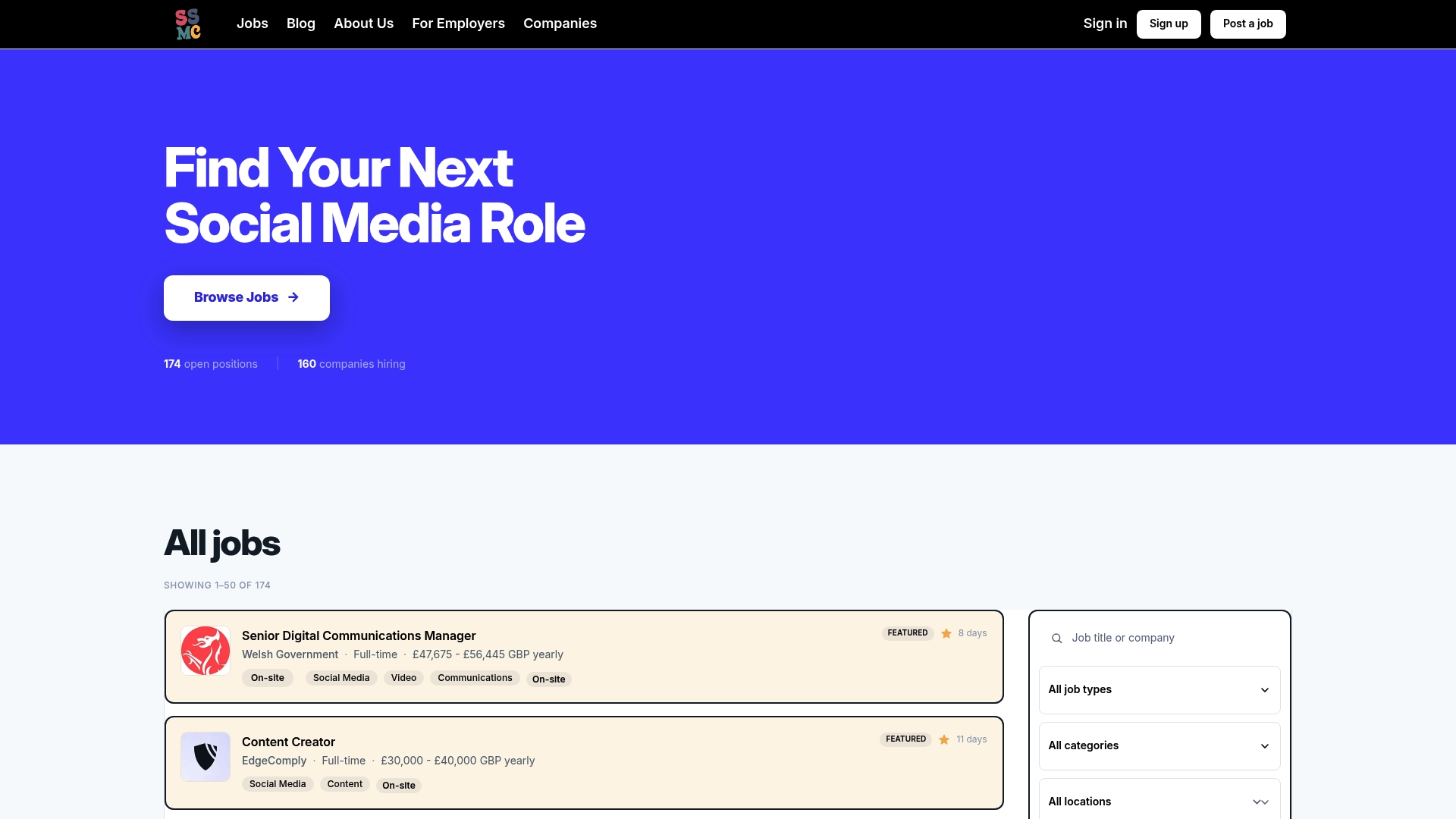
That transparency tends to attract candidates who are serious about the role rather than casting a wide net, and curation cuts down the mismatched applications you have to sift through. If you're ready to hire, advertise with SSMC to see current listing options, or send an enquiry if you want to talk through the best fit for your role first.
Sources
- Avoid overpaying: UK social media pricing (Hook Digital, 2026)
- Pre-employment vetting of candidates | ICO
- Social Media Screening UK: 2026 Employer Legal Guide (DavidsonMorris)
FAQ
How much does it cost to hire a social media manager?
Managed social media accounts commonly cost between £500 and £1,500 per month in the UK, while posting-only packages can start from about £250 per month. Premium packages with strategy and video production typically start around £1,500 and can rise past £3,000 for enterprise-level scope.
Is hiring a social media manager worth it?
It's worth it when the role is scoped against clear business goals, since unclear objectives are the main reason social media spend feels wasted. A properly briefed hire, whether freelance, agency, or in-house, gives you consistent content, reporting, and strategic direction that ad hoc internal posting rarely delivers.
What is the 5 5 5 rule on social media?
Definitions of this rule vary across sources, so treat any specific version with some caution. A common version suggests sharing five posts, commenting on five accounts, and engaging with five pieces of content daily, though no single authoritative source fixes this as a standard.
How much do you pay a social media manager per hour?
Freelance hourly rates vary widely depending on experience and specialism, with no single fixed industry rate. Rather than relying on quoted hourly figures alone, compare candidates using a short paid test task to judge output speed and quality directly.