
Hiring Managers: Social Media Interview Questions, Rubric & Paid Task
The right social media interview questions fall into six categories: strategy and attribution, metrics literacy, content and creative judgment, tool and AI fluency, crisis response, and culture fit. Ask candidates to walk through real scenarios in each one, then score every answer against a shared rubric. Pair that with a short paid practical task, and you’ll cut past the polished talking points that make weak hires sound strong. Transparent salary listings tend to draw candidates who are already past the “what does this pay” filter, which speeds up everything that follows.
TL;DR:
- Strategy and attribution questions should focus on real scenarios, emphasizing understanding of campaign tracking, attribution models, and upper-funnel activity.
- Candidates at all levels should demonstrate increasing ownership, from task descriptions for juniors to decision-making and trade-offs for seniors.
- A structured, multi-stage interview process and a paid practical task provide more reliable insight into a candidate’s true skills than one-off conversations alone.
- Portfolio reviews must clarify individual contributions, testing whether candidates genuinely drove results rather than benefited from team effort or luck.
- Posting job listings with transparent salaries filters for pre-qualified candidates who are ready to discuss strategy and fit from the start.
Table of Contents
- Core Question Categories and Why Each One Matters
- Sample Interview Questions by Role Level
- How to Score Answers Without Relying on Gut Feel
- The Take-Home Task That Reveals More Than Any Interview
- Building an Interview Process That Doesn’t Rely on One Good Conversation
- Using Portfolios to Separate Real Skill From Team Credit
- Platform-Specific Questions That Separate Fluency From Familiarity
- Behavioral Questions That Predict Team Fit
- Helping Candidates Prepare Better Answers (and Why That Helps You Too)
- Testing Creativity Without Asking “How Creative Are You?”
- What Separates a Strong Answer From a Weak One
- Publisher Perspective: Why Sam’s Social Media Club Built Hiring Guidance Into Its Service
- Post a Job That Attracts Candidates Who Already Clear Your Bar
- Sources
- FAQ
Core Question Categories and Why Each One Matters
A candidate who can name every platform feature but can’t explain how a campaign moved a business metric is not ready for the role. That’s the gap most interviews miss, and it’s why strategy questions tied to attribution deserve real weight. Ask candidates how they’d track a campaign from impression to conversion, and listen for fluency with UTM tracking and attribution models rather than a vague “we look at engagement.” Strong candidates also know that upper-funnel social activity, like brand awareness video, is genuinely harder to attribute to revenue, and they’ll say so instead of overclaiming.
Metrics questions separate people who report numbers from people who act on them. Content questions test whether someone can generate ideas on demand, not just execute a brief someone else wrote. Tool and AI questions matter more in 2026 than they did even two years ago, since hiring managers now prioritize AI tool literacy and short-form video production as baseline skills, not bonus ones.
Useful prompts across these categories:
- “Walk me through how you’d set up conversion tracking for a paid social campaign launching next week.”
- “A post is getting strong engagement but zero click-throughs. What’s your first move?”
- “Which AI tools do you use weekly, and where do you draw the line on human review?”
- “Pick a platform you haven’t used professionally. How would you learn it fast enough to post confidently in two weeks?”
- “Give me three content ideas for a mid-size B2B software brand launching a feature nobody asked for.”
Scenario prompts that force a candidate to pick one KPI over another, rather than list five, tend to expose real thinking faster than open-ended “tell me about your experience” questions.
Sample Interview Questions by Role Level
The bar changes dramatically depending on whether you’re hiring a coordinator, a manager, or a head of social. A junior candidate should show platform fluency and scheduling discipline. A manager needs to own KPIs and balance paid and organic work. A head-level hire should demonstrate budget ownership, P&L thinking, and comfort presenting to executives, a distinction the National Careers Service’s social media manager profile backs up when outlining how responsibility scales with seniority.
Here’s a level-mapped set you can use directly:
- Junior/Coordinator: “Show me a post you scheduled or wrote. What made you choose that format?” A strong answer names a specific platform constraint (aspect ratio, caption length). A weak one just describes the topic.
- Junior/Coordinator: “How do you organize a content calendar across three platforms?” Look for a real system, not “I just keep track.”
- Junior/Coordinator: “What’s one AI tool you use for drafting captions, and how do you edit its output?” A 1-level answer says “I don’t use AI.” A 5-level answer explains a specific editing habit.
- Manager: “Tell me about a campaign that underperformed. What did you change mid-flight?” This tests real-time judgment, not hindsight.
- Manager: “How would you build a short-form video strategy from zero for a brand with no existing following?” Expect a plan with a testing cadence, not just “post more Reels.”
- Manager: “A negative post about our brand is gaining traction at 9 p.m. Walk me through the next two hours.” Strong candidates escalate correctly and don’t improvise a public response alone.
- Manager: “How do you decide which metrics go in a monthly report to leadership?” Look for prioritization, not a dump of every available number.
- Senior/Head: “How have you defended social’s budget in a planning cycle where leadership wanted to cut it?” This tests P&L fluency and executive communication.
- Senior/Head: “Describe a time you had to align social strategy with a sales or product team that disagreed with your approach.”
- Senior/Head: “How do you evaluate whether your team should build an in-house AI workflow or buy a tool?”
Ownership and evidence should scale with the role: junior answers describe tasks, manager answers describe decisions, and senior answers describe trade-offs made under pressure.
How to Score Answers Without Relying on Gut Feel
Consistent hiring means scoring every candidate against the same weighted rubric, not remembering how confident they sounded. A practical structure, similar to the framework in the Zythr social media manager scorecard, spreads points across the skills that actually predict performance:
- Strategy: 20%
- Content and creative: 18%
- Community management: 15%
- Analytics and reporting: 15%
- Paid social: 12%
- Cross-team collaboration: 12%
- Brand voice consistency: 8%
Anchor each score from 1 to 5 with concrete behavior, not adjectives. On analytics, a 1 means the candidate can’t explain what a metric measures; a 3 means they can read a dashboard and explain trends; a 5 means they can tie a metric to a business decision they actually made. On crisis judgment, a 1 panics or goes silent; a 3 follows a process but needs prompting; a 5 identifies escalation paths unprompted and explains how they’d protect both the brand and the affected audience.
Average scores across every interviewer rather than letting one enthusiastic panelist override the group, and for senior hires, require at least two distinct 4-plus signals from different interviewers before making an offer. A single glowing review is not enough evidence at that level.
Pro Tip: Run a monthly calibration session where your panel scores the same sample answer independently, then compares notes. Score drift between interviewers is the single biggest reason “good on paper” hires disappoint six months in.
The Take-Home Task That Reveals More Than Any Interview
A short paid assignment shows you how a candidate actually thinks, not how well they interview. Structure it as a 2 to 3 hour brief with five concrete deliverables:
- Pick two social platforms for a sample brand and justify the choice.
- Draft a two-week content calendar that includes at least one short-form video concept.
- Write three AI prompts they’d use to accelerate copy drafts, plus a note on how they’d edit the output.
- Provide one sample caption and a 30 to 45 second video script outline.
- Define two success metrics and sketch a one-page report format.
Cap the time limit clearly, pay for the work, and state in writing that the brand concept and any submitted assets remain the candidate’s own IP unless you hire them. Each deliverable maps directly to a rubric line: the calendar tests strategy and content, the AI prompts test tool fluency, the metrics section tests analytics thinking. Work samples like this reliably predict on-the-job performance better than interview answers alone, since they show process under real constraints instead of rehearsed talking points.
Building an Interview Process That Doesn’t Rely on One Good Conversation
A single 45 minute interview cannot cover strategy, creative judgment, and crisis thinking with any real depth. A five stage process spreads that load and catches what one conversation misses:
- Recruiter screen (30 minutes): basic fit, salary alignment, availability.
- Hiring manager interview (60 minutes): strategy and metrics questions, plus a first read on communication style.
- Case presentation (90 minutes): candidate presents the take-home task; this is where creative and analytical scoring happens.
- Team interviews (three rounds of 45 minutes): platform-specific and collaboration questions from peers who’d actually work with the hire.
- Executive conversation (45 minutes): for manager-and-above roles, this tests business alignment and communication upward.
Assign one panelist per round to take detailed behavior notes rather than scores in the moment, then have everyone score independently afterward. Requiring agreement across multiple interviewers, rather than trusting one strong impression, catches the halo effect that sinks a lot of otherwise careful hiring processes.
Using Portfolios to Separate Real Skill From Team Credit
Ask candidates to walk through one portfolio piece in full: the original brief, their specific role, the decision points they controlled, the resulting metrics, and what they’d change now. That sequence exposes whether someone drove the work or stood near it.

Repeatable craft looks like a candidate who can explain why they tested two caption variants, not just that engagement went up. One-off luck sounds like “it just did well.” Red flags include no measurable outcome mentioned at all, vague language about “we” with no clarity on personal contribution, and no mention of testing or iteration. If a portfolio piece looks strong but thin on detail, ask for native files or read-only analytics access, and be upfront that you’ll treat anything shared as confidential and won’t reuse it.
Platform-Specific Questions That Separate Fluency From Familiarity
Knowing how to post on Instagram is not the same as knowing how Instagram’s algorithm rewards saves and shares over likes. Ask platform-specific questions that test current, working knowledge rather than resume keywords.
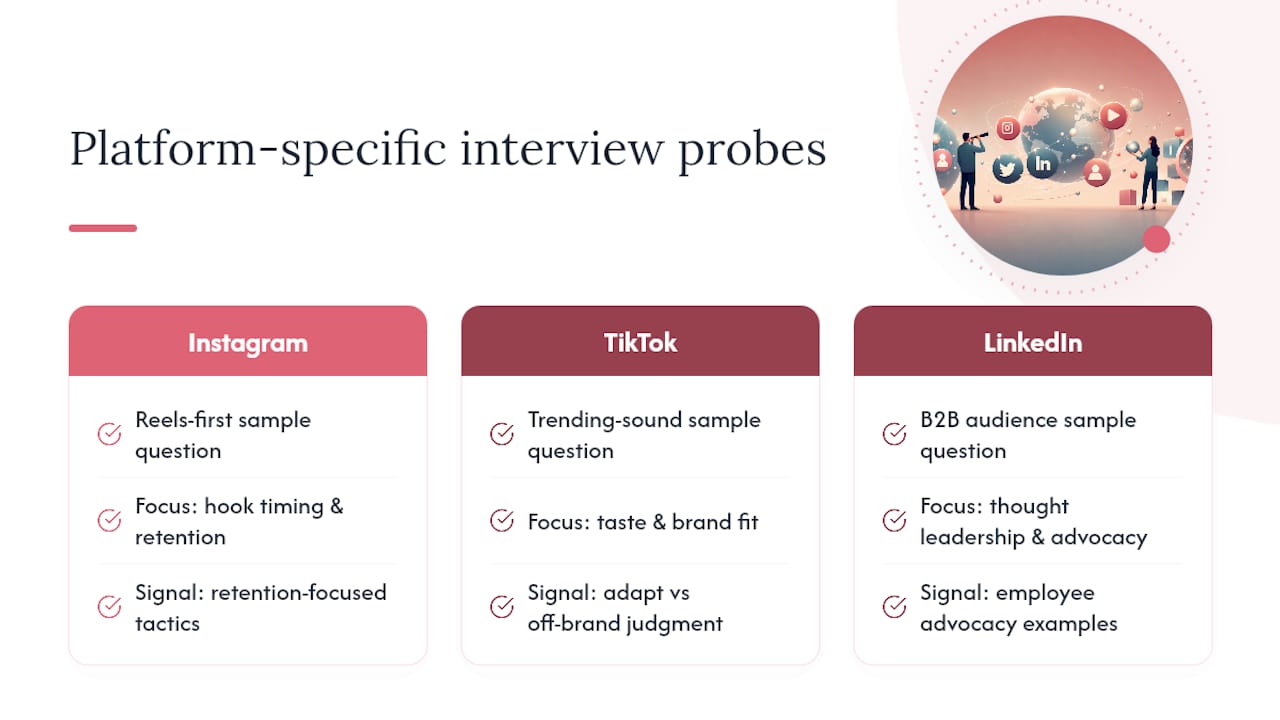
For Instagram: “How would you structure a Reels-first content mix for a brand that’s historically only posted static images?” Look for an answer built around hook timing and retention, not just posting frequency.
For TikTok: “Walk me through how you’d identify a trending sound or format worth adapting for our brand voice, versus one that’s off-brand.” This tests taste and brand judgment together, which matters more than trend-spotting alone.
For LinkedIn: “How does content strategy change when the audience is B2B decision-makers instead of consumers?” A strong candidate talks about thought leadership and employee advocacy, not just posting frequency.
A candidate who gives the same generic answer regardless of which platform you ask about probably hasn’t managed real platform-specific strategy, just scheduled content across all of them the same way.
Behavioral Questions That Predict Team Fit
Technical skill doesn’t guarantee someone will work well under a tight deadline with people who disagree with them. Behavioral and situational questions fill that gap.
Try: “Tell me about a time a stakeholder rejected your content idea. What did you do next?” Weak answers describe frustration; strong ones describe how they adapted or made a case with data.
Try: “Describe a moment you had to say no to a request from someone more senior than you.” This tests whether a candidate can hold a professional line without becoming defensive or simply caving.
Try: “How do you handle feedback on a piece of content you were proud of?” Listen for genuine openness rather than a rehearsed “I love feedback” line with no specifics.
These questions work best when you push for a specific example rather than accepting a general philosophy. “I’m a team player” tells you nothing; a real story about a disagreement resolved constructively tells you a lot.
Helping Candidates Prepare Better Answers (and Why That Helps You Too)
Candidates who prepare well give you more signal, not less, so it’s worth being transparent about what you’re testing. If your job posting or screening call mentions that you’ll ask about attribution, AI tool use, and a past campaign example, serious candidates will show up with specifics instead of generic answers.
Encourage candidates to bring one campaign they can discuss in real depth, complete with numbers, rather than a broad list of everything they’ve touched. Suggest they review the brand’s current social presence before the interview, since a candidate who references your actual content shows initiative that’s hard to fake. For crisis and scenario questions, tell candidates in advance that there’s no single right answer, you’re evaluating their process. That framing reduces interview anxiety without lowering the bar.
Testing Creativity Without Asking “How Creative Are You?”
Nobody answers “I’m not very creative” in an interview, so asking directly gets you nothing useful. Test it through action instead.
Give a live, timed prompt: “You have five minutes. Give me three content angles for a boring product, like packing tape.” Watch how fast someone generates options and whether their ideas differ from each other or just restate the same joke three ways.
Ask candidates to critique existing content: “Here’s a real post from a brand in our space. What would you change?” This reveals taste and instinct faster than asking them to generate something from scratch.
Look for range, not just cleverness. A candidate who can pitch a serious LinkedIn angle and a playful TikTok angle for the same product shows more range than one who’s only ever funny.
What Separates a Strong Answer From a Weak One
The clearest tell in any interview is specificity. A weak answer to “how do you measure success” sounds like “I look at engagement and reach.” A strong answer names the actual metric tied to a business goal: “For that launch, we tracked click-through to a landing page because the goal was demo signups, not just visibility, and engagement alone wouldn’t have told leadership anything useful.”
On crisis questions, a weak answer freezes or jumps straight to a public response. A strong one says something like: “I’d pause scheduled posts, screenshot the situation for the team, and loop in comms before responding, because the wrong quick reply usually does more damage than a short delay.” That sequencing, not the eloquence, is what separates a 2 from a 4 on a rubric.
On AI tool questions, a weak answer either dismisses AI entirely or admits to publishing its output unedited. A strong answer describes a specific workflow: drafting three caption variants with a tool, then rewriting the one that best matches brand voice before it goes live.
Publisher Perspective: Why Sam’s Social Media Club Built Hiring Guidance Into Its Service
Curated listings with mandatory salary transparency change who applies. When candidates already know the pay range, conversations move straight to fit and skill instead of stalling on negotiation guesswork, which is part of why employers using the platform report stronger applicant quality. For more on the skills side of this, our insider’s guide to landing a social media job breaks down what candidates should actually bring to these conversations.
— Sam
Post a Job That Attracts Candidates Who Already Clear Your Bar
There are job boards for hiring social, content, and marketing talent that require transparent salary ranges on every listing, which filters out candidates who’d walk away mid-process over pay and filters in those ready to talk strategy from question one. That single requirement does more screening work before an interview even starts than most rubrics do during one.
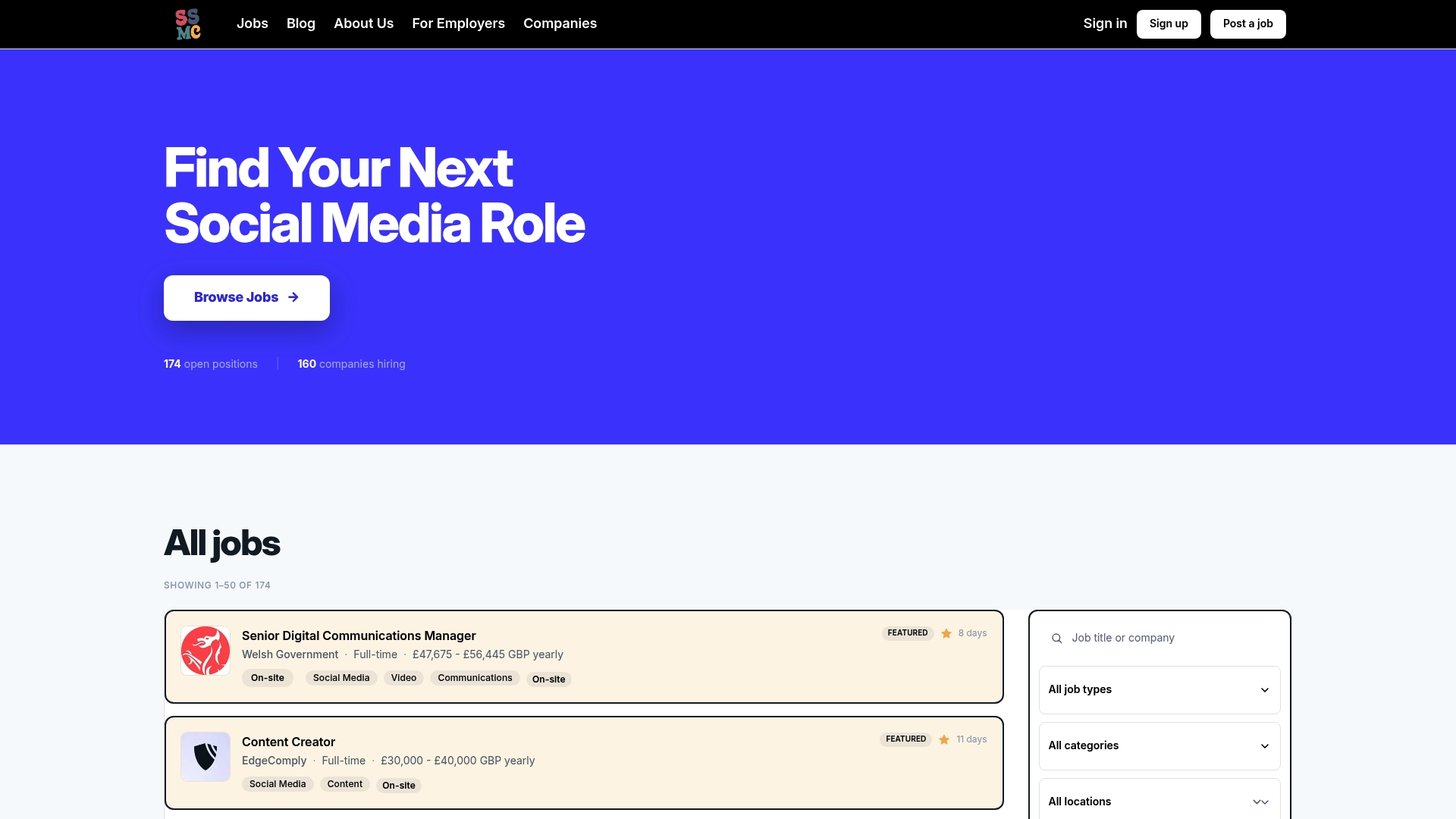
Employers post a curated listing, and applicants come pre-qualified against the role’s actual scope rather than a vague job title. A GoCardless content marketing manager listing on the platform shows the level of detail that draws serious applicants: clear salary, clear scope, no guessing games. If you’re building a hiring process around the question categories and rubric above, pair it with a listing that does the same filtering work upfront. Start an enquiry to post your role, or browse Sam’s Social Media Club to see how current listings are structured.
Sources
- Social Media Manager job description templates (Rework, 2026)
- Social Media Manager interview scorecard (ZYTHR)
FAQ
What Are the Best Social Media Interview Questions to Ask?
The strongest questions are scenario-based and cover strategy and attribution, metrics interpretation, content ideation, AI and tool fluency, crisis response, and team collaboration, scored against a shared rubric rather than gut feel.
How Do I Differentiate Junior vs. Senior Candidates in an Interview?
Junior candidates should demonstrate platform fluency and execution discipline, while senior candidates need to show budget ownership, P&L thinking, and comfort presenting strategy to executives.
Should I Use a Take-Home Task for Social Media Hires?
Yes. A paid 2 to 3 hour brief covering channel selection, a content calendar, AI-assisted drafting, and success metrics predicts on-the-job performance more reliably than interview answers alone.
What Should a Hiring Rubric Include?
A useful rubric weights strategy, content and creative, community management, analytics, paid social, collaboration, and brand voice, with 1 to 5 anchor behaviors defined for each dimension.
How Can Employers Attract Better Social Media Candidates?
Posting on a curated board like Sam’s Social Media Club, which requires transparent salary ranges on every listing, tends to draw candidates who are already aligned on pay and ready to discuss skill and fit.