Put Salary Ranges First: How to Find UK Remote Marketing Roles

The fastest routes to a genuine remote marketing role are curated marketing job boards, company career pages, and targeted LinkedIn searches, filtered hard by one rule: if a listing has no salary range and no clear definition of remote (fully remote, hybrid, or role-based flexibility), move on. That single filter cuts out most of the wasted applications job seekers send into vague or misleading postings.
TL;DR:
- Salary transparency and clear remote definitions in listings significantly reduce application mismatches and streamline the job search process.
- Curated niche boards with salary information outperform general job sites by offering higher-quality, targeted remote marketing opportunities.
- Verifying specific remote working arrangements, timezone overlap, and payroll details before applying prevents mismatched expectations and compliance issues.
- Highlighting remote collaboration tools and asynchronous workflows during application and interviews increases chances of standing out as a suitable remote candidate.
- The hiring process typically spans two to six weeks, depending on role complexity and organisation size, with transparent salary ranges and clear remote policies speeding the timeline.
Find remote roles with clear salaries. Sam's Social Media Club curates remote and work-from-home roles across social media, content, marketing, and communications, with the pay on every listing. See remote UK jobs
Table of Contents
- Where to find remote marketing roles across boards and networks
- What to check in a remote marketing job listing before you apply
- How to apply and stand out for remote marketing roles
- How long does the remote marketing hiring process usually take
- What remote marketing roles typically pay
- How to evaluate and select the right remote marketing candidate
- Interview questions and red flags for remote marketing hires
- Sam's viewpoint: why curated, salary-transparent listings speed up the search
- Find transparent remote marketing roles on Sam's Social Media Club
- Where to verify flexible working rights and trends
- Sources
- FAQ
Where to find remote marketing roles across boards and networks
General job boards like Indeed, LinkedIn, and Reed still carry volume, but volume is the problem. Set up saved searches with remote-specific keywords ("remote", "hybrid", "work from home") combined with your specialty (content, paid social, SEO) so new postings land in your inbox instead of getting buried in a feed. Turn on alerts rather than browsing daily: most boards let you choose instant or daily digest emails, which stops you from missing time-sensitive roles.
Niche and curated boards tend to produce a higher hit rate because they filter for quality before you ever see a listing. A board built specifically around salary-transparent marketing and social media roles, like Sam's Social Media Club's remote UK jobs, removes most of the guesswork that general boards leave in.
Company career pages matter more than most applicants think, because many remote roles never reach the big boards. If you have three or four target employers, check their careers page weekly rather than waiting for a board to surface them.
Networking fills the rest of the gap:
- Search LinkedIn by job title plus "remote" and filter by date posted to catch fresh listings before they flood with applicants.
- Join marketing-focused Slack and Discord communities, where hiring managers often post roles directly to a smaller, more engaged audience.
- Follow marketing directors and recruiters at companies you admire, since many share openings before they're formally listed.
- Ask your existing network directly: a short message asking if anyone knows of remote marketing openings often surfaces roles that never get advertised.
To avoid chasing duplicate or stale postings, keep a simple spreadsheet logging the company, date applied, and source. Many roles get cross-posted on three or four boards simultaneously, and without a log you risk applying twice or missing that a listing has quietly expired.
- Set alerts on two or three boards maximum so you're not drowning in near-identical emails.
- Check company pages for your shortlisted employers at a fixed weekly time.
- Log every application with date, source, and salary range so you can compare offers later.
What to check in a remote marketing job listing before you apply
Not all "remote" means the same thing, so define the arrangement before you invest time in an application. Fully remote usually means no office requirement at all. Hybrid means a set number of in-office days. Role-based flexibility means some team members work remotely and others don't, depending on function. Part-time and contract roles carry their own rules around hours and benefits, so check which category you're actually applying to.

Salary transparency is the biggest predictor of a listing worth your time. A stated range tells you the employer has already settled on a budget and is not using the application process to find out how low they can go. CIPD research on flexible and hybrid working found that a majority of employers say advertising flexibility helps them attract staff and address skills shortages, which is part of why transparent listings tend to come from more candidate-aware employers.
Before applying, check these practical details:
- Permitted working locations or countries, since "remote" sometimes means remote within one country only.
- Timezone overlap requirements, especially if the employer is based in a different region.
- Payroll and tax setup: are you hired as an employee, or expected to invoice as a contractor?
- Contract type, benefits, and expected hours, so you know if "full-time" really means 40 hours or something closer to a retainer.
- Signals of mature remote practice: async-first tools, documented onboarding, a sane meeting cadence, and a visible path for progression.
CIPD research on flexible and hybrid working practices notes that remote does not automatically mean work-from-anywhere, and recommends checking permitted countries, payroll arrangements, and any required in-person meetups before assuming a role fits your life.
Pro Tip: Ask directly in your application or first call whether remote flexibility is written into the contract or just an informal manager preference, since only one of those survives a change in leadership.
If an employer refuses a flexible-working request, the Employment Rights Act 2025 requires them to state the ground for refusal and explain why it's reasonable, covering grounds like additional costs, customer-demand impact, or inability to reorganise work.
How to apply and stand out for remote marketing roles
Your CV should lead with evidence of remote collaboration, not just campaign results. Mention the specific tools you've used daily, content calendars like Asana or Notion, analytics dashboards, and async comms platforms like Slack or Loom, because hiring managers scanning for remote fit look for this before they look at your portfolio.
- Choose two or three campaign case studies that show measurable outcomes and explicitly note which parts were coordinated across time zones or without live meetings. Fylde Digital's guide on how to get social media management clients has useful pointers on presenting this kind of proof.
- Write your cover message around outcomes and availability: state your timezone, your overlap hours with the employer's core team, and one concrete example of hitting a deadline asynchronously.
- Prepare durable answers for remote interviews: how you structure your day, which rituals you use to stay visible to a manager you rarely see live, and what equipment you already have set up.
- Ask the interviewer direct questions that test their flexibility claims, such as how often the team meets live, whether meetings are recorded for people in other time zones, and how performance gets reviewed without in-person contact.
- Follow up within a week of any interview, and if you offer references, pick ones who can specifically speak to your remote performance rather than general character.
The CIPD's Labour Market Outlook for Summer 2025 points to a cooling labour market, which makes it more important for candidates to tailor their evidence to the core outcomes an employer actually needs, rather than listing every skill they have.
Pro Tip: Keep one short portfolio page dedicated to remote-specific proof (a cross-timezone project, an async handoff, a documented process you wrote for a team), since it answers the employer's real question before they ask it.
How long does the remote marketing hiring process usually take
Most remote marketing roles move through application, screening call, a skills or portfolio review, and one or two further interviews before an offer. Screening calls typically happen within one to two weeks of application if the role is active, since remote-first employers tend to run lean on fixed screening slots rather than ad hoc scheduling.

The portfolio or skills stage is where timelines stretch, particularly for content and campaign roles where the employer wants to see a worked example. Expect this stage to take another one to two weeks, especially if a test project or writing sample is involved.
Final interviews and offer decisions vary more than any other stage. A startup might move from first call to offer within two weeks total, while a larger organisation with multiple stakeholders can take four to six weeks. Keeping your own application log, as outlined earlier, helps you spot when a process has gone quiet rather than simply moved slowly, since remote hiring teams don't always update candidates proactively.
What remote marketing roles typically pay
Pay for remote marketing roles varies by discipline, seniority, and the specific employer's budget rather than following one fixed formula, which is exactly why salary transparency matters more here than in office-based hiring. A transparent range signals the employer has already set a budget and isn't using the interview process to discover your floor. For current UK bands, see what social media and marketing jobs pay.
When a listing gives a range, treat the bottom of the band as the starting point for someone meeting the minimum requirements, and the top as reserved for candidates who exceed them on experience or specialised skills. If a listing has no range at all, ask for one directly in your first conversation rather than waiting until an offer appears, since employers offering genuine flexibility are generally comfortable sharing it early.
Contract and freelance marketing positions often price differently from salaried roles, usually as a day rate or project fee rather than an annual figure, so compare like for like when weighing a freelance offer against a full-time one. Our day rate calculator helps with that comparison.
How to evaluate and select the right remote marketing candidate
Strong remote marketing candidates show evidence of self-direction before you ever ask them about it: a portfolio that names specific tools, a CV that explains how they coordinated work without live meetings, and application messages that answer questions you hadn't asked yet.
Screen for outcomes over activity. A candidate who describes what a campaign achieved and how they measured it is a stronger signal than one who lists tasks performed. Ask for one detailed example of a project they ran mostly asynchronously, since the explanation reveals how they structure communication when nobody is watching in real time.
Verify timezone overlap and realistic availability early, rather than assuming it will sort itself out after hire. The CIPD's flexible working guidance recommends treating flexibility as a condition to confirm in writing, including whether arrangements are contractual or informal and what the expected office days are, if any. Applying that same clarity when selecting candidates protects both sides from mismatched expectations later.
Interview questions and red flags for remote marketing hires
Ask candidates to walk through a specific project where most of the collaboration happened without a live meeting. Their answer should include how they documented decisions, how they flagged blockers, and how they kept a manager informed without constant check-ins.
Useful questions include: how do you structure your day when no one is monitoring your screen, what tools do you rely on for async updates, and can you describe a time a remote handoff went wrong and what you changed afterwards. Strong answers are specific and process-driven rather than general statements about being "self-motivated."
Red flags include vague answers about daily structure, no concrete tool preferences, and an inability to describe how they've handled miscommunication across time zones. On the employer side, red flags run the other way too: a job description with no salary range, a vague remote policy, or an interviewer who can't explain the team's actual meeting cadence suggests the flexibility on offer may be informal rather than reliable.
Sam's viewpoint: why curated, salary-transparent listings speed up the search
Mandatory salary ranges and a curated applicant pool solve the two biggest time sinks in remote marketing job hunting: guessing at pay and applying to roles that were never a fit. When every listing states a band and a clear remote definition upfront, candidates self-select more accurately, and employers spend less time sorting through mismatched applications. That clarity is the entire point of building a board around transparency rather than volume.
— Sam
Find transparent remote marketing roles on Sam's Social Media Club
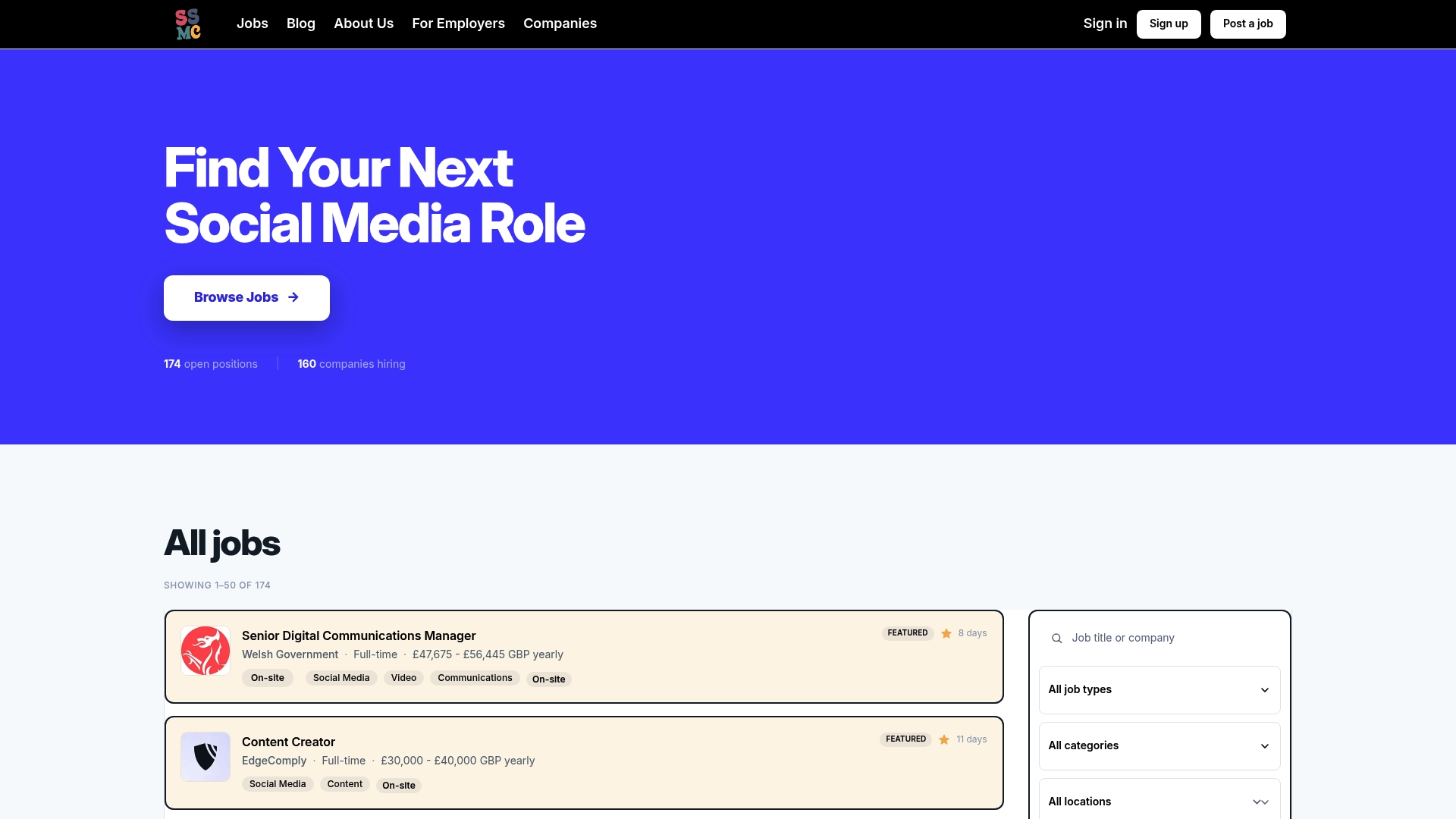
Sam's Social Media Club lists social media, content, marketing, and communications roles with salary ranges stated upfront, so you never have to guess at pay before applying. Listings are curated to focus on roles in this field rather than everything with "marketing" somewhere in the title.
Getting started takes a few minutes:
- Browse remote and work-from-home roles in the UK, or all open jobs.
- Read each listing's stated pay band and working arrangement before applying.
- Get new roles in your inbox every week with the free SSMC newsletter.
If you're an employer looking to reach a focused, salary-transparent audience, visit the pricing page to see listing options, or send questions through the enquiry page if you want details before committing.
Where to verify flexible working rights and trends
- Employment Rights Act 2025: statutory grounds for refusing flexible-working requests.
- UK Government flexible working consultation: policy direction on flexible working.
- CIPD flexible and hybrid working update: current employer practice data.
Sources
- Flexible and hybrid working practices in 2025 (CIPD)
- Employment Rights Act 2025 — Right to request flexible working
- Make work pay: improving access to flexible working — UK Government consultation
- Labour Market Outlook – Summer 2025 (CIPD)
FAQ
What's the single best way to find remote marketing jobs?
No single channel works alone, but combining a curated marketing job board with saved alerts on general boards and a short list of target company career pages covers the most ground. Prioritise listings with a stated salary range and a clear remote definition over those without either.
How do I know if a "remote" job is actually flexible?
Check whether the remote arrangement is written into the contract or just an informal manager preference, since only the former holds up through a change in leadership. The CIPD recommends verifying permitted countries, payroll setup, and timezone overlap before assuming a listing fits your situation.
Can my employer refuse my flexible working request?
Yes, but under the Employment Rights Act 2025 they must state the specific ground for refusal and explain why it's reasonable, such as additional costs or an inability to reorganise work. Vague refusals without a stated ground don't meet this standard.
How long does it typically take to get hired for a remote marketing role?
Screening calls usually happen within one to two weeks of application if the role is active, with portfolio or skills stages adding another one to two weeks. Final decisions range from around two weeks at smaller companies to four to six weeks where multiple stakeholders are involved.
Does Sam's Social Media Club charge job seekers to use the board?
No, job seekers use Sam's Social Media Club to browse and apply to listings at no cost. Employers pay for listings, with plans detailed on the pricing page.