
Marketing Portfolio Examples: 6 Job-Ready Templates (2026)
Marketing Portfolio Examples: 6 Job-Ready Templates

Build a web-based, case-study-first portfolio and publish one strong, measurable case study this week. That single move does more for your job search than a polished CV ever will. Hiring managers in the UK increasingly skip résumés and go straight to portfolio links, especially for social media, content, and growth roles. If you have nothing to send them, you are invisible.
Here is what to publish in the next 48–72 hours:
- Pick one project where you can name a clear before-and-after metric (even a small one).
- Write three bullet points: objective, what you did, what changed.
- Add one visual: a screenshot, a chart, or a creative asset.
- Put it online with a contact link underneath.
That is your minimum viable portfolio. Everything below helps you build from there.
Platform quick-reference:
- Webflow — best for growth marketers and social media managers who want full design control and interactive case studies.
- Squarespace — best for brand and campaign managers who want a polished look without coding.
- Wix — best for early-career marketers who need a fast, low-cost start.
- Behance — best for visual and creative roles where gallery exposure matters.
- Adobe Portfolio — best for designers already in the Creative Cloud ecosystem.
- Canva — best for a quick PDF portfolio or a simple one-pager.
- LinkedIn — best as a distribution layer on top of your main portfolio, not a replacement for it.
Key Takeaways
A web-based, case-study-first portfolio with one strong, measurable case study published this week is the single most effective move a UK marketing jobseeker can make right now.
| Point | Details |
|---|---|
| Publish one case study first | Lead with a metric headline, then context, role, approach, and results. |
| Pick the right platform | Webflow for growth/social roles; Squarespace or Wix for speed; Canva PDF for a quick start. |
| Tailor for UK hiring | Use British English, £ for budgets, and state your location and right-to-work status upfront. |
| Use Samssocialmediaclub | Apply to curated UK roles with transparent salaries and include your portfolio link for direct hiring manager review. |
| Update quarterly | Run a 30-minute check every quarter; do a full refresh after every significant win or role change. |
Table of Contents
- What does a marketing portfolio actually do for hiring?
- What every marketing portfolio should include
- How to structure each case study (a template you can copy)
- Which platform should you build your portfolio on?
- Six annotated marketing portfolio examples you can model
- How to build a convincing portfolio with no paid experience
- Where to share your portfolio and how to tailor it for UK hiring
- Quick checklist and templates you can use right now
- How often should you update your portfolio?
- What hiring managers actually look for (and what most portfolios miss)
- Samssocialmediaclub helps you get your portfolio in front of the right people
- Useful resources and platform docs
- Sources
What does a marketing portfolio actually do for hiring?
A marketing portfolio is a curated collection of case studies that proves impact. It is not a résumé substitute. A résumé tells a hiring manager what you did; a portfolio shows how you think, what you measured, and what changed because of your work.
Hiring managers prefer case-study formats because they reveal three things a CV cannot: your method, your specific role in a project, and the measurable outcomes you drove. A senior content marketing manager role at a company like GoCardless will attract dozens of applicants with similar job titles. The candidates who get interviews are usually the ones whose content marketing portfolios show a clear hypothesis, a defined audience, and a result tied to a real KPI.
Different roles require different proof points:
- Social media manager — follower growth rate, engagement rate, reach, and community response time. Show platform-specific work (Instagram Reels, LinkedIn carousels, TikTok) with screenshots.
- Growth marketer — customer acquisition cost (CAC), conversion rate, A/B test results, and retention uplift. Numbers are non-negotiable here.
- Content writer / SEO writer — target keywords, ranking improvements, organic traffic gains, and time-on-page. Samples without performance context are weak; linking content to measurable search results is what separates the best content portfolios from the rest.
- Campaign manager — budget managed, CPL, ROAS, and reach across channels. Show the brief, the creative, and the result together.
LinkedIn works as a distribution channel for your portfolio link, but it is not the portfolio itself. Post your case study as a LinkedIn article, then link back to the full version on your site.
What every marketing portfolio should include
Six sections cover everything a hiring manager needs to assess fit and make a decision quickly.
1. Hero section One headline that states who you are, what you specialize in, and who you help. “Growth marketer helping SaaS companies reduce CAC through paid and lifecycle channels” is specific enough to be memorable. Avoid “passionate marketer with 5+ years of experience.”
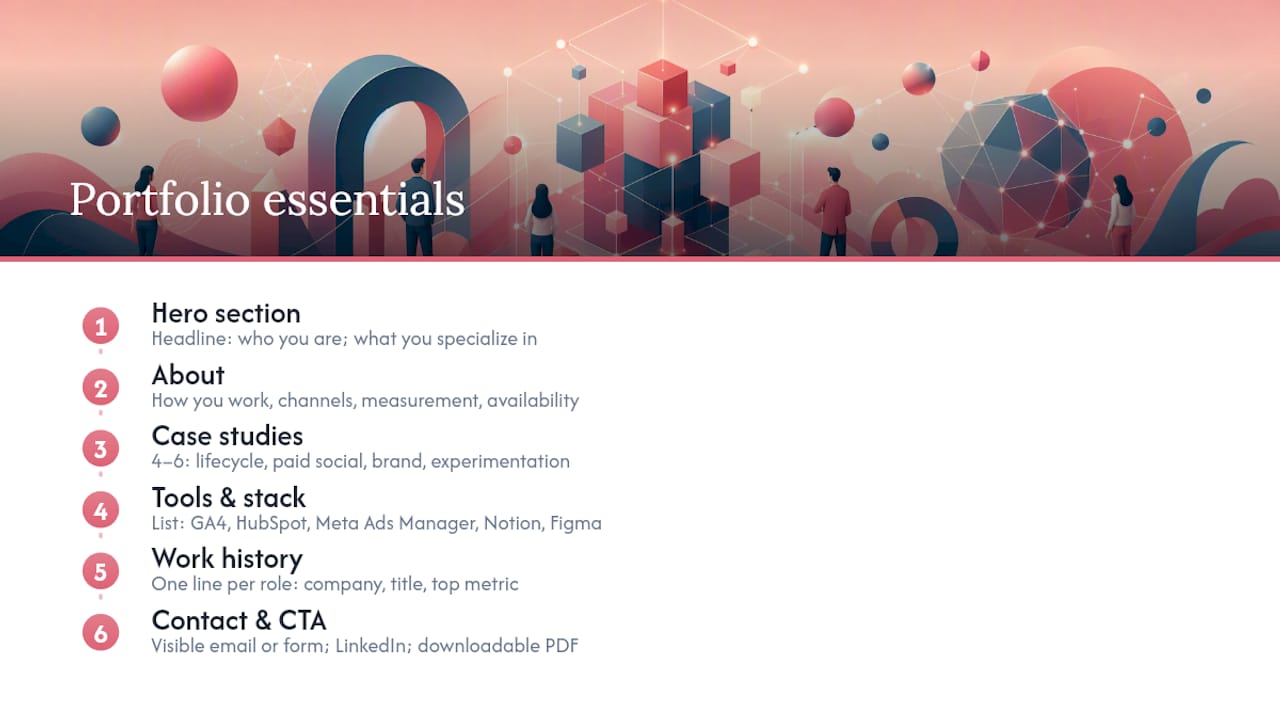
2. About (operating style and availability) Two to three sentences on how you work: your preferred channels, your approach to measurement, and whether you are available for full-time, contract, or freelance work. UK recruiters also want to know your location and right-to-work status upfront.
3. Case studies (four to six, prioritized) A strong marketing manager portfolio leads with four focused case studies across varied categories: lifecycle, paid social, brand awareness, and an experimentation framework. Four is enough. Six is the ceiling. More than that and you are diluting the impact of your best work.
4. Tools and stack A short list of the platforms and tools you use day-to-day: GA4, HubSpot, Meta Ads Manager, Notion, Figma, Mailchimp, or whatever is genuinely in your workflow. This section helps ATS systems and recruiters match you to role requirements fast.
5. Work history (headline results only) Not a full CV. One line per role: company, title, and the single most impressive metric from that position.
6. Contact and CTA A visible email address or contact form, a link to your LinkedIn, and a downloadable PDF version of your portfolio or résumé. Make it impossible to miss.
Inside each case study, include: objective, your role, the audience, the budget or scale, your approach, the tools you used, the results, and a link to any live assets or published work.
How to structure each case study (a template you can copy)
Every case study follows the same sequence. Once you have written one, the rest take half the time.
- Top-line headline — one sentence stating what changed and by how much. “Reduced CPL by 34% over 90 days through audience segmentation and creative testing on Meta.” This goes at the top, in large type.
- Context and objective — the problem you were solving, the audience, the timeframe, and the budget or scale. Keep it to three sentences.
- Role and contribution — your exact responsibilities. If this was a team project, say so and name your specific lane. Hiring managers are checking whether you can own a workstream, not just participate in one.
- Approach and tactics — your hypothesis, the channels you used, the experiments you ran, and the tools involved. Name them specifically: GA4 for tracking, Meta Ads for paid, HubSpot for lifecycle, Semrush for keyword research. Specificity signals real experience.
- Results with evidence — your primary KPI, secondary outcomes, and the timeframe. Before-and-after figures are the clearest format. If you ran an A/B test, include the hold-out result. Personal portfolio sites that show percentage improvements for metrics like CPL, organic traffic, and conversion rates consistently outperform those that describe results in vague terms.
- Reflection — one short paragraph on what you learned and what you would do differently. This signals seniority and intellectual honesty. Junior portfolios almost never include it, which is exactly why it stands out.
- Visuals and CTA — screenshots of the creative, a chart of the results, or a short video walkthrough. End with a one-line prompt: “Download the full results deck” or “See the live campaign.”
Pro Tip: If your results are under NDA, use percentages and relative lifts instead of absolute numbers. “Improved performance significantly” tells a hiring manager nothing.
Which platform should you build your portfolio on?
The right platform depends on your role, your design confidence, and how much time you can invest upfront.
| Platform | Best for | Format | Ease of use | Cost (approx.) | Customization | Shows interactive work? |
|---|---|---|---|---|---|---|
| Webflow | Growth marketers, social media managers | Personal website | Moderate | Free tier; paid plans available | High | Yes |
| Squarespace | Brand and campaign managers | Personal website | Easy | Paid plans available | Medium | Partially |
| Wix | Early-career, generalists | Personal website | Very easy | Free tier; paid from ~£9/mo | Medium | Partially |
| Behance | Visual creatives, designers | Hosted gallery | Easy | Free | Low | Limited |
| Adobe Portfolio | Designers in Creative Cloud | Hosted gallery | Easy | Included with Creative Cloud | Low | Limited |
| Canva | Quick PDF or one-pager | PDF / slide deck | Very easy | Free tier available | Low | No |
| Distribution layer | Profile + articles | Easy | Free | None | No |
Visual-first portfolio sites built on platforms like Webflow are increasingly the standard for social media roles because they let you present immersive, interactive case studies alongside visuals and metrics in a way a PDF simply cannot replicate.
Behance is useful for gallery exposure and visual assets, but it is less effective than a personal site for demonstrating process, experimentation design, and detailed measurement. Use it to complement your main site, not replace it.
UK-specific notes:
- Register a
.co.ukdomain if you are targeting UK employers. It signals locality and tends to rank better in UK search results. - Check that your portfolio loads cleanly on mobile. UK recruiters frequently review applications on phones.
- Accessibility matters: use sufficient color contrast and alt text on images. Some UK public sector and charity roles will notice.
- Canva’s free tier is a legitimate starting point. A well-structured PDF portfolio beats a half-finished Webflow site every time.
For layout and design inspiration, curated portfolio galleries show a range of patterns that non-designers can adapt directly, without needing to start from scratch.
Six annotated marketing portfolio examples you can model
These six examples map to specific roles. For each one, the structure and the standout element are what matter most.
1. Senior growth marketer A personal site with four case studies covering paid social, lifecycle email, SEO, and an experimentation framework. Each case study opens with a one-sentence metric headline, then walks through hypothesis, test design, and results. The standout element: an A/B test result table showing the hold-out group. Platform: personal website (Webflow-style). What to copy: the metric headline format and the hold-out table. What to avoid: listing every campaign you have ever run.

2. Brand campaign manager A Squarespace site with a strong hero image, a brief about section, and three campaign case studies. Each case study includes the brief, the creative concept, the media mix, and the reach and engagement results. The standout element: side-by-side before/after brand perception data. What to copy: the brief-to-result narrative arc. What to avoid: showing only the creative without any performance data.
3. Social media manager A grid-based visual portfolio on a personal site, with embedded Reels, carousel screenshots, and community management examples. Social media manager portfolios perform best when they combine platform-specific visuals with engagement metrics and a short note on strategy. Platform: Webflow or Squarespace. What to copy: embedding native content rather than screenshots alone.
4. Content and SEO writer A clean, text-forward site with writing samples linked directly to their live URLs, alongside ranking data for the target keywords. SEO content portfolios that explicitly connect samples to measurable search performance consistently outperform those that show samples without context. Platform: personal site or Authory. What to copy: the keyword-to-ranking table next to each sample.
5. Lifecycle and CRM marketer A PDF portfolio (well-designed, Canva-built) showing an email automation flow, the segmentation logic, open and click rates, and the revenue impact. The standout element: a flowchart of the automation sequence. Platform: Canva PDF, shared via Google Drive link. What to copy: the flowchart. What to avoid: sharing raw Mailchimp screenshots without context.
6. Early-career marketer (spec project) A Wix site with one spec project: a mock social media campaign for a real brand, including a brief, a content calendar, three sample posts, and simulated engagement projections. Labeled clearly as a spec project. What to copy: the mock brief format and the honest “spec” label. What to avoid: presenting spec work as if it were a paid campaign.
| Role | Best for | Platform format | Standout element |
|---|---|---|---|
| Senior growth marketer | Mid-to-senior roles | Personal website | A/B test hold-out table |
| Brand campaign manager | Mid-level brand roles | Personal website | Before/after brand data |
| Social media manager | All levels | Visual personal site | Embedded native content |
| Content / SEO writer | All levels | Personal site or Authory | Keyword-to-ranking table |
| Lifecycle / CRM marketer | Mid-level | PDF (Canva) | Automation flowchart |
| Early-career (spec) | Entry-level | Wix site | Mock brief + spec label |
How to build a convincing portfolio with no paid experience
No paid experience does not mean no portfolio. It means you need to be more deliberate about what you build and how you label it.
- Spec projects — pick a real brand you admire, write a mock brief, execute a small campaign (even just three social posts and a content calendar), and document the process. Label it “spec project” clearly. Hiring managers respect the initiative; they penalize the deception.
- Pro bono work — offer a local charity, a small business, or a community organization a month of social media management or a content audit. You get real data; they get free help. A coordinator-level role often lists hands-on channel experience as a requirement, and pro bono work counts.
- Course projects — if you have completed a Google Analytics, HubSpot, or Meta Blueprint certification, the projects from those courses are legitimate portfolio entries. Show the brief, your approach, and any simulated or real results.
- Personal experiments — run a small paid ad campaign on Meta with a £20 budget. Track the CPL. Write it up as a case study. The budget is irrelevant; the method is what hiring managers are assessing.
- Reverse-engineering — analyze a competitor’s campaign: their ad creative, their landing page, their likely audience targeting. Write up what you think their strategy is and what you would test differently.
Pro Tip: Reverse-engineering a real campaign is one of the strongest interview talking points available to an early-career marketer. It shows strategic thinking without requiring a budget or a client. Bring a one-page write-up to every interview.
For more on turning coursework and small pilots into credible entries, the first marketing job guide on Samssocialmediaclub covers the full process.
Where to share your portfolio and how to tailor it for UK hiring
Getting the portfolio built is step one. Getting it in front of the right people is step two.
Primary distribution channels:
- Personal domain — your main hub. Share this link everywhere.
- LinkedIn — add the URL to your featured section and your about summary. Post one case study as a LinkedIn article each month.
- Behance — useful for visual and creative roles. Cross-post your visual assets there for discovery.
- Samssocialmediaclub — when applying to roles listed on the platform, include your portfolio link directly in your application. The platform’s curated vetting process means hiring managers actively review portfolio evidence, so a strong link here carries real weight.
Tailoring for UK roles:
- Use British English in your portfolio copy if you are targeting UK employers. Spelling matters more than most people think.
- Present metrics in UK-relevant formats: percentages, £ for budget figures, and month/year date formats.
- State your location and right-to-work status in the about section. UK hiring managers need this early in the process.
- For senior roles, include a short testimonial or a verifiable reference. Even one sentence from a former manager, with their name and title, adds credibility that no metric can replicate.
EEAT signals to add:
- Links to published campaign pages, live articles, or press coverage.
- Verifiable metrics (link to a Google Analytics screenshot or a published case study where possible).
- Short written references or LinkedIn recommendations embedded or linked.
Practical sharing workflow:
- Send a private PDF for initial applications through ATS systems.
- Share your public portfolio URL at the interview stage.
- Prepare a short “sample pack” (three to five pages, PDF) for roles where the full site might not be reviewed.
Pro Tip: Samssocialmediaclub lists salaries transparently on every role. When you reference a role in outreach, you can cite the listed salary range as evidence that you have researched the market rate. It signals preparation and saves an awkward conversation.
Quick checklist and templates you can use right now
Launch checklist:
- [ ] Domain registered (
.co.ukor.com) - [ ] Hero section written and live
- [ ] One case study published with a metric headline
- [ ] Résumé PDF linked or downloadable
- [ ] Contact email or form visible
- [ ] GA4 tracking installed
- [ ] Mobile display tested
- [ ] Accessibility check run (color contrast, alt text)
Copyable snippets:
Hero headline template: “[Role] helping [audience] achieve [outcome] through [channels/approach].”
About blurb template: “I specialize in [channel/discipline] with a focus on [metric or outcome]. Currently [available for / open to] [full-time / contract / freelance] roles in [location or remote].”
Case study headline template: “[Metric] improvement in [timeframe] through [tactic] for [audience/brand type].”
Outreach email snippet: “I have attached a short sample pack and included a link to my full portfolio below. The [specific case study] is most relevant to this role — it covers [brief description of the project and result].”
Suggested file naming: [YourName]-Portfolio-2026.pdf | [YourName]-CaseStudy-[ProjectName].pdf
Image sizes for fast publishing: Hero image: 1440 × 800px. Case study visuals: 1200 × 675px. Thumbnail: 600 × 400px.
For presentation formats and layout ideas beyond the basics, this portfolio resource covers modern formats worth exploring.
How often should you update your portfolio?
The honest answer: more often than you think, less often than you fear.
A quarterly check takes 30 minutes and keeps your portfolio from going stale. Look at whether your metrics are still accurate, whether your tools list reflects what you actually use, and whether your hero statement still matches the roles you are targeting.
A major refresh makes sense every 6–12 months, or immediately after a significant win: a campaign that hit a record result, a promotion, a new tool you have mastered, or a project that shows a new capability.
What to add as you progress:
- Bigger projects with larger budgets or broader reach.
- Evidence of leadership: managing a team, owning a channel strategy end-to-end, or presenting to senior stakeholders.
- New tools and platforms that are appearing in job descriptions for your target roles.
- A senior creative content producer role, for example, will expect portfolio evidence of editorial strategy and cross-channel production, not just execution.
When to remove older work:
Remove a case study when it no longer represents your best output, when the results are no longer impressive relative to your recent work, or when it targets a role type you have moved away from.
Keeping an outdated case study on your portfolio because you spent time on it is the sunk-cost fallacy applied to your career. Cut it.
What hiring managers actually look for (and what most portfolios miss)
Most portfolios fail for the same reason: they show what was done, not what changed. A hiring manager reviewing applications for a content strategist role is not asking “did this person write content?” They are asking “did this person’s content move a number?”
The portfolios that get interviews are the ones where the result is in the headline, the role is clearly defined, and the reflection section shows that the marketer learned something. Honesty about setbacks is a senior signal. A portfolio that claims every campaign was a success reads as either inexperienced or dishonest.
One more thing most portfolios miss: professional branding photography on the about page. A strong headshot and a consistent visual identity across your portfolio and LinkedIn profile signal that you understand brand, which is exactly what marketing roles require.
Samssocialmediaclub helps you get your portfolio in front of the right people
Sending a strong portfolio into a generic job board is like printing a great poster and leaving it in a drawer. Samssocialmediaclub is a curated job board built specifically for social media, content, marketing, and communications roles in the UK, with every listing showing the salary upfront.
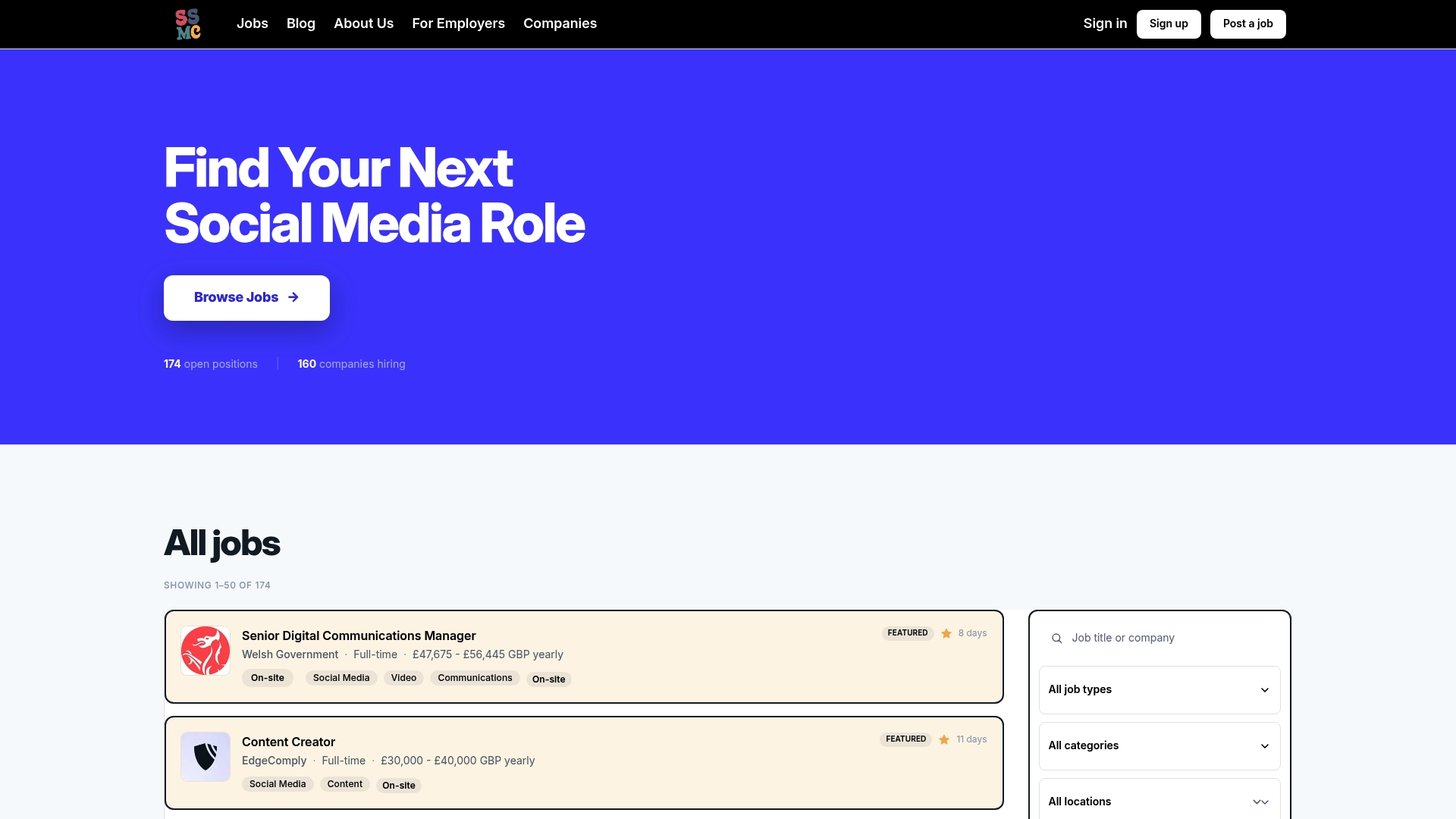
Every role on the platform is vetted, which means hiring managers who post there are actively looking for portfolio evidence, not just CVs. When you apply through Samssocialmediaclub, your portfolio link goes directly to a decision-maker who has already committed to reviewing qualified candidates seriously. No black-hole applications, no mystery salary ranges.
Submit an enquiry to have your portfolio reviewed or to browse current roles matched to your skills and experience level.
Useful resources and platform docs
- Webflow blog: social media manager portfolio examples — practical examples and layout guidance for visual-first portfolios, with templates for social media roles.
- Authory: SEO content writer portfolio examples — shows how to connect writing samples to measurable search performance; useful for content and SEO writers building their first portfolio.
- Myseera: marketing manager portfolio example — a detailed annotated example with a free template covering hero, case studies, tools stack, and contact sections.
- JR Marketing Portfolio — a live personal portfolio site showing how to present channel skills, tech stack, and KPI results in a clean format.
- Colorlib: writer portfolio examples — a curated gallery of layout and design patterns non-designers can adapt directly.
- Behance: digital marketing portfolio projects — useful for visual asset discovery and gallery-style exposure, particularly for creative and design-adjacent roles.
- Sorcery — covers modern portfolio formats and presentation techniques across creative disciplines.