
UK Content Career Path: 12–24 Month Plan to Prove Pipeline Impact
UK Content Career Path: 12–24 Month Plan to Prove Pipeline Impact

A content career path scales predictably from writer to Head of Content when you track measurable impact, not just output. Expect roughly 2 to 5 years to reach mid-level roles and 7 to 10 to reach leadership, according to the National Careers Service. Demand hasn’t dried up. It’s shifted toward people who can prove content moves revenue, not just traffic. Here’s the roadmap, the skills, and the pay that comes with each stage.
TL;DR:
- Progression from entry to leadership relies on measurable impact, with mid-level roles taking 2 to 5 years and leadership roles requiring 7 to 10 years.
- Skills such as audience research, SEO, analytics, storytelling, and AI fluency become increasingly strategic and data-driven at higher levels.
- Salary growth at senior levels depends heavily on quantifiable contributions to revenue or pipeline, not just role titles or workload volume.
- Breaking into content with no experience is most effectively achieved through portfolios, apprenticeships, or relevant degrees, with a focus on translating previous work into content-specific language.
- AI tools mainly automate low-value tasks, making judgment and strategic workflow design the key differentiators for mid and senior roles.
Table of Contents
- What Does the Content Career Path Look Like Stage by Stage?
- Which Skills Matter Most at Each Career Stage?
- How Much Does a Content Career Path Pay at Each Level?
- How Do You Break Into a Content Career With No Experience?
- What’s the Best Order to Learn Content Skills?
- Which Specialization Should You Choose?
- How This Guide Was Put Together
- What Trips People Up at Each Career Stage?
- Where Do You Find Mentors and Networking Opportunities in Content?
- How Are AI Tools Changing Content Roles?
- Which Certifications Are Worth Your Time?
- Does the Content Career Path Differ by Industry?
- What Does Work-Life Balance Look Like in Content Careers?
- Specialist Depth or Leadership Breadth: Which Should You Choose?
- Find Transparent Content Roles Through Sam’s Social Media Club
- Sources
- FAQ
What Does the Content Career Path Look Like Stage by Stage?
Most people start as a content writer, content assistant, or SEO assistant, handling briefs, on-page optimization, and basic content calendars. Within 2 to 3 years, competent performers move into content marketing manager or content strategist roles, owning a channel or content pillar and reporting on results rather than just producing them.
Mid-level is where the job changes shape. You’re briefing freelancers, running editorial calendars across formats, and defending your budget in planning meetings. The jump to senior or Head of Content roles, typically 7 to 10 years in, adds team management, an actual budget line, and a seat in front of executives, per CXL’s career roadmap.
- Entry level: content writer, SEO assistant, content coordinator. Task: execute briefs, learn keyword research and CMS basics.
- Mid-level: content marketing manager, content strategist. Task: own a channel, set editorial calendars, report on pipeline or organic growth.
- Senior/leadership: Head of Content, Content Director. Task: hire and manage a team, set strategy, answer to revenue targets.
You’ll see the readiness signal before a title changes: you’re already doing the next role’s work informally. A real content strategist job posting usually spells out that scope shift in the requirements list.
Which Skills Matter Most at Each Career Stage?
Six skills carry a content marketing career from entry to leadership: audience research, SEO, editorial operations, storytelling, analytics, and working with AI tools. What “competence” means in each one changes hard as you climb.
At entry level, competence means executing a brief accurately: keyword targeting, structure, and a clean draft on deadline. At mid-level, it means owning the research that produces the brief in the first place, reading a Google Search Console report without help, and running an editorial calendar that doesn’t collapse when a freelancer disappears. At senior level, it means tying content output to pipeline or revenue and defending that link with numbers in a leadership meeting, an idea reinforced by CXL’s framing of content as a growth function rather than a cost center.
- Audience research: entry = follow a persona doc; senior = build the persona doc from customer interviews.
- SEO: entry = on-page basics; senior = technical audits and content gap strategy across a whole site.
- Editorial ops: entry = follow a calendar; senior = design the calendar and the approval workflow.
- Storytelling: entry = clear writing; senior = a distinct brand voice others are briefed to match.
- Analytics: entry = report pageviews; senior = report pipeline influence and cost per lead.
- AI fluency: entry = use AI for drafts and research; senior = build AI-assisted workflows the whole team follows.
Pro Tip: Keep a running log of every piece of content you’ve shipped alongside its measurable result, even a small one. Hiring managers for mid-level roles ask for this constantly, and most candidates show up empty-handed.
How Much Does a Content Career Path Pay at Each Level?
Moving into content leadership carries a financial incentive: senior leaders can earn significantly more than individual contributors doing similar work one level down, as noted by Select’s salary data. That gap is bigger than most people assume when they’re still weighing whether to specialize or manage.
Pay also depends heavily on industry and company stage. Well-funded technology companies tend to pay the most for senior content roles, while nonprofits and smaller agencies typically pay less at every level but often offer faster scope growth. A content marketing manager listing at a fintech company will usually show a different band than an equivalent role at a small charity, even with similar responsibilities.
The leadership pay jump isn’t automatic. It gets unlocked when you can walk into a salary conversation with specific numbers: pipeline influenced, organic revenue attributed, or cost per acquisition improved. Vague claims about “growing the blog” rarely move the number. Bring the metric, not the anecdote.
The strongest negotiation lever at any stage is pipeline or revenue attribution. Learn to tie your work to a number executives already track, and use that number, not your job title, as your negotiating position.
How Do You Break Into a Content Career With No Experience?
Three routes get people into content work, and each suits a different situation.
- A degree or HND in marketing, English, or journalism gives you the theory and often a foot in the door for graduate schemes, though it’s the slowest route and the most expensive.
- An apprenticeship gets you paid while training, typically requiring five GCSEs at grades 9 to 4 for entry in the UK system, and puts you inside a real content team from week one, per National Careers Service guidance.
- A self-built portfolio works fastest for career changers: write three to five sample pieces targeting real keywords, publish them somewhere visible, and apply directly to entry roles or micro-internships.
Whichever route you take, translate your previous work into content-relevant language on your application. Customer service experience becomes “audience insight.” Retail work becomes “understanding buyer objections.” Hiring managers reward candidates who can make that connection themselves.
What’s the Best Order to Learn Content Skills?
Sequence matters more than most people realize. Learning analytics before you understand audience research produces reports nobody trusts. The order that tends to work: audience research and SEO fundamentals first, then editorial operations, then measurement, then AI-assisted workflows layered on top of all three.
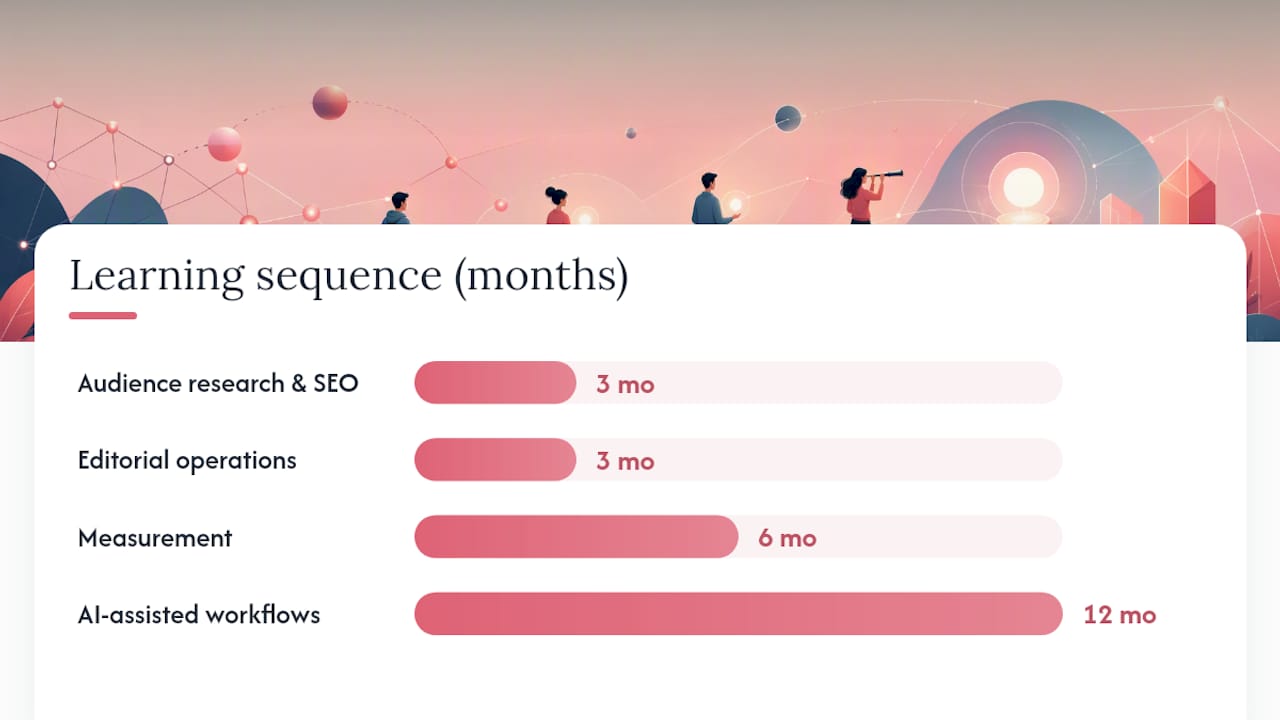
A practical starter plan for the first year: spend months one through three on audience research and SEO basics, months four through six launching one measurable editorial pilot you can point to later, and months seven through twelve optimizing distribution while learning to measure pipeline influence rather than just traffic.
If you’re accelerating an existing content career rather than starting from zero, stretch that same sequence to 24 months and add a fourth phase: building or managing a small team, even informally, by mentoring a freelancer or junior writer.
- Months 1 to 6: audience research, SEO fundamentals, one owned content pilot.
- Months 7 to 12: editorial ops systems, basic analytics reporting, AI-assisted drafting workflows.
- Months 13 to 24: revenue attribution, cross-functional partnership with sales or product, informal team leadership.
Pro Tip: Pick one project each quarter that produces a number you can defend in an interview, not just a link you can show.
Guides like Creator Guard’s content strategy resources are useful for structuring the editorial ops phase specifically, since planning systems are where a lot of self-taught people stall.
Which Specialization Should You Choose?
Content careers fork into a few distinct tracks, and picking one shapes your day-to-day work far more than your job title does. Access Creative’s breakdown of career paths in content creation counts 15 distinct roles across the field, from SEO specialist to video producer to e-commerce content manager.
- SEO specialist: deep technical and content gap work; ceiling is high in-house, higher in agencies with multiple clients.
- Content operations: systems, workflows, and tooling; the path with the clearest route into a Head of Content role.
- Product marketing (PMM): content tied directly to launches and sales enablement; pays well early because it sits close to revenue.
- Creator business: building your own audience and monetizing it directly; highest ceiling, least stability, and far more time spent on contracts and analytics than most people expect going in.
The bridges between these tracks are real. Someone strong in content ops moves into Head of Content roles more easily than a pure writer, because Rework’s research on content leadership points to hiring, editorial strategy, and cross-functional partnership as the actual gatekeeping skills, not writing volume.
How This Guide Was Put Together
This roadmap draws on career progression data from the National Careers Service, salary benchmarks from Select, and role frameworks from CXL and Access Creative, cross-checked against real job listings. Sam’s Social Media Club built this guide on the same principle behind its job board: transparent salary data and honest role descriptions, not vague titles hiding unclear pay. Where a figure isn’t publicly sourced, we’ve said so rather than guessing.
What Trips People Up at Each Career Stage?
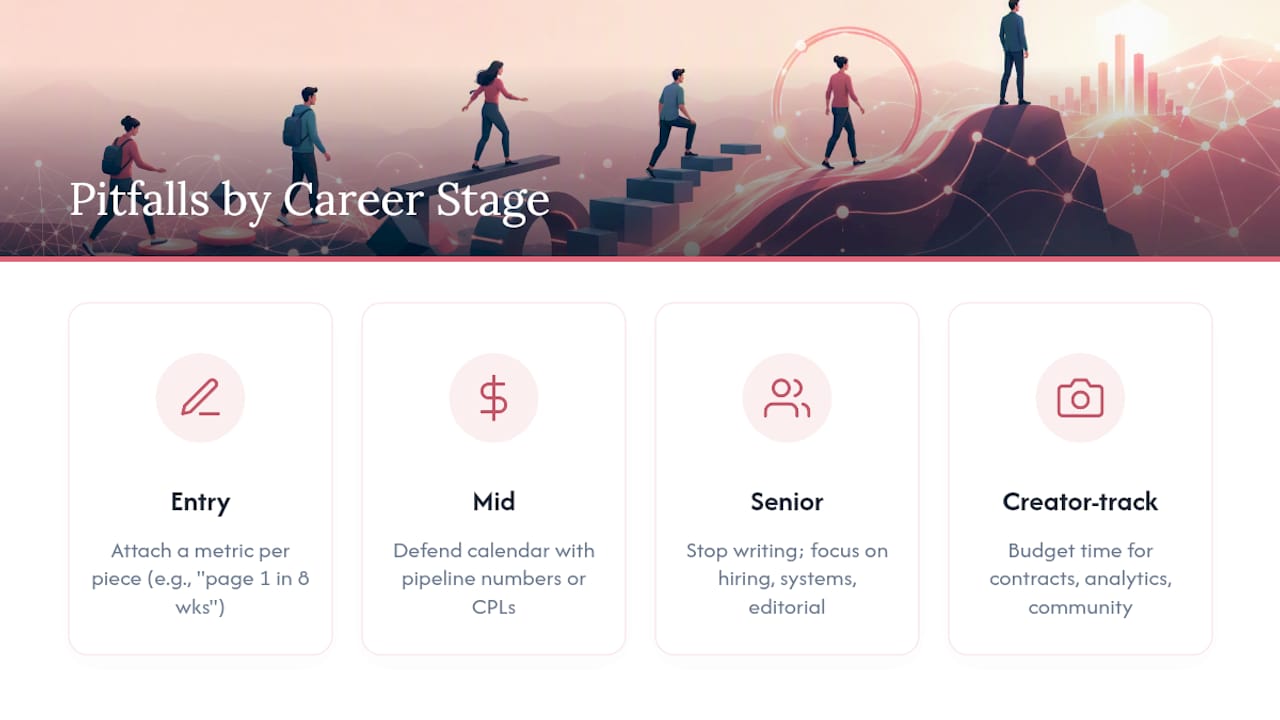
Entry-level content workers usually struggle with one thing: proving impact when they don’t yet control strategy. The fix is small but effective. Attach a number to every piece you write, even something as simple as “ranked page 1 for target keyword within eight weeks,” rather than waiting until you’re in a role with more authority.
Mid-level professionals hit a different wall: they’re excellent producers but haven’t learned to manage up. You’ll be asked to defend your content calendar against a shrinking budget or a skeptical sales team, and “the content performs well” isn’t an answer executives accept. Come with pipeline numbers or cost-per-lead comparisons instead.
Senior and leadership roles bring a harder, less obvious challenge: letting go of the writing itself. Many people get promoted into Head of Content roles and keep trying to write every hero piece personally, which caps team output at their own bandwidth. The Rework framework names this directly: the shift to leadership means trading authored output for hiring, systems, and editorial strategy.
Creator-track professionals face a challenge that rarely gets discussed: a large share of a full-time creator’s week goes to contracts, analytics, and community management rather than actual content creation. Budgeting time for that reality early, rather than discovering it after quitting a stable job, saves a lot of disappointment.
Across every stage, the common thread is the same. The people who stall are the ones still measuring themselves by output volume long after their role started being measured by outcomes.
Where Do You Find Mentors and Networking Opportunities in Content?
Content careers reward a specific kind of networking: peer relationships with people one or two stages ahead of you, not just senior executives. A mid-level content manager learns more from a Head of Content who was in their seat three years ago than from a VP of marketing who’s never written a brief.
LinkedIn remains the most direct channel for this, but the useful version isn’t posting content, it’s commenting substantively on the posts of people doing the job you want next and asking specific questions in direct messages. Industry Slack communities and local marketing meetups tend to produce better mentorship connections than large conferences, simply because the group is small enough for real conversation.
Internal networking matters just as much as external. If your company has a content strategist or Head of Content, ask for 20 minutes a quarter to review your work and ask what they’d want to see before recommending you for the next level. Most senior people say yes to this request more often than junior staff expect, and it costs the company nothing.
If you’re actively job hunting, browsing listings with clear scope and salary bands, like a Head of Content role with its responsibilities spelled out, doubles as a form of networking research. It shows you exactly what language and metrics senior hiring managers expect to hear.
How Are AI Tools Changing Content Roles?
AI hasn’t replaced content roles. It’s replaced the parts of content roles that were already the least valuable: first drafts, basic research summaries, and repetitive formatting work. The skill that’s grown in value is judgment: knowing what to keep, what to cut, and what to fact-check before publishing anything AI-assisted.
At entry level, this means AI fluency is now table stakes, not a differentiator. Every content writer is expected to know how to use AI tools for drafting and research. What separates a strong entry-level candidate from a weak one is whether they can spot when an AI-generated draft is confidently wrong.
At mid and senior levels, the impact is structural. Content teams that build AI-assisted workflows, standardized prompts for research, consistent editing checklists, shared style guides, produce more output per person than teams still treating AI as a novelty. That operational skill, not raw AI usage, is what shows up in Head of Content job requirements now.
The specialization most affected is SEO. Search behavior is shifting toward AI-generated answers, and SEO specialists who understand how to structure content for both traditional search and AI citation are becoming more valuable than those optimizing for keyword rankings alone. For video-specific work, resources like Voclify’s guide on video optimization reflect the same shift playing out on a different platform.
Which Certifications Are Worth Your Time?
Certifications matter less than portfolios in content careers, but a handful are worth the hours they take. Google’s free Analytics and Search Console certifications teach the reporting literacy that separates entry-level candidates from mid-level ones, and they cost nothing.
HubSpot’s Content Marketing certification is widely recognized and covers editorial strategy basics reasonably well, though treat it as a starting point rather than proof of expertise. SEO-specific certifications from Semrush or Ahrefs carry more weight with hiring managers than generic marketing certificates, because they test practical skill rather than multiple-choice theory.
Beyond formal certifications, Coursera’s guidance on the digital content creator path makes a point worth repeating: a certificate paired with a real project you built using what it taught you is worth far more than the certificate alone. Nobody hires a content strategist because of a badge on LinkedIn. They hire because the badge came with evidence.
The continuous learning habit that actually compounds over a career isn’t formal coursework. It’s reading one long-form breakdown of a successful campaign every week and asking what you’d have done differently.
Does the Content Career Path Differ by Industry?
The core skills stay the same across industries, but the day-to-day work and the pay ceiling shift quite a bit depending on where you land. B2B software companies pay the most for content roles that can demonstrably influence pipeline, because content sits close to a measurable sales funnel. A content strategist at a SaaS company will spend real time in CRM data and sales call recordings, work a consumer content role rarely touches.
E-commerce content roles lean harder into SEO and conversion copy, since the connection between content and a purchase is short and direct. Nonprofit and mission-driven organizations typically pay less across every level but often hand junior staff much broader scope faster, since smaller teams can’t afford narrow specialization.
Media and publishing content careers still exist but look different: they reward storytelling and audience-building skill more than the metrics-driven approach that dominates B2B and e-commerce. If you’re choosing where to specialize, match the industry to the version of “success” you actually want to be measured on, revenue influence, audience size, or subscriber retention, rather than picking based on prestige alone.
What Does Work-Life Balance Look Like in Content Careers?
Content work has a reputation for being flexible, and at entry to mid-level, that’s often true. Deadlines are usually predictable, and much of the work can be done asynchronously. That changes at senior and leadership levels, where the job adds team management, executive reporting, and the always-on pressure of owning a number someone above you is watching.
Creator-track careers carry a different balance problem entirely. The flexibility is real, but so is the always-on nature of audience-facing work: comments need responses, algorithms reward consistent posting schedules, and a large share of the week disappears into non-creative business tasks like contracts and analytics rather than the creative work that drew people to the path in the first place.
The practical advice here is unglamorous but true: protect your calendar early, before a promotion adds meetings you didn’t ask for. People who set boundaries at mid-level, blocking deep work time and refusing to answer messages after hours, generally keep those boundaries into leadership. People who don’t set them early rarely find the time to start once the team and the budget both get bigger.
Specialist Depth or Leadership Breadth: Which Should You Choose?
Stay specialist as long as the work still teaches you something and your pay keeps pace with your skill. Move toward leadership once you notice you’re more excited by making someone else’s work better than by publishing your own. That shift in what energizes you is the real signal, more reliable than a job title becoming available.
The honest mantra: get good enough at the craft that people trust your judgment, then decide whether you want to keep using that judgment yourself or start lending it to a team.
— Sam
Find Transparent Content Roles Through Sam’s Social Media Club
Most job boards bury salary information behind vague ranges or leave it out entirely, which makes it nearly impossible to know if a content strategist role at one company pays fairly compared to another. Some job boards require transparent salary listings on every posting, so you can compare roles honestly instead of guessing.
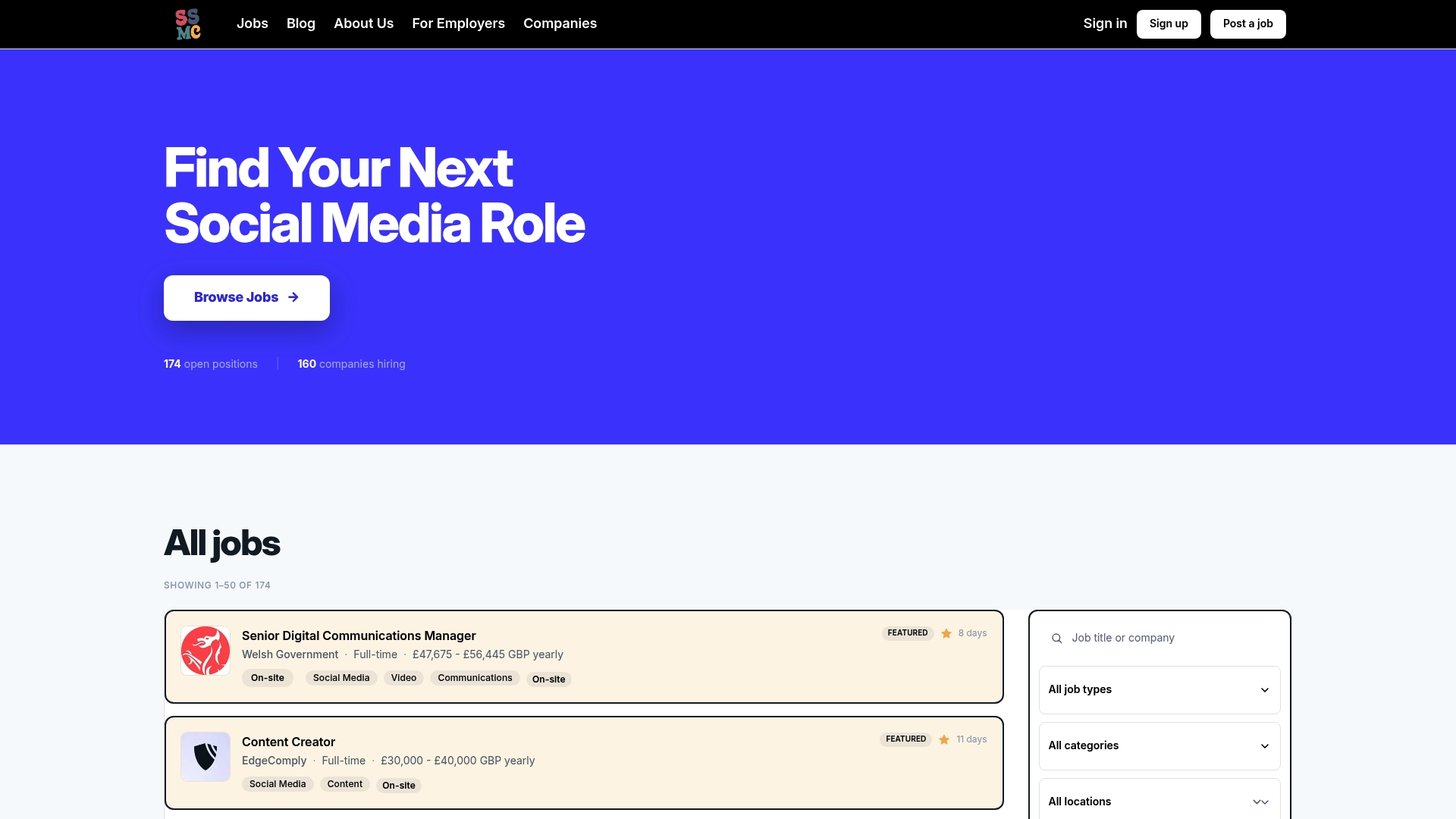
A curated vetting process can ensure listings match applicants’ skill levels and interests, rather than presenting roles that may waste applications. Use the roadmap in this guide to identify your next target title, then search job boards to see what companies are currently offering. If you’re ready to see what’s currently listed, submit an enquiry and start matching against roles with pay you can actually verify.
Sources
- National Careers Service – Marketing manager job profile
- Select — Content marketing careers (salary insights)
- CXL — Content marketing career path: Essential skills & roadmap
- Access Creative — 15 potential career paths in content creation
FAQ
What Is the Career Path of a Content Creator?
Most content creators start with entry-level writing or coordination work, move into strategist or manager roles within 2 to 5 years, and reach leadership positions like Head of Content within 7 to 10 years, according to career progression data. Some branch into specialized tracks like SEO, content operations, or building an independent creator business instead of climbing the traditional management ladder.
What Career Is Gen Z Most Interested In?
Content creation and creator-economy roles rank among the careers younger workers show the strongest interest in, drawn by the flexibility and direct audience connection these paths offer. That interest comes with a caveat worth stating plainly: full-time creators spend a meaningful share of their time on analytics, contracts, and community management rather than pure creative work.
Are Content Writers Still in Demand?
Yes, though the role has shifted. Employers still hire content writers, but they increasingly expect AI fluency and measurable results alongside strong writing, not writing skill alone. Writers who can tie their output to search rankings, engagement, or pipeline influence remain in steady demand.
What Jobs Can You Get as a Content Creator?
Content creation opens into roles including content writer, content strategist, SEO specialist, video producer, social media manager, and e-commerce content manager, among 15 identified career paths in the field. You can browse live examples of these roles, along with their salary ranges, directly on Samssocialmediaclub.
How Long Does It Take to Become a Head of Content?
Reaching a Head of Content or Content Director role typically takes 7 to 10 years, provided you build the leadership skills, hiring, editorial strategy, and metrics fluency, that the role actually requires beyond strong writing. The jump usually happens once you shift from measuring your own output to managing and reporting on a team’s results.