ONS Median £30,479: UK Social Media Manager Salaries 2026

UK social media managers earn a median salary generally in the low to mid £30,000s per year, with entry-level roles starting in the low £20,000s and senior or head-of-social positions earning above the mid £50,000s. Actual figures vary by location, sector, and specialism. Location, sector, and platform specialism drive most of the spread. The breakdown below shows exactly where you should sit on that scale.
TL;DR:
- Median salaries for social media managers in the UK hover around £30,000, with senior roles exceeding £50,000 especially in London and specialized fields.
- Salary variation is driven mainly by seniority, platform specialism, and location, with paid social and short-form video specialists earning premiums.
- Remote work has reduced regional pay gaps, but London typically commands a 15% to 22% higher rate than the national median.
- Employers in agency, in-house, charity, and freelance sectors offer significantly different pay structures, with freelancing having the potential for higher day rates.
- Negotiating should focus on base salary relative to industry benchmarks, and consider other compensation elements like bonuses, pension, equipment, and flexible work policies.
Every job on Sam's Social Media Club shows the salary. Browse social media, content and marketing roles with the pay listed upfront. Explore the job board
Table of Contents
- Social Media Manager Salary UK: The Real National Ranges
- How Seniority and Specialism Change Your Pay Ceiling
- Does Location Still Matter for Social Media Salaries?
- Agency, In-House, Charity, or Freelance: Which Pays More?
- What to Negotiate Beyond the Base Salary
- Where These Numbers Come From
- What Sam's Social Media Club Sees in the UK Job Market
- Search Jobs With the Salary Already on the Table
- Why Pay Transparency Changes the Negotiation Entirely
- Sources
- FAQ
Social Media Manager Salary UK: The Real National Ranges
Ask five sources for the average social media manager salary in the UK and you'll get five different numbers. That's not sloppiness. Each one measures something different.
The Office for National Statistics data via WhatDoIEarn puts the median at £30,479 a year. This figure comes from the ONS's Annual Survey of Hours and Earnings (ASHE), which samples actual PAYE records rather than self-reported job-site data. That's why it tends to sit lower than the platforms most jobseekers check first.

Glassdoor UK reports an average salary in the mid £30,000s, with top earners reaching into the high £50,000s. Indeed UK suggests an average salary in the mid £30,000s range. PayScale UK notes an average salary near £29,000, with a typical range from the low £20,000s to mid £40,000s. The gap comes down to sample size, self-selection (people who log salaries on Glassdoor skew toward larger employers), and whether the figure reflects live job postings or reported pay.
Reconciled into practical bands, here's what most UK employers are actually offering:
- Junior/executive level: £20,000 to £27,000
- Mid-level manager: £28,000 to £38,000
- Senior manager/head of social: £40,000 to £58,000+
The most defensible national benchmark: ONS's £30,479 median, because it's built on tax and payroll records rather than voluntary self-reporting. Treat aggregator averages as a useful upper-bound sanity check, not the number to anchor your negotiation on.
How Seniority and Specialism Change Your Pay Ceiling
Seniority explains a lot of the variation, but specialism explains almost as much. A generalist community manager and a paid social specialist with the same job title can sit £15,000 apart.
Rough UK bands by level:
- Social media executive/coordinator: £20,000 to £26,000
- Social media manager: £28,000 to £38,000
- Senior social media manager: £38,000 to £48,000
- Head of social/social media director: £48,000 to £65,000+
Paid social and social commerce roles carry a consistent premium. Employers reward candidates who can tie ad spend directly to revenue, not just candidates who post consistently. TikTok and short-form video specialism is following the same trajectory as paid social did five years ago: still building toward a standardized premium, but already showing up in job ads that pay above the generalist median for the same seniority level.
Pro Tip: Walk into salary conversations with your ROAS (return on ad spend), not your follower growth.
Does Location Still Matter for Social Media Salaries?
Yes, though less than it used to. London typically commands a noticeable premium, estimated between 15% and 22% above national median pay, according to ecommerce-sector benchmarking. A mid-level manager role that pays £32,000 in the North West might list at £38,000 to £40,000 in London for an equivalent scope of work.
Outside London, the picture varies more than most guides admit:
- London: £35,000 to £48,000 for mid-to-senior roles
- South East and Manchester: £30,000 to £40,000
- North West, Yorkshire, and Wales: £24,000 to £32,000
- Northern Ireland and Scotland (outside Edinburgh/Glasgow): £22,000 to £30,000
Regional pay gaps are shrinking for remote roles. Many employers now set a single national band or a modest location adjustment rather than a strict London/non-London split, which is why hybrid hiring has flattened the geographic curve over the past few years.
If you're hired remotely by a London-headquartered company, don't assume you'll get the regional rate automatically, and don't assume you'll get the London rate either. Ask directly whether the employer uses location-based bands or a single national pay scale before you accept an offer.
Agency, In-House, Charity, or Freelance: Which Pays More?
Employer type shapes your paycheck almost as much as your job title does.
- Agency roles often carry lower base salaries but add project bonuses or new-business commission, so total pay can swing 10% to 15% year over year depending on client wins.
- In-house roles at established brands tend to offer more stable base pay and clearer progression, especially in ecommerce, where a mid-level social media manager averages around £38,000.
- Charity and third-sector roles typically pay below market median, though many offset that with stronger pension contributions and genuinely flexible hours.
- Freelance day rates in the UK commonly run £200 to £400 depending on experience and specialism. To compare a day rate against a salaried offer, a rough method is multiplying your realistic day rate by 220 working days, then subtracting what an employer would have covered in National Insurance contributions and benefits.
What to Negotiate Beyond the Base Salary
Base pay is only part of the offer. Before you accept or counter, check every one of these:
- Base salary against the bands above, adjusted for your region and sector.
- Bonus structure — is it discretionary, or tied to specific KPIs you can actually hit?
- Pension contribution — many employers match above the 3% statutory minimum.
- Holiday allowance — 25 days plus bank holidays is standard for mid-level roles; anything less is a red flag.
- Training or conference budget — a genuine signal that a company invests in staying current.
- Equipment and software — who pays for Canva Pro, scheduling tools, or a decent camera setup.
- Flexible or remote work terms — spelled out in writing, not just implied at interview.
When you negotiate, set your target range before the call, bring two or three benchmark figures from this article, and lead with your impact metrics rather than your tenure. A simple line works well: "Based on the ONS and industry benchmarks for this seniority level, and given my experience managing paid budgets, I'd expect a base closer to £X."
Pro Tip: If a hybrid or remote arrangement is non-negotiable for you, treat it as part of the compensation package and say so explicitly. A company saving on office space should be willing to trade some of that saving for a stronger base.
Where These Numbers Come From
The figures in this guide draw on seven sources, each measuring pay differently:
- ONS via WhatDoIEarn — payroll-based national median, the most statistically reliable figure available.
- Glassdoor UK and Indeed UK — self-reported and job-posting data, useful for sensing employer demand but skewed toward larger companies that post more listings.
- PayScale UK — smaller self-reported sample, useful as a lower-bound check.
- Digital Waffle's 2026 salary guide and SocialDay's Social Media Salary & Trend Report — sector-specific surveys, including SocialDay's roughly 100-respondent sample, which found 42% of social professionals feel underpaid relative to workload.
- EliteX Recruit — ecommerce-specific benchmarking with regional splits.
None of these fully cover executive-level packages or international comparisons, so treat the figures above as UK-specific and role-specific rather than universal.
What Sam's Social Media Club Sees in the UK Job Market
Every listing on Sam's Social Media Club carries a mandatory salary range, which means the pay data you see reflects what employers are actually willing to offer, not just what candidates hope for. That transparency also changes employer behavior: companies that post honest ranges tend to attract applicants whose expectations already match the role, which cuts down on wasted interviews for both sides.
For a deeper role-by-role breakdown, see what social media and marketing jobs pay across the UK and the reasoning behind why pay transparency matters for candidates.
Search Jobs With the Salary Already on the Table
Many job boards still list "competitive salary" without specifying pay. Some platforms list salary ranges up front, allowing filtering by pay, location, and sector before applying.
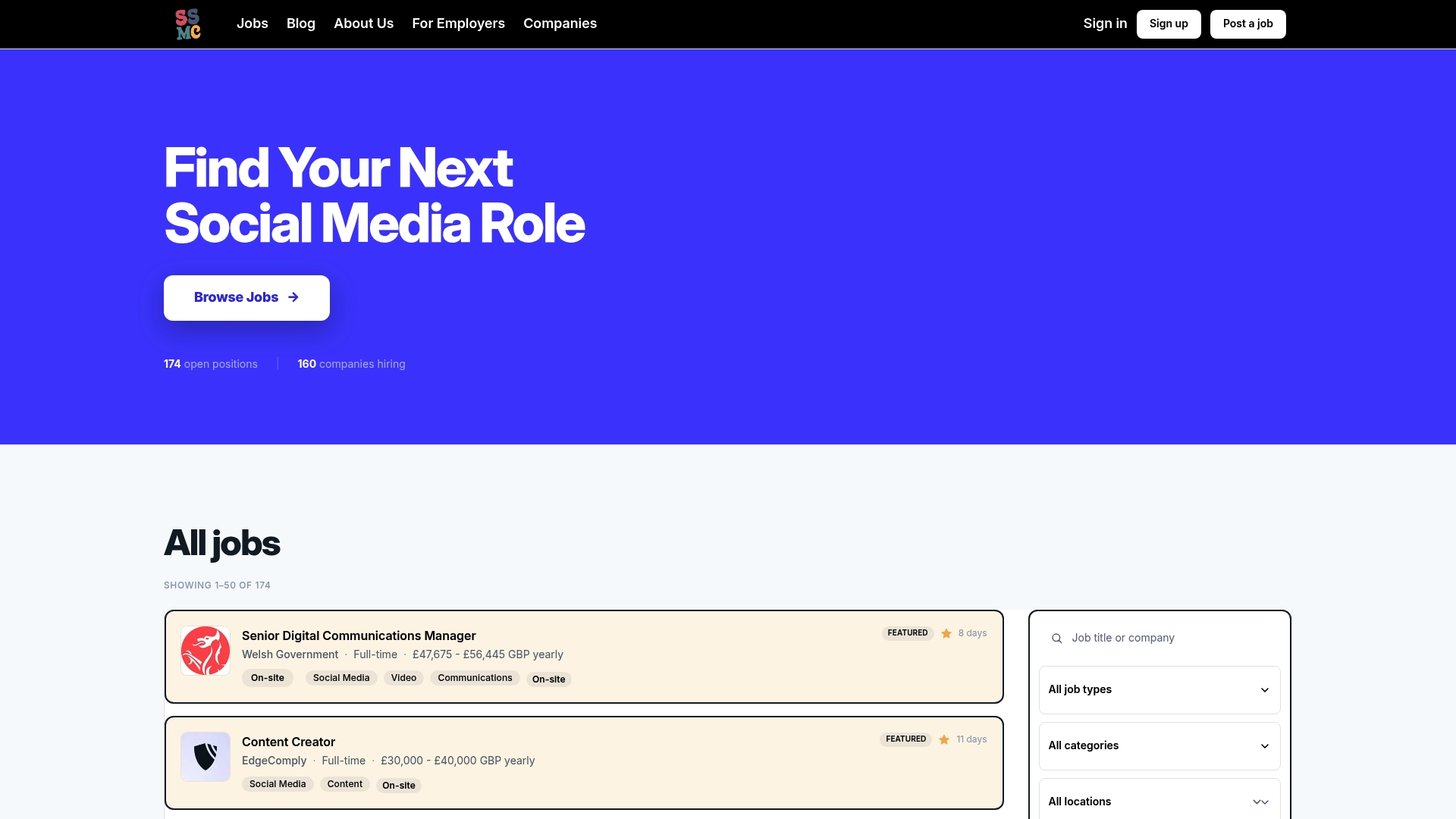
That matters more as specialisms like paid social and social commerce start commanding real premiums, discussed above. It's easier to know if an offer is fair when the range was published before you applied, not negotiated blind after three interview rounds. As automation reshapes what employers expect from a "social media manager" job description, roles increasingly blend content, paid strategy, and light production work, which is worth understanding before you set your target range. If you want more context on how automation is reshaping required skills, this rollout guide for AI in social media teams is a useful read.
If you're hiring rather than job hunting, Sam's Social Media Club's curated listings connect you with candidates who already know the market rate, cutting down on mismatched applications. Check current pricing and advertising options to post a role with a transparent salary attached.
Why Pay Transparency Changes the Negotiation Entirely
The conventional advice for salary negotiation, research the market, know your worth, walk in confident, assumes you can actually find reliable numbers. Most UK social media managers can't. Job ads say "competitive," recruiters dodge the question until the final round, and the aggregator sites disagree with each other by £7,000 on the same role.

That gap is exactly why the ONS figure and the SocialDay survey finding that 42% of social professionals feel underpaid matter more than they first appear. It's not that employers are uniformly stingy. It's that pay information asymmetry favors whoever controls the offer, and right now that's almost always the employer. Publishing salary ranges before the application stage, which is the whole premise behind pay-transparent job boards, doesn't just save candidates time. It resets who holds the leverage in that first conversation.
The specialisms commanding premiums right now, paid social, social commerce, short-form video, aren't rewarded because they're trendy. They're rewarded because they produce numbers a finance director can point to. If you're early in your career, that's the clearest signal in this entire guide: chase the skill that shows up on a P&L, not just the one that shows up in a portfolio.
— Sam
Sources
- Social Media Manager Salary UK 2026: £30,479 Median | WhatDoIEarn
- Social Media Manager Salary in United Kingdom in 2026 | PayScale
- Social Media Manager Salary in Ecommerce UK: The Pay Data You Need | EliteX Recruit
FAQ
How much do social media managers get paid in the UK?
The UK median is £30,479 a year according to ONS data, though aggregator sites like Glassdoor and Indeed report averages around £34,500 to £36,000. Practical ranges run from about £20,000 at entry level to £58,000 or more for head-of-social roles.
Is £70,000 a good salary in the UK?
Yes, £70,000 sits well above the typical range for social media manager roles, including senior and head-of-social positions in London. That figure is more typical of a marketing director, VP of marketing, or a highly specialized paid social lead managing a large budget.
Is social media manager a high-paying job?
It depends on seniority and specialism rather than the job title alone. Entry-level pay is modest, but senior managers with paid social or ecommerce experience can earn £48,000 to £58,000 or more, comparable to many mid-level digital marketing management roles.
What do M&S managers get paid?
Marks & Spencer doesn't publish social media manager salaries specifically, and pay for named employers varies by department, seniority, and location. General retail and ecommerce social media roles at large UK employers tend to track close to the £30,000 to £40,000 mid-level band covered above.
How does a social media manager's pay compare to a digital marketing manager's?
The two roles overlap in mid-level bands, often running from about £28,000 to upper mid-range, but digital marketing managers with paid media or SEO oversight sometimes edge ahead due to broader budget responsibility. Specialism and measurable revenue impact matter more than the job title itself.