
10–20% More in London: UK Junior Marketing Salaries 2026
Junior marketing roles in the UK typically pay within a moderate range that varies based on job title, location, and specialism. A marketing assistant or coordinator sits at the lower end, a junior marketing manager or email marketing manager at the top. London roles and candidates with SEO, PPC, or analytics skills usually see 10 to 20% higher offers than the rest of the market. The role-by-role breakdown, plus how to negotiate once you have an offer, follows below.
TL;DR:
- Salaries for junior marketing roles in the UK vary significantly by role, location, and skills, with London roles generally paying 10-20% more.
- Candidates with technical skills in SEO, PPC, or analytics can expect higher offers, especially if they have certifications or demonstrated results.
- Employer type influences pay, with agencies offering quicker promotions and broader experience, while larger in-house companies provide better benefits.
- The actual cost to employers includes on-costs of roughly 25 to 30%, which may lead to negotiations or higher advertised salaries.
- Progression within two to five years is common, with specializations and changing employers boosting salary growth more effectively than tenure alone.
Table of Contents
- Junior Marketing Salary UK: Pay by Job Title
- How Location and Employer Type Change the Number
- Which Skills Actually Move the Salary Needle
- How to Evaluate and Negotiate a Junior Marketing Offer
- What Pay Looks Like After Your First Junior Role
- Why Salary Transparency Changes the Job Search
- Find Junior Marketing Roles With the Pay Already Listed
- Sources
- FAQ
Junior Marketing Salary UK: Pay by Job Title
Titles in marketing are messy. Two companies can call the same job a “marketing executive” and a “marketing coordinator” and pay £8,000 apart for it. Scope matters more than the label on the offer letter: does the role own a piece of a campaign, or does it mostly support someone else who does?
That said, current UK data gives a reasonably consistent picture for 2026:
- Marketing assistant / coordinator: roughly £19,000 to £26,000, based on entry-level marketing salary data from Bright Network. Expect admin-heavy work, campaign support, and reporting rather than strategy ownership.
- Marketing executive: government careers guidance puts starter pay around £23,000, rising toward £30,000 to £50,000 with experience, and Whito’s 2026 salary research puts the average marketing executive salary closer to £30,000.
- Social media executive: often £19,000 to £24,000 at entry level, per Bright Network, climbing toward the £34,000 mark once you’re managing a social media manager’s remit, according to Whito.
- Junior SEO / content executive: closely aligned with general marketing executive salaries, slightly higher when technical SEO or analytics skills are involved.
- Junior marketing manager / email marketing manager: typically £30,000 to £44,500, with Whito placing the marketing manager average between £42,000 and £44,500 nationally.
If your job title doesn’t map cleanly onto one of these, look at what you actually own day to day. A “marketing officer” running their own budget line is closer to executive pay than to assistant pay, whatever the job spec calls them.
How Location and Employer Type Change the Number
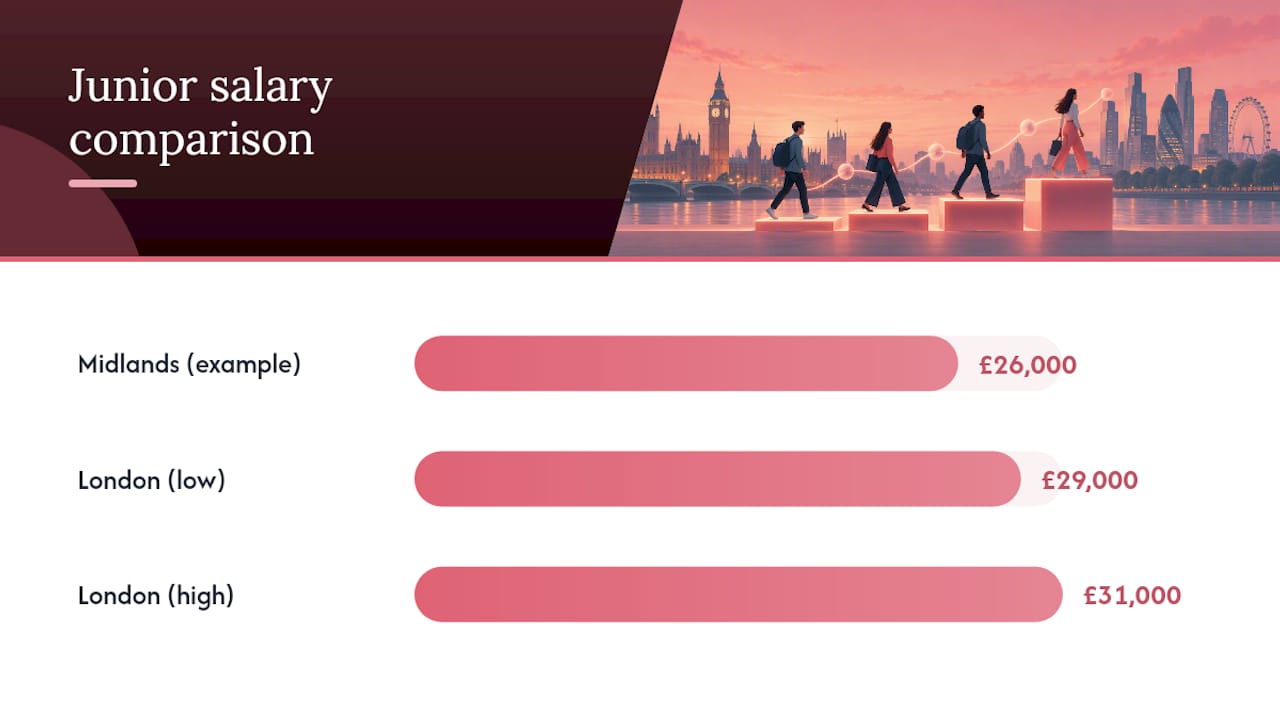
Where you work and who employs you can shift a salary offer by thousands of pounds, sometimes more than the job title itself does. London and the South East regularly command a noticeable premium over the rest of the UK, according to Zest4Talent’s 2026 salary guide. A marketing executive earning £26,000 in the Midlands might see £29,000 to £31,000 for an equivalent London role, once you account for that gap. Remote roles complicate this: some employers now pay London rates regardless of where you sit, while others quietly apply the regional band. It’s worth asking directly rather than assuming.
Employer type matters just as much as postcode:
- Agencies often pay slightly less base salary than in-house teams at the junior level but move faster on promotions and expose you to more brands and channels.
- In-house roles at larger companies tend to offer stronger benefits (pension matching, healthcare, structured training) even when the headline salary looks similar.
- Smaller employers frequently pay less at the outset but hand junior staff broader, more hands-on responsibility earlier, which can accelerate the skills that drive your next pay rise.
Employer on-costs add roughly 25 to 30% on top of your headline salary, according to Whito’s 2026 research, once National Insurance, pension contributions, and overhead are factored in. That’s not money that lands in your pocket, but it explains why some employers negotiate harder than the advertised range suggests: your actual cost to them is higher than the number on the offer.
Which Skills Actually Move the Salary Needle
Specialism pays. Candidates with skills in SEO, paid media (PPC), analytics, or marketing automation typically earn an uplift over generalist peers, according to Zest4Talent and the Ashdown Group’s 2026 salary guide, which notes generalist roles see smaller pay increases. The Chartered Institute of Marketing found that 67% of marketers reported a wage increase in the prior 12 months, and its research points to measurable, performance-driven skills as the main reason employers open their wallets wider.
If you’re building a case for a higher starting offer, these routes are worth pursuing before you apply:
- Google Analytics and Google Ads certifications — free, widely recognized, and directly testable in an interview.
- A marketing apprenticeship or T-level, which give you paid, structured entry routes into the profession without a degree.
- A short PPC or SEO course with a portfolio project attached, not just a certificate.
- Hands-on automation tool experience (HubSpot, Klaviyo, or similar) gained through a volunteer project or freelance gig.
- A small content or SEO audit you’ve done yourself, even for a friend’s business, that you can walk an interviewer through.
Pro Tip: Don’t just list a certification on your CV. Bring one real number to the interview, like “I ran a paid campaign that dropped cost-per-click by 15%,” because employers weigh proof of outcome far higher than a course completion badge.
How to Evaluate and Negotiate a Junior Marketing Offer
A salary number in isolation tells you almost nothing. Compare offers properly before you accept or reject either one.
- Line up base salary against pension contribution, not just the headline figure. A 5% employer pension match on £26,000 beats a flat £27,000 with no match once you run the math.
- Check training budget and progression timelines. Ask directly: “What does someone in this role earn after 18 months, and what triggers that increase?”
- Weigh flexibility. Hybrid or remote options carry real value, particularly if commuting costs would eat into a London premium anyway.
- Calculate rough take-home pay, not gross salary, before comparing two offers in different tax brackets or with different benefits.
- Negotiate with a specific number and reason, not a vague request. Try: “Based on current market data for this role and location, I was expecting closer to £ X. Is there flexibility here, or room to revisit after six months?”
Pro Tip: If the base salary won’t move, negotiate the review date instead. A guaranteed pay review at month six is often easier for an employer to agree to than a higher starting number.
Walk away if the offer sits well below market for the role and location with no benefits to offset it, and the employer won’t commit to a review date. That combination usually signals the role is underpriced, not just tightly budgeted.
What Pay Looks Like After Your First Junior Role
Most people who stay in marketing see meaningful movement within two to five years. A marketing executive earning £26,000 to £30,000 at entry level can realistically expect £35,000 to £42,000 once they’re managing a specialism or a small team, based on the progression implied by Whito’s role averages.
Three things reliably speed this up:
- Picking a specialism (SEO, paid media, lifecycle email) rather than staying a generalist.
- Changing employer roughly every two to three years, which tends to move pay faster than waiting for an internal promotion.
- Taking ownership of a metric or budget line, since employers usually promote based on demonstrated ownership, not tenure alone.
If you want a fuller playbook for that first jump, how to land your first marketing job with no experience covers the groundwork that makes the second job easier to get.
Why Salary Transparency Changes the Job Search

Vague pay bands waste everyone’s time. When a listing hides the number, candidates apply blind and employers filter out good people who guessed wrong. The UK is already moving toward mandatory salary transparency in job adverts, and that shift favors candidates who show up with market data already in hand, not employers hoping to lowball someone who didn’t check.
A quality listing tells you the band before you apply, not after three interview rounds.
— Sam
Find Junior Marketing Roles With the Pay Already Listed
An alternative to typical job boards is one where every role carries a mandatory salary listing, so you can filter straight to roles in your target band instead of applying blind and finding out the pay three interviews in. Every role posted through Samssocialmediaclub carries a mandatory salary listing, so you can filter straight to roles in your target band instead of applying blind and finding out the pay three interviews in.

If you’re job hunting, search current openings by role and salary range to see what marketing assistant, coordinator, and executive roles are actually paying right now, including content roles across the UK and remote content positions if location flexibility matters to you. If you’re hiring, Advertise with SSMC or check the SSMC SUPER package to reach a curated pool of marketing candidates who already expect a transparent number, not a guessing game. Got questions before you commit either way? Send an enquiry and get a straight answer.
Sources
- Marketing Salaries UK 2026 | Whito
- Marketing executive | Explore careers (National Careers Service)
- UK marketing salary guide 2026 — Zest4Talent
All figures reflect UK-focused data compiled in 2026.
FAQ
Is £30,000 a Low Salary in the UK?
For a junior marketing role, £30,000 sits toward the upper end of the entry-level range and roughly matches the average marketing executive salary reported by Whito. Outside London, it’s a solid starting salary rather than a low one; inside London, it’s closer to the lower end once cost of living is factored in.
Is Marketing Well Paid in the UK?
Marketing pays reasonably well once you move past entry level, particularly with a specialism like SEO or paid media. The Chartered Institute of Marketing reports 67% of marketers saw a wage increase in the prior year, which suggests steady, if not dramatic, growth for most people in the field.
What Jobs Pay £40,000 a Year in the UK Without Experience?
Very few roles pay above £30,000 with zero experience; higher pay is more typical for a junior marketing manager or specialist executive with some years in the career. Entry-level marketing roles more typically start between £19,000 and £30,000, according to Bright Network, with pay climbing as you add measurable skills.
What Is the Average Salary for a Junior Marketing Assistant in the UK?
A marketing assistant in the UK typically earns between £19,000 and £26,000, based on entry-level data from Bright Network. Pay tends toward the higher end in London or for assistants supporting specialist teams like paid media or SEO.